
CP2 Final Exam Graded A The digestive system consists of the heart, blood, vessels, and the structures that make up the lymphatic system. ✅False - Circulatory system The lymphatic system is responsible for moving blood through the body and removing waste. ✅False - Immune system The lymphatic system which is a subsystem of the circulatory system acts as the bodies transportation system. ✅True The lymphatic system is responsible for defending the body against disease causing agents called pathogens. ✅True The left and right sides of the heart are separated by a wall called the septum. ✅True The right atrium is the first chamber blood enters as it enters the heart. ✅True The final stop in the heart for the flow of blood, is the power house chamber, the right ventricle. ✅False - left ventricle Heart rates initiated by the SA node are typically 60 -80 beats per minute for a healthy adult at rest. ✅True The cardiac cycle includes all the events that occur during one complete heart beat. ✅True The arteries are the vessels that carry blood away from the heart. ✅True The vessel that transport blood from the peripheral tissue to the heart are the veins. ✅True Blood pressure is defined as the measurement of force applied to walls of the arteries. ✅True The average resting blood pressure of a resting adult is 80/120. ✅False - 120/80 Pulse pressure is the difference between systolic and diastolic blood pressure. ✅True Blood is a type of connective tissue made up of cells and plasma. ✅True A medic al assistant should wear jewelry sparingly. ✅True Coronary Heart Disease (CHD) or Coronary Artery Disease (CAD) is considered one of the most common forms of _________ disease. ✅heart Atherosclerosis or narrowing of the vessel lumen of the arteries is du e to a buildup of ________ material. ✅fatty Often referred to as hardening of arteries, arteriosclerosis is the thickening and loss of ________ in the arteries. ✅elasticity A heart attack or MI occurs when the ________ supply of the myocardium is severel y reduced or stopped. ✅blood Angioplasty is frequently used to reopen _________ coronary arteries and stents. ✅blocked CHF is a condition in which the condition cannot pump enough _______ to the body or organs. ✅blood An arrhythmia is an irregular heartbeat caused by a disturbance of ________ activity of the heart. ✅electrical Tachycardia is an abnormal _______ heartbeat over ______ beats per minute. ✅fast / 100 People who suffer from endocarditis may experience weakn ess, fever, diaphoresis, dyspnea or difficulty ______, or embolism that can lodge in other organs ✅breathing Thrombophlebitis occurs when a blood ________ occurs in one or more veins causing inflammation. ✅clot Anemia is a condition in which there is a l ow numbers of healthy ________ blood cells circulation in the body. ✅Red Leukemia is a malignant cancer of the bone marrow and blood, like all cancers it involves the uncontrolled growth of abnormal ________. ✅cells An aneurysm is an abnormal widening or ballooning of a portion of an artery related to _________ in the walls of the blood vessel. ✅weakness A CVA occurs when the blood to part of the brain is suddenly interrupted by an occlusion of blood vessel, ischemia or embolism, or a ruptured blood vess el a hemorrhage in the ____________. ✅brain Bradycardia is an abnormally ________ heart rate under _______ beats per minute. ✅slow / 60 After going through the tricuspid valve the blood then enters the ______ ventricle. ✅right Carbon dioxide in the bloo d is exchanged for oxygen via the _________ artery. ✅pulmonary The largest artery in the body is the __________. ✅aortic The blood pressure of a child is generally _________ than that of an adult. ✅higher What are the five sites for palpating an artery to obtain and accurate pulse rate. ✅- temporal - side of skull
Preview 3 out of 17 pages
Exam (elaborations)
CP2 Final Exam Graded A
Preview 3 out of 17 pages
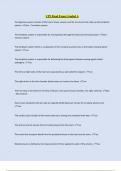
CP2 Final Exam Graded A The digestive system consists of the heart, blood, vessels, and the structures that make up the lymphatic system. False - Circulatory system The lymphatic system is responsible for moving blood through the body and removing waste. False - Immune system The lymphatic system which is a subsystem of the circulatory system acts as the bodies transportation system. True The lymphatic system is responsible for defending the body against disease causing agents called pathogens. True The left and right sides of the heart are separated by a wall called the septum. True The right atrium is the first chamber blood enters as it enters the heart. True The final stop in the heart for the flow of blood, is the power house chamber, the right ventricle. False - left ventricle Heart rates initiated by the SA node are typically 60-80 beats per minute for a healthy adult at rest. True The cardiac cycle includes all the events that occur during one complete heart beat. True The arteries are the vessels that carry blood away from the heart. True The vessel that transport blood from the peripheral tissue to the heart are the veins. True Blood pressure is defined as the measurement of force applied to walls of the arteries. True The average resting blood pressure of a resting adult is 80/120. False - 120/80 Pulse pressure is the difference between systolic and diastolic blood pressure. True Blood is a type of connective tissue made up of cells and plasma. True A medical assistant should wear jewelry sparingly. True Coronary Heart Disease (CHD) or Coronary Artery Disease (CAD) is considered one of the most common forms of _________ disease. heart Atherosclerosis or narrowing of the vessel lumen of the arteries is due to a buildup of ________ material. fatty Often referred to as hardening of arteries, arteriosclerosis is the thickening and loss of ________ in the arteries. elasticity A heart attack or MI occurs when the ________ supply of the myocardium is severely reduced or stopped. blood Angioplasty is frequently used to reopen _________ coronary arteries and stents. blocked CHF is a condition in which the condition cannot pump enough _______ to the body or organs. blood An arrhythmia is an irregular heartbeat caused by a disturbance of ________ activity of the heart. electrical Tachycardia is an abnormal _______ heartbeat over ______ beats per minute. fast / 100 People who suffer from endocarditis may experience weakness, fever, diaphoresis, dyspnea or difficulty ______, or embolism that can lodge in other organs breathing Thrombophlebitis occurs when a blood ________ occurs in one or more veins causing inflammation. clot Anemia is a condition in which there is a low numbers of healthy ________ blood cells circulation in the body. Red Leukemia is a malignant cancer of the bone marrow and blood, like all cancers it involves the uncontrolled growth of abnormal ________. cells An aneurysm is an abnormal widening or ballooning of a portion of an artery related to _________ in the walls of the blood vessel. weakness A CVA occurs when the blood to part of the brain is suddenly interrupted by an occlusion of blood vessel, ischemia or embolism, or a ruptured blood vessel a hemorrhage in the ____________. brain Bradycardia is an abnormally ________ heart rate under _______ beats per minute. slow / 60 After going through the tricuspid valve the blood then enters the ______ ventricle. right Carbon dioxide in the blood is exchanged for oxygen via the _________ artery. pulmonary The largest artery in the body is the __________. aortic The blood pressure of a child is generally _________ than that of an adult. higher What are the five sites for palpating an artery to obtain and accurate pulse rate. - temporal - side of skull - carotid - lateral neck - brachial - midarm at elbow bend - apical - heart - radial - wrist - femoral - groin - popliteal - behind knee - dorsal pedis - top of foot - anterior tibial - ankle medial to Achilles tendon Difference between hypo-tension and hypertension. Hypotension is low blood pressure below 90/60 Hypertension is high blood pressure above 140/90 What are the 3 functions of blood? - transportation blood to all organs - regulation of body temp. - defense against invasion of pathogens What are the terms of carditis or inflammation of the heart? - endocarditis - pericarditis - myocarditis What are two symptoms of a CVA? - vision problems - slurred speech - loss of balance - numbness on one side - confusion The heart is a ____ chambered muscular pump. 4
Content preview
Document information
- Uploaded on
- March 21, 2024
- Number of pages
- 17
- Written in
- 2023/2024
- Type
- Exam (elaborations)
- Contains
- Questions & answers
$10.99
Wrong document? Swap it for free
Within 14 days of purchase and before downloading, you can choose a different document. You can simply spend the amount again.
Written by students who passed
Immediately available after payment
Read online or as PDF

Reputation scores are based on the amount of documents a seller has sold for a fee and the reviews they have received for those documents. There are three levels: Bronze, Silver and Gold. The better the reputation, the more your can rely on the quality of the sellers work.

