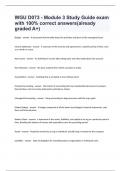
WGU D073 - Module 3 Study Guide exam with 100% correct answers(already graded A+)
Budget A document that formally states the priorities and plans of the managerial team Income Statement A summary of the revenue and expenses for a specific period of time, such as a month or a year. Brainpower Read More Previous Play Next Rewind 10 seconds Move forward 10 seconds Unmute 0:04 / 0:15 Full screen Net Income An individual's income after taking taxes and other deductions into account. Raw Materials the basic material from which a product is made. Assumptions Anything that is accepted as true without proof Financial Accounting the branch of accounting that uses standardized processes to prepare financial docs such as income statements and balance sheets. Managerial Accounting Using accounting to align processes with the org's goals. Master Budget A budget composed of all the lower level budgets, financial statements, cash flow, and financial plans. Balance Sheet a statement of the assets, liabilities, and capital of an org at a particular point in time, detailing the balance of income and expenditure over the preceding period. Assets Properties owned by an org or individual, should bring in money for the company. Liabilities State of obligation for something that an organization or individual owes. Equity Value of a property after debt is deducted or the value of shares of stocks issued by a company. Pro Forma A financial report based on hypothetical scenarios. Production Budget The number of units of products that must be produced based on the sales budget and the requirements for inventory on hand. Costs Financial measure of the resources used or given up to achieve a stated purpose. Inventory a complete list of items such as property, goods in stock, or the contents of a building. just-in-time inventory system a system that minimizes or virtually eliminates inventories by purchasing and producing goods only in response to actual, rather than forecasted, sales. Opportunity Cost Any time a decision is made to spend money on a course of action. The inability to pursue another alternative that offers a potential gain after making a choice to invest in a certain thing. Revenues The income generated from the sale of goods or services. Overhead The necessary expenses of running a business that cannot be directly linked to a product or service. Variable Cost A cost that changes in relation to another variable such as production output. Forecast The act of predicting business activity for a future period of time. Depreciation The reduction in the value of an asset over the course of time. Disbursement The money paid out by an org to settle an obligation. Cash Receipts The money received by an org as payment for a good or service. Capital Assets Significant pieces of a property such as a building, cars, investment properties, stock, and bonds. Accounts Receivable Money owed to a company by its debtors Inventory Financing Using inventory as collateral for a loan if the business doesn't sell its products and cannot repay the debt. Dividends A sum of money paid regularly by a company to its shareholders out of its profits. Operational Budget Covers the following: 1. The Sales plan 2. The Production plan 3. The Materials Purchasing plan 4. Labor, Hiring, and Training Program plan 5. Admin and Discretionary Spending plan. The Financial Budget Outlines the companies assets and liabilities, a
Document information
- Uploaded on
- March 19, 2024
- Number of pages
- 4
- Written in
- 2023/2024
- Type
- Exam (elaborations)
- Contains
- Questions & answers