
Introduction
As an analytical technician for Yorkshire Water, I have been asked to write a report that develops a
reaction scheme that can be utilised to analyse water throughout the wastewater treatment
procedures in order to find any potential transition metal complexes.
Transition metal
Metals are described as easily losing their electrons, malleable, lustrous, and effective heat and
electrical conductors. As a result, there are several groups of transition metals into which metal
elements can be divided. Any element having a partially filled d or f electron subshell is considered a
transition metal.
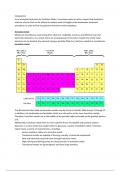
The 40 elements that make up transition metals may be found in Periodic Table Groups 3 through 12.
In addition, the lanthanides and actinides, which are referred to as the inner transition metals.
Therefore, transition metals are in the middle of the periodic table and make up the greatest portion
of it.
Additionally, transition metals have an inner subshell that is incomplete and contains valence
electrons in a shell, which also enables them to generate a variety of oxidation states. Transition
metals share a variety of characteristics, including:
- various oxidation states of a transition metal.
- Transitional metals are capable of forming a variety of coloured compounds.
- Heat and electricity may both pass through transition metal.
- High melting and boiling points are characteristics of transition metal.
- Transitional metals are paramagnetic and have large densities.
, Comparing Mercury and vanadium
Mercury Vanadium
The third element in the 12th column of the Vanadium is the first element in the 5 column
periodic table is Mercury which is designated as of the periodic table and is categorised as a
a transition metal. Mercury also has 122 transition metal. The isotope of vanadium also
neutrons along with 80 protons and 80 has 28 neutrons, 23 electrons, and 23 protons.
electrons.
Density : 13.534 grams per cm cubed Density : 6.0 grams per cm cubed
Phase at room temperature : Liquid Phase at room temperature : Solid
Symbol of Mercury Symbol of Vanadium
Atomic number : 80 Atomic number : 23
Atomic weight : 200.59 Atomic weight : 50.94
Melting point : -38.83C Melting point : 1910C
Boiling point : 356.7C Boiling point : 3407C
Characteristics: Characteristics:
Mercury is a lustrous, silvery liquid that is dense Vanadium is a hard, silvery-grey metal in its
when it is in its normal state. Additionally, normal state. Vanadium is a non-reactive
mercury is the only metal that is liquid at room element that won't react with oxygen or water
temperature, which means that it will evaporate at room temperature because it is ductile,
into the atmosphere. malleable, and corrosion-resistant.
In summary:
Hg stands for Mercury, while V stands for Vanadium. The fact that all of the atoms and ions have
fully filled d-orbitals prevents mercury from being classified as a transition metal, despite the fact
that it is a member of group 12 and is a transition metal. As a result, in either its atomic state or
common oxidation state (Hg2+), it possesses a partially filled d-orbital. Because vanadium has five
valence electrons that might lose them, it is regarded as a transition metal. One of the
characteristics of transition metals is their ability to adopt a variety of oxidation states. Vanadium
has a melting point of 1910C and a boiling point of 3407C, whereas mercury has a melting point of
-38.83C and a boiling point of 356.7C.


