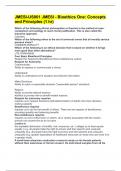
JMESI-US001 JMESI - Bioethics One: Concepts
and Principles (1 hr)
Which of the following ethical philosophies or theories is the method of case-
comparison and analogy to reach moral justification. This is also called the
Inductive approach.
Casuistry
Which of the following refers to the set of universal norms that all morally serious
persons share?
COMMON MORALITY
Which of the following is an ethical decision that is based on whether it brings
more good than other alternatives?
UTILITARIANISM
Four Basic Bioethical Principles
Respect for Autonomy Beneficence Nonn-maleficence Justice
Respect for Autonomy
Communicate:
Ability to express or communicate a choice.
Understand:
Ability to understand one's situation and relevant information.
Make Decisions:
Ability to reach a reasonable decision ("reasonable person" standard)
Reason:
Ability to provide rational reasons
Abilities to provide risk-or benefit-related reasons.
Respect for autonomy requires
requires us to respect decisions (self-determination) of adults who have decision-
making capacity
Beneficence requires
requires us to act for the benefit of others. There are two aspects of beneficence:
providing benefits and balancing benefits
Non-maleficence requires
requires us not to inflict harm on others. Its is closely associated with the maxim,
primum non nocere-first to do no harm
Justice is
the equitable distrivution of benifits, risk, resources, etc. I obliges us to treat equals
equally ( e.g. all people habe the right to privacy and free speech) and unequals
unequally (e.g. all people have the right to privacy and free speech) and unequal's
unequally (e.g. greater expenditure of healthcare resources on those who are more ill or
in greater need).
A small-town physician conducted a research study on his female patients
without their awareness or formal consent. He took blood samples from all his
and Principles (1 hr)
Which of the following ethical philosophies or theories is the method of case-
comparison and analogy to reach moral justification. This is also called the
Inductive approach.
Casuistry
Which of the following refers to the set of universal norms that all morally serious
persons share?
COMMON MORALITY
Which of the following is an ethical decision that is based on whether it brings
more good than other alternatives?
UTILITARIANISM
Four Basic Bioethical Principles
Respect for Autonomy Beneficence Nonn-maleficence Justice
Respect for Autonomy
Communicate:
Ability to express or communicate a choice.
Understand:
Ability to understand one's situation and relevant information.
Make Decisions:
Ability to reach a reasonable decision ("reasonable person" standard)
Reason:
Ability to provide rational reasons
Abilities to provide risk-or benefit-related reasons.
Respect for autonomy requires
requires us to respect decisions (self-determination) of adults who have decision-
making capacity
Beneficence requires
requires us to act for the benefit of others. There are two aspects of beneficence:
providing benefits and balancing benefits
Non-maleficence requires
requires us not to inflict harm on others. Its is closely associated with the maxim,
primum non nocere-first to do no harm
Justice is
the equitable distrivution of benifits, risk, resources, etc. I obliges us to treat equals
equally ( e.g. all people habe the right to privacy and free speech) and unequals
unequally (e.g. all people have the right to privacy and free speech) and unequal's
unequally (e.g. greater expenditure of healthcare resources on those who are more ill or
in greater need).
A small-town physician conducted a research study on his female patients
without their awareness or formal consent. He took blood samples from all his