PALS-Pretest Verified Solutions
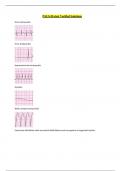
PALS-Pretest Verified Solutions Sinus tachycardia Sinus bradycardia Supraventricular tachycardia Asystole Wide-complex tachycardia Ventricular fibrillation with successful defibrillation and resumption of organized rhythm Sinus bradycardia Pulseless electrical activity Torsades de pointes Ventricular fibrillation Wide-complex tachycardia SVT converting to sinus rhythm after adenosine administration Normal sinus In asystole, what is the effect of epi? stimulate spontaneous contractions Routine administration of calcium chloride (is/is not) indicated in pediatric patients during cardiac arrest is not A 9-year-old boy is agitated and leaning forward on the bed in obvious respiratory distress. The patient is speaking in short phrases and tells you that he has asthma but does not carry an inhaler. He has nasal flaring, severe suprasternal and intercostal retractions, and decreased air movement with prolonged expiratory time and wheezing. You administer 100% oxygen by a nonrebreathing mask. His SpO2 is 92%. What medication do you prepare to give to this patient? albuterol You are part of a team attempting to resuscitate a child with vfib cardiac arrest. You delivered 2 unsynchronized shocks. A team member established IO access, so you give a dose of epi, 0.01mg/kg IO. At the next rhythm check, persistent vfib is present. You administer a 4 J/kg shock and resume CPR. What should be administered next? amiodarone 5mg/kg IO What oxygen delivery system most reliably delivers a high (≥90%) concentration of inspired oxygen to a 7-year-old child? nonrebreathing face mask ET drug administration during resuscitative efforts for pediatric patients is the (least/most) desirable route of administration. least You are called to help treat an infant with severe symptomatic bradycardia (HR 66 bpm) associated with respiratory distress. The bradycardia persists despite establishment of an effective airway, oxygenation, and ventilation. There is no heart block present. What is the 1st drug you should administer? epi Paramedics are called to the home of a 1-year-old child. Their initial assessment reveals a child who responds only to painful stimuli and has irregular breathing, faint central pulses, bruises over the abdomen, abdominal distention, and cyanosis. Bag-mask ventilation with 100% oxygen is initiated. The child's HR is 36 bpm. Peripheral pulses cannot be palpated, and central pulses are barely palpable. The cardiac monitor shows sinus bradycardia. Two-rescuer CPR is started. Upon arrival to the ED, the child is intubated and ventilated with 100% oxygen, and IV access is established. The HR is now 150 bpm with weak central pulses but no distal pulses. SBP is 74 mmHg. What intervention should be provided next? rapid bolus of 20mL/kg of isotonic crystalloid A previously healthy infant with a history of vomiting and diarrhea is brought to the ED by her parents. During your assessment, you find that the infant only responds to painful stimulation. The infant's RR is 40 bpm, and central pulses are rapid and weak. The infant has good bilateral breath sounds, cool extremities, and a capillary refill time of 5 sec. The infant's BP is 86/65 mmHg, and glucose is 30mg/dL. You administer 100% oxygen via face mask and start in IV. What is the most appropriate treatment? bolus of isotonic crystalloid 20mL/kg over 5-20 min and D25W 2-4mL/kg IV We have an expert-written solution to this problem! Initial impression of a 2-year-old girl shows her to be alert with mild breathing difficulty during inspiration and pale skin color. On primary assessment, she makes high-pitched inspiratory sounds (mild stridor) when agitated; otherwise, her breathing is quiet. Her SpO2 is 92% on room air, and she has mild inspiratory intercostal retractions. Lung auscultation reveals transmitted upper airway sounds wi
Document information
- Uploaded on
- March 14, 2024
- Number of pages
- 10
- Written in
- 2023/2024
- Type
- Exam (elaborations)
- Contains
- Questions & answers