

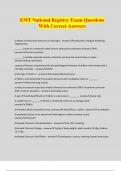
EMT National Registry Exam Questions With Correct Answers
EMT National Registry Exam Questions With Correct Answers 3 effects of intracranial pressure on vital signs - answerbradycardia, irregular breathing, hypertension ___ ___ is part of a syndrome called chronic obstructive pulmonary disease (COPD) - answerchronic bronchitis ___ ___ is usually caused by viruses or bacteria and may last several days or weeks. - answerAcute bronchitis a group of diseases characterized by the pathological limitation of airflow in the airway that is not fully reversible. - answerCOPD A late sign of shock is: - answerdecreased blood pressure A PASG is contraindicated if the patient presents with cardiogenic shock or _______. - answerabnormal lung sounds a policy or protocol issued by a medical director that authorizes EMTs to perform particular skills in certain situations - answerstanding orders A sign of breathing difficulty in children is a decrease in ___ ___. - answerpulse rate A sudden loss of _______ of blood is considered serious in an average adult. - answer1000cc A thrombus which has broken loose, moving with blood flow, is called - answeran embolism A weakened section of an arterial wall that begins to dilate is known as a(n) - answeraneurysm Activated Charcoal: Contraindications - answerPoor LOC, vomiting Activated Charcoal: Dosage - answer1 g/kg of body weight, adults usually 25-50g, children 12.5-25g Activated Charcoal: Side Effects - answerConstipation, nausea, vomiting, bowel obstruction After delivering your first shock with an AED, the patient is still pulseless, you should next - answerperform two minutes or 5 cycles of CPR Albuterol: Action - answerBronchodilator Albuterol: Contraindications - answerAllergy Albuterol: Dose - answer2.5 mg nebulized with 2.5 mL saline (for a total of 3mL) Albuterol: Indications - answerAcute bronchospasm due to asthma or COPD Albuterol: Side effects - answerHeadache, tachycardia, hypertension An example of a shockable rhythm - answerpulseless ventricular tachycardia An infant or child patient who exhibits wheezing, increased breathing effort on exhalation, or rapid breathing without stridor probably has: - answerA lower-airway disease an inflammation of the bronchi (medium-size airways) in the lungs - answerbronchitis ASA: Action - answerImpedes blood clotting ASA: Contraindications - answerallergy, bleeding disorder, already taken 324mg ASA: Dosage - answer324mg (81mg x 4) Atrovent: Action - answerBronchodilator Atrovent: Contraindications - answerAllergy to drug, soybeans, peanuts, glaucoma Atrovent: Dose - answer0.5 mg nebulized w/ 2.5 mL saline (3mL total) Atrovent: Side Effects - answerDry mouth, headache, gastrointestinal distress caused by loss of elasticity of the lung tissue, from destruction of structures supporting the alveoli, and destruction of capillaries feeding the alveoli. - answeremphysema Chaotic electrical activity originating from many sites in the heart is called: - answerVentricular fibrillation DCAP-BTLS = - answerdeformities, contusions, abrasions, punctures, burns, tenderness, lacerations, swelling Emphysema, chronic bronchitis, and many undetermined respiratory illnesses are classified as - answerCOPD Epinephrine: Action - answervasoconstriction, bronchodilation
Document information
- Uploaded on
- March 10, 2024
- Number of pages
- 6
- Written in
- 2023/2024
- Type
- Exam (elaborations)
- Contains
- Questions & answers


