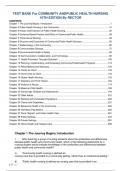
Test bank for Community and Public Health Nursing 10th Edition RectorCONTENTS Chapter 1 The Journey Begins: Introduction ........................................................................................... 1 Chapter 2 Public Health Nursing in the Community ............................................................................... 10 Chapter 3 History and Evolution of Public Health Nursing ..................................................................... 20 Chapter 4 Evidence-Based Practice and Ethics in Community/Public Health ........................................ 28 Chapter 5 Transcultural Nursing ........................................................................................................... 39 Chapter 6 Structure and Economics of Community/Public Health Services ........................................... 50 Chapter 7 Epidemiology in the Community ........................................................................................... 62 Chapter 8 Communicable Disease ........................................................................................................ 72 Chapter 9 Environmental Health & Safety ............................................................................................. 83 Chapter 10 Communication, Collaboration, and Technology ................................................................. 90 Chapter 11 Health Promotion Through Education ............................................................................... 100 Chapter 12 Planning, Implementing, and Evaluating Community/Public Health Programs ................... 113 Chapter 13 Policy Making and Advocacy ............................................................................................ 124 Chapter 14 Family as Client ................................................................................................................ 134 Chapter 15 Community as Client ........................................................................................................ 144 Chapter 16 Global Health Nursing ...................................................................................................... 153 Chapter 17 Disasters and Their Impact ............................................................................................... 164 Chapter 18 Violence & Abuse ............................................................................................................. 174 Chapter 19 Maternal-Child Health ....................................................................................................... 183 Chapter 20 School-Age Children and Adolescents .............................................................................. 194 Chapter 22 Older Adults ..................................................................................................................... 212 Chapter 23 Working with Vulnerable Populations ................................................................................ 222 Chapter 24 Clients with Disabilities ..................................................................................................... 231 Chapter 25 Behavioral Health in the Community ................................................................................. 242 Chapter 26 Homeless Populations ...................................................................................................... 252 Chapter 27 Rural, Migrant, and Urban Health Care ............................................................................. 261 Chapter 28 Public Settings .................................................................................................................. 270 Chapter 29 Private Settings ................................................................................................................ 281 Chapter 30 Home Health and Hospice Care ....................................................................................... 293
Chapter 1 The Journey Begins: Introduction 1.
After teaching a group of nursing students about the similarities and differences
between public health and community health, which of the following statements by a nursing student would indicate knowledge of the similarities and differences between public health and community health?
A) “Community health nursing is defined as
nursing care that is provided in a community setting, rather than an institutional setting.” B)
“Public health nursing is defined as nursing care that is provided in an 1 | P a g einstitutional setting.”
C)
“Public health nursing is focused on
the health of individuals.”
D)
“Community health nursing can shape the quality of community health
services and improve the health of the general public.”
Ans:
D
Feedbac
k:
Operating within an environment of rapid change and increasingly complex
challenges, this nursing specialty holds the potential to shape the quality of community
health services and improve the health of the general
public.
2. Which of the following statements would best
describe the difference between public health nursing and community health nursing?
A) Public health nursing is focused on the private aspects of health, and
community health nursing is focused on the public aspects of
health.
B)
In our textbook, the term community health practice refers to a focus on
specific, designated communities and is a part of the
larger public health effort.
C)
Public health nursing and community health nursing relate to the very same
types of services and perspectives.
D) Both public health nursing and community health nursing are practiced
exclusively within institutions.
Ans:
B
Feedbac
k:
In this textbook, community health practice refers to a focus on specific,
designated communities. It is a part of the larger public health effort and recognizes the
fundamental concepts and principles of public health as its birthright and foundation for
practice. Public health nursing is focused on the public aspects of health. Public health
nursing and community health nursing have distinctive types of services and
perspectives. Neither public health nursing nor community health nursing is practiced
exclusively within
institutions.
3. Which of the following is most accurate
about the concept of community?
A) A community is a collection of people
who share some important features of their
lives.
B) Community members live in the
same geographic location.
C) Community members are biologically related.
D) A community is made up of people who do not necessarily interact with one
2 | P a g eanother and do not necessarily share a sense of belonging
to that
group.
Ans: A
Feedback:
The broad definition of a community is a collection of people who share some
important features of their lives. Community members may not live in the same
geographic location as in a common-interest community or a community of solution. A
population is made up of people who do not necessarily interact with one another and
do not necessarily share a sense of belonging to that
group.
4.
A group of students are reviewing material for a test on populations,
communities, and aggregates. Which of the following indicates
that the students understand these concepts?
A) Members of a population share a
sense of belonging.
B) Communities and populations are
types of aggregates.
C)
Individuals of a community are
loosely connected.
D) Members of an aggregate share a strong
bond. Ans:
B
Feedback:
An aggregate refers to a mass of grouping of distinct individuals who are
considered as a whole and who are loosely associated with one another. Communities
and populations are types of aggregates. A population is made up of people who do not
necessarily interact with one another and do not necessarily share a sense of
belonging to the group. A community is a
collection of people who chose to interact with one another because of common
interests, characteristics, or goals, which form the basis for a sense of unity or
belonging.
5. Which of the following would a community health nurse identify as a
community of common interest?
A)
The global community
B)
C)
D)
Small rural town in a northern state
National professional organization
Counties addressing water
pollution Ans: C
Feedback:
A common-interest community shares a common interest or goal that binds the
members together. Membership in a national professional organization is one example.
The global community and a small rural town in a northern state would be examples of a
geographic community. Counties addressing a water pollution problem would be an
example
of a community of solution.
6.
The nurse is working with a community of solution. Which of the following
would the nurse expect to find?
A) A health problem affecting the group
3 | P a g eB) Common goal binding members together
C)
Sharing of a similar goal
D)
Locational
boundaries Ans:
A
Feedback:
A community of solution involves a group of people coming together to solve a
problem that affects them. A common-interest community involves a collection of
people widely scattered geographically who have an interest or goal that binds the
members together. A geographical community is one defined by its geographical or
locational
boundaries.
7. Which one of the following statements made by a student would the nurse
educator recognize as evidence that a student
understands the health continuum?
A)
The distinction between health and
illness is well demarcated.
B)
Illness refers to a state of being
relatively unhealthy.
C)
The term health is limited to reflect
an individual's state.
D)
Treatment of acute conditions reflects
the current focus of health care.
Ans: B
Feedback:
Although society typically depicts an absolute line of difference between being
either well or ill, health is considered a relative term. Thus, illness is viewed as a state
of being relatively unhealthy. Health is typically described as a continuum that involves
a range of degrees from optimal health at one end to total disability or death at the
other. The line of demarcation is not clear. Health applies to individuals, families, and
communities.
Traditionally, most health care has focused on the treatment of acute and chronic
conditions at the illness end of the continuum, but this emphasis is shifting to focus on
the wellness
end.
8. When discussing the concept of the health continuum with a class, the nurse
educator would be certain to include which statement
in the description?
A) Wellness is a relative concept, not an absolute, and illness is a state
of being relatively unhealthy.
B)
A client's placement on the health
continuum is static throughout time.
C)
Health is best described as cyclic.
D)
The health continuum can only be
applied to individuals.
Ans: A
Feedbac
k:
Wellness is a relative concept, not an absolute, and illness is a state of being
4 | P a g erelatively unhealthy. The continuum can change. Because health involves a range of
degrees from optimal health at one end to total disability or death at the other, it is often
described as a continuum. The health continuum applies not only to individuals but
also to families and communities.
9.
After discussing the leading health indicators with a class, which condition if
stated by the class as one of these indicators suggests that
the class has understood the information?
A)
Cardiac disease
B) Mental health
C)
Sedentary lifestyle
D) Maternal health
care Ans:
B
Feedback:
Mental health is a leading health indicator. Other leading health indicators
include physical activity, overweight and obesity, tobacco use, substance use,
responsible sexual behavior, injury and violence, environmental quality,
immunization, and access to health care.
10. Which of the following statements about
health promotion and disease prevention is the most accurate?
A)
Health promotion and disease prevention include all efforts that seek to
move people closer to optimal well-being or higher levels
of wellness.
B)
Disease prevention differs from health promotion in that disease
prevention is targeted toward a specific disease or diseases.
C)
Health promotion can be described in
terms of primary, secondary, and tertiary
prevention.
D)
The goal of disease prevention is to raise levels of wellness for individuals,
families, populations, and communities.
Ans: B
Feedbac
k:
Health promotion includes all efforts that seek to move people closer to optimal
well- being or higher levels of wellness. The goal of health promotion is to raise levels
of wellness for individuals, families, populations, and communities. Disease prevention
is targeted toward a specific disease or diseases and consists of primary, secondary,
and tertiary
prevention.
11. A group of community health nursing students design a health education
program for a group of pregnant teens that includes teaching nutrition during
pregnancy, demonstrating helpful exercises, and discussing their concerns. This is an
example
of which of the following?
A)
Health promotion
B)
C)
5 | P a g e
Treatment of disorders
RehabilitationD) Evaluation
Ans: A
Feedbac
k:
The student nurses are engaging in health promotion activities. Health
promotion incorporates all efforts that seek to move people closer to optimal well-
being or to higher levels of wellness. Treatment of disorders would include direct care
for issues involving the group, such as complications that might arise in this
population.
Rehabilitation would involve activities to minimize disability or restore or preserve function.
Evaluation would involve an analysis of the effectiveness of these
activities.
12.
plan of primary prevention activities. Which of the following might the nurse
include? Select all that apply.
A)
Teaching about safe-sex practices to high
school students
B)
Encouraging older adults to install
safety devices in the bathroom
C)
Providing regular immunization programs
for communicable diseases
D) Participating in cholesterol
screening programs at health fairs
E)
Providing skin testing for tuberculosis
for children over 1 year of age
F) Working with a group testing water
samples for contamination
Ans: A, B, C
Feedback:
Primary prevention activities are those taken to keep illness or injuries from
occurring.
These include teaching about safe-sex practices, encouraging older adults to use safety
devices in the bathroom, and providing regular immunization programs for communicable
diseases.
Cholesterol screening programs, skin tests for tuberculosis, and working with a group
testing water samples for contamination are examples of secondary prevention
activities.
13. A community health nurse is preparing a presentation for a group of nursing
students about community health nursing. Which of the following descriptions about
community health nursing would the nurse most likely
include in the presentation?
A)
Focusing on addressing continuous needs
B) Working with the client as an equal partner
C)
Engaging in tertiary prevention as the priority
D) Encouraging clients to reach out to the
nurse Ans:
B
Feedback:
The community health nurse works with the client as an equal partner,
encouraging autonomy. At any time, the nurse deals with continuous and episodic
needs simultaneously. Primary prevention is the priority for community health nurses.
6 | P a g eThe community health nurse engages in primary prevention as the priority, having the
obligation to actively reach out to all who might benefit from a specific activity or
service.
14. A community health nurse is working with other members of a team that will
be implementing a citywide immunization program. The nurse is coordinating the
services and addressing the needs of the population groups to ensure which of the
following?
A)
Involvement of the community
B)
C)
Client participation
Continuity of service
D) Plan for follow-
up Ans: C
Feedback:
Working in cooperation with other team members and coordinating services and
addressing the needs of population groups are essential to interprofessional
collaboration. In doing so, the community health nurse is preventing fragmentation and
gaps thereby ensuring continuity of service. Involvement of the community and client
participation are important but these help to ensure that the clients are viewed as equal
partners of the health care team. A plan for follow-up may or may not be appropriate. In
addition, it is the only aspect that may be addressed with the
program.
15. A community health nurse works to ensure the greatest good for the greatest
number of people by applying which of the following?
A) Secondary prevention activities
B)
Autonomy
C)
D)
Justice
Utilitarianism
Ans: D
Feedbac
k:
The ethical theory of utilitarianism promotes the greatest good for the greatest
number. Primary prevention activities, not secondary prevention, are the priority.
Autonomy refers to the freedom of choice. Justice involves
treating people fairly.
16. When working in the community, the community health nurse adopts the
teaching plan to ensure that the population understands the basic information provided
to address
which of the following?
A) Self-care
B)
Health disparities
C)
Health literacy
D) Episodic needs
Ans: C
Feedbac
k:
Consumers are often intimated by health professionals and are uninformed
about health and health care affecting the quality of care.
Adopting a teaching plan to ensure that the population understands the basic
information addresses health literacy, the ability to read, understand, and use health
7 | P a g ecare information appropriately. Doing so helps to ensure that the teaching plan will be
effective. Self-care refers to the process of taking responsibility for developing one's own
health potential by actively participating in promoting one's own health. Health
disparities reflect differences in all aspects of health care related to vulnerable
populations. Episodic needs are one-time
specific negative health events that arise and are not an expected part of life.
17. Which of the following would be crucial for the community health nurse to
address as the priority when dealing with policy makers about the development of
community health programs?
A)
Research-based best practices
B)
C)
Population's make up
Amount of services to be provided
D) Scarcity of the available
resources Ans: A
Feedback:
Decisions for programs or services are often made on the basis of cost-
effectiveness or cost–benefit. Therefore, community health nurses must provide policy
makers with information about best practices, grounded in research. Although
population make up, amount of services to be provided, and scarcity of resources are
factors that may need to be considered, the community health nurse
must demonstrate evidence-based practice.
18. After a class that described the differences between acute care nursing and
community health nursing, which statement by the class about community health
nurses indicates successful teaching?
A)
Use a reactive approach.
B)
C)
Seek out potential health problems.
Concentrate on the illness end of
the continuum.
D) Emphasize curative
care. Ans:
B
Feedback:
Community health nurses, in contrast to acute care nurses, seek out
potential health problems, identifying high-risk groups and instituting preventive
programs; use a proactive approach; concentrate on the wellness end of the health
continuum; and put
less emphasis on curative care.
19. Which of the following activities would be associated with a community health
nurse? Select all that apply.
A) Examining infants in a city well-baby clinic
B)
Caring for elderly stroke victims in
their homes
C)
Providing emergency care in an acute
care facility
D)
Carrying out epidemiologic research
E)
Participating in health policy
analysis Ans: A, B, D, E
Feedback:
Community health nurses work in every conceivable kind of community agency,
from a state public health department to a community-based advocacy group. Their
duties rang from examining infants in a well- baby clinic or teaching elderly stroke
victims in their homes to
8 | P a g ecarrying out epidemiologic research or engaging in health policy analysis and decision
making.
Providing care in an acute care facility would not be an
activity associated with a community health nurse.
20. The term health can be described in many different ways. A community
health nurse would view health as which of the following?
A)
The absence of disease
B)
C)
The potential to lead a productive life
An environment free of toxins
D) A holistic state of well-
being Ans:
D
Feedback:
Community health nurses view health as a holistic state of well-being, which
includes soundness of mind, body, and spirit. Along with this foundational view is the
emphasis on wellness, which includes the definition of health as well as the capacity to
develop a person's potential to lead a fulfilling and productive life. Health is more than
just the absence of disease or an environment free of
toxins.
21. While interviewing a client, which of the following statements would a nurse
identify as reflecting an objective dimension of
health?
A)
“I'm feeling better since I started taking
that medication.”
B)
“Life is pretty good right now, except for
an occasional upset stomach.”
C)
“I'm able to wash myself in the mornings
with just a bit of help.”
D)
“Sometimes when I wake up, I don't
even want to face the day.”
Ans: C
Feedbac
k:
The objective dimension of health involves one's ability to function in daily
activities. The statement about being able to care for one's self is an example. The
statements of feeling better with medication, life being pretty good, and not wanting to
face the day are examples of the subjective dimension of
health, which involves how people feel.
22. When employing a population-oriented focus, the community health nurse
would do which
of the following?
A) Assess the groups' relationships looking
for a common need.
B)
Consider the members individually for
similarities.
C)
Focus on the geographical area
of the population.
9 | P a g eD) Promote the groups'
dependency for improving health.
Ans: A
Feedbac
k:
A population-oriented focus requires the assessment of relationships,
considering the groups or communities in relationship to the rest of the community to
discover common needs or risks for a common health problem. The nurse does not
consider the groups or communities separately but rather in context. The population
may or may not be delineated by the geographical area. The community health nurse
encourages individuals' participation to promote their autonomy rather
than permitting dependency.
23. A community health nurse is involved in a project to evaluate the health of a city.
Which of the following findings would suggest that the city would most likely need
additional programs?
A)
Citizens are actively involved in the city's department of recreation and
after-school programs.
B)
The construction of affordable organized
housing developments and communities is nearing completion.
C)
Approximately one third of the people are recently unemployed due to
closure of the automotive factory.
D) Several new recreational facilities for adults and children have been created
at several locations.
Ans: C
Feedbac
k:
A healthy city is one in which there is continual creation and improvement the
physical and social environments with expansion of community resources so that
people can mutually support one another. It is characterized by the meeting of basic
needs for all of the city's people. This would include food, water, shelter, income, safety,
and work. Loss of employment of one third of the city's workforce would be a threat to
the health of the city and necessitate intervention. Active involvement in the city's
functioning, affordable housing, and recreational facilities
are suggestive of a healthy city.
Chapter 2 Public Health Nursing in the Community
1.
A community health nurse is engaging in assurance activities. Which of the
following would best explain these activities?
A) Gathering and analyzing information that
will affect the health of the people to be served
B)
Providing leadership in facilitating community groups toward meeting their
needs, often involving changes in and
additions to existing laws
10 | P a g eC)
Being involved in activities to make certain that necessary services are being
provided to the community
D) Accessing relevant data that enable identification of strengths,
weaknesses, and needs within the community
Ans: C
Feedbac
k:
Assurance activities are those activities that make certain that services are
provided and include focusing on the availability of necessary health services
throughout the community, maintaining the ability of public health agencies and private
providers to manage day-to-day operations as well as the capacity to respond to critical
situations and emergencies. Assessment involves gathering and analyzing information
that will affect the health of those to be served and accessing relevant data to enable
the nurse to identify strengths, weaknesses, and needs. Policy development involves
providing leadership in
facilitating community groups.
2. When fulfilling the function of assessment, which of the following would be
most important for the community health nurse to
do?
A) Secure the trust of the clients
B)
Gather appropriate information
C)
D)
Interact with key community leaders
Use a variety of assessment
tools Ans:
A
Feedback:
Although securing and maintaining the trust of others is pivotal to all nursing
practice, it is even more critical when working in the community. Trust can afford a
nurse access to client populations that are difficult to engage, to agencies, and to
health care providers. As difficult as it may be for the nurse to gain the trust and respect
of the community, if it is ever lost, these attributes can be difficult if not impossible to
regain. Gathering information, interacting with key community leaders, and using a
variety of assessment tools are important, but they can only occur
after trust is established.
3.
The community health nurse is engaging in the core function of policy development.
With which of the activities would the nurse
most likely be involved?
A) Monitoring health status to
identify community health problems
B)
Empowering communities about
important health issues
C)
Linking individuals to needed personal
health services
D) Ensuring a competent health care
workforce is available
Ans: B
Feedbac
k:
With policy development, the community health nurse would be involved in
11 | P a g einforming, educating, and empowering people about health issues. Monitoring health
status is associated with the assessment function.
Linking individuals to needed personal health services and ensuring a competent
public health and personal health care workforce are
associated with assurance.
4.
A community health nurse is collaborating with local community leaders to
prepare a community disaster plan. Which function is
the nurse fulfilling?
A)
Research
B)
C)
Assurance
Policy development
D) Assessment
Ans: B
Feedbac
k:
Community health nurses perform the assurance function at the community level
when they collaborate with community leaders in the preparation of a community
disaster plan.
Research is demonstrated by gaining new insights and innovative solutions to health
problems. Policy development would involve client information, education and
empowerment, mobilization of community partnerships, and the development of plans
and policies to support community health efforts. Assessment involves monitoring
health status for community health problems and diagnosing and investigating health
problems and hazards in the
community.
5.
A community health nurse has collected data for several months on the birth
weights of newborns to mothers who smoked throughout their pregnancy. This nurse
is acting in which role?
A)
Collaborator
B) Manager
C)
Researcher
D)
Clinician
Ans: C
Feedbac
k:
The nurse is assuming the role of a researcher, that is, engaging in systematic
investigation that includes data collection. In the collaborator role, the nurse would work
with numerous members of the health team, working jointly with others in a common
endeavor. In the manager role, the nurse exercises administrative direction toward the
accomplishment of specified goals. In the clinician role, the nurse ensures the provision
of health care services to individuals,
families, groups, and populations.
6.
A nurse in community health nursing setting works with police officers, social
workers, health educators, and other nurses to promote the health of clients. The
nurse is acting in
which role?
A)
Clinician
B)
12 | P a g e
EducatorC)
D)
Researcher
Collaborator
Ans: D
Feedbac
k:
The nurse is assuming the role of collaborator. In this role, the community health
nurse works jointly with many individuals to benefit client care. In the clinician role, the
nurse ensures the provision of health care services to individuals, families, groups, and
populations. As an educator, the nurse is the health teacher and provides information
to community clients. In the researcher role, the community health nurse engages in
systematic investigation, collection, and analysis of data for solving problems and
enhancing community health practice.
7.
A community health nurse is interviewing for employment. The interviewer
describes some of the typical activities that the nurse would be involved in, such as
making home visits to families, holding immunization clinics for infants and children,
and setting up flu-shot clinics for elders. The interviewer is
describing which role?
A) Educator
B)
Advocate
C)
Clinician
D) Manager
Ans: C
Feedbac
k:
The interviewer is describing direct care activities associated with the clinician
role. As an educator, the nurse is the health teacher and provides information to
community clients. In the advocate role, the nurse pleads for the clients' cause or acts
on their behalf. In the manager role, the nurse exercises administrative direction toward
the
accomplishment of specified goals.
8.
A community health nurse is reviewing his or her schedule for the day. Included
in his or her activities are planning client care, leading a staff conference, and
supervising a new staff member. This nurse is fulfilling which role?
A) Advocate
B) Manager
C)
Collaborator
D)
Researcher
Ans: B
Feedbac
k:
When functioning in the manager role, the nurse exercises administrative
direction toward the accomplishment of specified goals. Overseeing client care as a
case manager, supervising ancillary staff, managing caseloads, running clinics, or
conducting community health needs assessment projects are examples of activities
associated with the manager role. In the advocate role, the nurse pleads for the clients'
cause or acts on their behalf. In the collaborator role, the nurse would work with
numerous members of the health team, working jointly with others in a common
endeavor. In the researcher role, the community health nurse engages in systematic
13 | P a g einvestigation, collection, and analysis of data for solving problems and enhancing
community health practice.
9. While providing care to a family at a local center, the community health nurse
contacts the local department of social services to help the family attain assistance
with health insurance coverage. The nurse also gives the family a list of pharmacies
where they can get their prescriptions filled. The nurse is acting
in which role?
A) Educator
B)
Leader
C)
Clinician
D) Advocate
Ans: D
Feedbac
k:
The nurse is acting in the role of advocate, by pleading their cause and acting
on their behalf. The nurse acts as an advocate by showing clients what services are
available, the ones to which they are entitled, and how to obtain them. As an educator,
the nurse is the health teacher and provides information to community clients. As a
leader, the nurse directs, influences, or persuades others to effect change that will
positively impact people's health and move them toward a goal. In the clinician role, the
nurse ensures the provision of health care services to individuals, families, groups, and
populations.
10. Which of the following best exemplifies the attributes of a community health
nurse in the researcher role?
A) Gaining the trust and respect of the
staff members
B)
Interpreting abstract ideas so
others can understand
C)
Implementing a staff development
program for a technique
D) Evaluating the correlation between
variables in specific health conditions
Ans: D
Feedbac
k:
Attributes of a researcher include a spirit of inquiry, careful observation, analytic
skills, such as evaluating the possible cause and effect of a situation, and tenacity.
Gaining the trust and respect of staff, interpreting abstract ideas, and implementing a
staff development program are examples of the management
skills used in the role of manager.
11. Which of the following statements about the
role of educator within the framework of public health nursing functions is true?
A)
The educator role has the potential for finding greater receptivity and providing
higher- yield
results.
B)
People are unable to recognize the value of
health and are not well motivated to achieve higher levels of wellness.
14 | P a g eC)
It is only possible for a nurse to
reach a limited number of persons.
D)
The public's higher level of
health consciousness hinders the
educator's role. Ans: A
Feedback:
The educator role has the potential for finding greater receptivity and providing
higher- yield results. People are recognizing the value of health and are increasingly
motivated to achieve higher levels of wellness. With an emphasis on populations and
aggregates, the educational efforts of community health nursing are appropriately
targeted to reach many people.
One factor that enhances the educator role is the public's higher
level of health consciousness.
12. Which of the following statements about
the importance of the role of collaborator is
true?
A) Community health nurses frequently
practice in isolation.
B)
Successful community health practice depends on multidisciplinary
collegiality and leadership.
C) Community health nurses must assert themselves as the most powerful
person on the health care team to ensure each client
receives services that are necessary.
D)
It is best for community health nurses to focus on what they, as nurses, can do
for their clients.
Ans: B
Feedbac
k:
Community health nurses seldom practice in isolation. As collaborators, nurses
work jointly with others in a common endeavor, cooperating as partners. Successful
community health practice depends on multidisciplinary collegiality and leadership. The
community health nurse's collaborator role requires skills in communicating, in
interpreting the nurse's unique contribution to the team, and in acting assertively as an
equal
partner.
13. Which of the following statements about the community health nurse's
selection and practice of each role is true?
A) Within a given time, a community
health nurse may practice multiple roles.
B)
The knowledge that vulnerable populations need someone to guide them
through the complexities of the health care system and the
nurse can serve as an advocate for them
C)
The researcher role for community
health nurses involves only the use of
quantitative statistics.
D)
The leadership role consists
15 | P a g esolely of managing staff.
Ans: B
Feedbac
k:
Community health nurses wear many hats while conducting day-to-day
practice. At any given time, however, one role is primary.
They need someone to guide them through the complexities of the system and
assure the satisfaction of their needs. This is particularly true for minorities and
disadvantaged groups. Although research technically involves a complex set of
activities conducted by persons with highly developed and specialized skills,
research also means applying that technical study to real-practice situations. As
leaders, community health nurses seek to initiate changes that positively
affect people's health.
14. A community health nurse is involved in education, screening, referral, and
support for the individuals of a specific religious congregation. The nurse is practicing
in which
setting?
A)
Occupational health nursing
B)
C)
D)
Faith community nursing
School nursing
Residential institution
nursing Ans: B
Feedback:
In faith community nursing, the practice focal point is the faith community and
the religious belief system provided by the philosophical framework. It may be called
church-based health promotion, parish nursing, or primary care parish nursing practice.
Occupational health nursing occurs in business and industry settings. School nursing,
as the name implies, involves practicing in the school system, including from
preschools to colleges and universities.
Residential institution nursing occurs in any facility where the clients reside such as a
halfway house or continuing care
center.
15. Which of the following differentiates the home setting for community health
nursing from other settings?
A)
The nurse acts primarily as an educator.
B)
The client is viewed within his or
her environment.
C)
Technologically advanced care is limited.
D)
The home is being used less frequently
today. Ans: B
Feedback:
In the home, unlike most other health care settings, clients are on their own
“turf,” such that the client is the host, comfortable and secure in familiar surroundings,
and the nurse is a guest. Although education may be a major component of care in the
home, all community health nursing roles are performed to varying degrees. In addition,
technologically advanced care in the home is increasing in demand, with the home
being the most frequently used setting for community health nursing.
16. After teaching a group of students about the various settings for community
16 | P a g ehealth nursing, the instructor determines that this teaching was successful when the
students identify which of the following as an example
of ambulatory service setting?
A)
Local preschool
B)
C)
D)
Halfway house
Continuing care center
Family planning
clinic Ans:
D
Feedback:
Ambulatory service setting includes a variety of venues for community health
nursing in which clients come for day or evening services that do not include overnight
stays. One example is a family planning clinic. A local preschool would be an example
of a school setting. A halfway house and continuing care center are examples of
residential institutions.
17. After teaching a group of students about the changing roles of the
community health nurse in the occupational setting, the instructor determines that
the students need additional teaching when they state which of the
following?
A)
Occupational health nurses are
increasing their role as employee advocates.
B)
Health education is a key function of
the occupational health nurse.
C)
There is a greater emphasis on
the occupational health nurse's role as a
clinician.
D)
Collaboration with other health care
providers fosters the offering of better services.
Ans: C
Feedbac
k:
The clinician role was primary for many years, as nurses continued to care for
sick or injured employees at work. However, recognition of the need to protect
employees' safety and, later, to prevent their illness led to the inclusion of health
education in the occupational health nurse role. Occupational health nurses also act as
employee advocates, assuring appropriate job assignments for workers and adequate
treatment for job- related illness or injury. They collaborate with other health care
providers and company management to offer better services to their clients. They act as
leaders and managers in developing new health services in the work setting, endorsing
programs such as
hypertension screening and weight control.
18. A community health nurse is working as a lobbyist for health legislation for
AIDS research at the state capital. This nurse is
practicing in which setting?
A)
Faith community
B)
C)
Ambulatory service
Residential institution
D) Community at
large Ans:
D
Feedback:
17 | P a g eThe community at large is not confined to a specific philosophy, location, or
building. It serves as the setting for practice of a nurse who serves on health care
planning committees, lobbies for health legislation at the state capital, runs for a school
board position, or assists with
flood relief in another state or country. Faith community nursing focuses on activities
involving the faith community and religious belief system.
Ambulatory service settings include a variety of venues in which clients come for day or
evening services that do not include overnight stays. Residential institutions include any
facility where clients reside.
19. Which of the following is included in
the most accurate description of school
nursing?
A)
This is one community health setting
where the role is static.
B)
The primary role of school nurses is clinician.
C)
The practice of school nurses is widening.
D) School nurses rarely act as
advocates. Ans:
C
Feedback:
School nurses, whose primary role initially was that of clinician, are
widening their practice to include more health education, interprofessional
collaboration, and client advocacy.
20. A community health nurse is assuming the role of a manager. Which function
would be most important for the nurse to address first?
A) Planning
B)
Organizing
C)
D)
Leading
Controlling
Ans: A
Feedbac
k:
The management process incorporates a series of problem-solving activities or
function: planning, organizing, leading, and controlling and evaluating. Although these
activities occur simultaneously, they are sequential with
planning being the first activity.
21. A nursing student is interviewing a community health nurse about the various
roles the nurse assumes and the skills and behaviors necessary to perform each role.
Which of the following would the community health nurse identify as being essential
to the
role of an advocate? Select all that apply.
A) Assertiveness
B)
Ability to plan
C)
D)
E)
F)
Ability to negotiate
Risk taking
Holistic view
Questioning
attitude Ans:
A, C, D
Feedback:
18 | P a g eAs an advocate, the community health nurse must be assertive, willing to take
risks, be able to communicate and negotiate well, and be able to identify resources and
obtain results. The ability to plan is associated with the manager role. A holistic view is
critical to the community health nurse acting as a clinician. A questioning attitude is
necessary
for the role as a researcher.
22. A community health nurse works in a busy community health nursing practice.
Today, the nurse is devoting the day to the educator role. With which of the following
activities would the nurse be involved? Select all that apply.
A) Planning seven home visits today
B) Working on a new curriculum for high-
risk teens
C) Meeting with colleagues to
discuss organizational changes in the
office
D)
Ordering pamphlets over the Internet
to be used in a parenting class
E)
Tabulating data from surveys
distributed to elders during a flu-shot clinic
F)
Going to social services to speak up
for a family in his or her caseload
Ans: B, D
Feedback:
In the educator role, the nurse would work on a new curriculum for high-risk
teens and order pamphlets for use in a parenting class. Planning seven home visits
would be part of the clinician role. Meeting with colleagues to discuss organizational
changes would be part of the manager role. Tabulating data from surveys would be part
of the researcher role. Speaking up for a family in the nurse's caseload would be an
example of the advocate
role.
23. A community health nurse is devoting the day to being a manager. Which
activities would the nurse expect to perform? Which of the following activities are
part of this role? Select all that apply.
A)
Orienting three new community health
nurses in the agency
B)
Attending a strategy meeting for a
new service the community will be offering
C) Working with a team to direct a
smoking cessation program in public areas
D)
Investigating an outbreak of Salmonella in
the community
E)
Tabulating the findings of
exploring immunization practices
among teens
F)
Reviewing the staff evaluations to assist
with planning future in-services
Ans: A, B, F
Feedback:
19 | P a g eAs a manager, a community health nurse would be involved in orienting new
nurses in the agency, attending meetings for new services to be offered, and reviewing
staff evaluations. Working with a team to direct a smoking cessation program in public
areas exemplifies the leadership role. Investigating an outbreak of Salmonella and
tabulating the findings of immunization practices depict the
researcher role.
24.
Of all the nursing roles assumed by community health nurses, which role
must be assumed in every situation?
A)
Researcher
B) Manager
C)
Leader
D)
Clinician
Ans: B
Feedbac
k:
The type and number of roles that are practiced vary with each set of clients and
each specific situation, but the nurse should be able to successfully function in each of
these roles as the particular situation demands. The role of manager is one that the
nurse must play in every situation, because it involves assessing clients' needs,
planning and organizing to meet those needs, directing and leading clients to achieve
results, and controlling and evaluating the progress to ensure that the goals and clients'
needs are
met.
25. Which of the following are core values of
professional behavior that are unique to public health nursing? Select all that apply.
A) Community/population as client
B)
Prevention
C)
Rehabilitation
D) Partnership
E)
Healthy environment
F)
Diversity
Ans: A, B, D, E,
F
Feedback:
Core values of professional behavior emphasize community/population as client,
prevention, partnership, healthy environment, and diversity. Rehabilitation is not
population centered.
Chapter 3 History and Evolution of Public Health Nursing
1.
A group of students are reviewing the various historical events associated with
the evolution of community health nursing in preparation for a test. They identify the
time from 1970 to the present as the era known as community health nursing based
on the understanding that which of the following influences
contributed most to this change?
A)
The settings and the nurses delivering
health care in the community
B)
Decisions made by the American
Nurses Association
20 | P a g eC)
Decisions made by physicians in a
variety of community settings
D)
The demand to eliminate the word
“public” from health services
Ans:
A
Feedbac
k:
The numbers, increasing variety of settings, and many nurses coming to
work in the community settings since the 1970s have contributed most significantly
to the change. As a result, professional associations supported the broader term of
community health nursing.
Physician decisions played no role in the change. The term public
health nursing still remains.
2.
Before the mid-1800s, early home care nursing was best recognized by
which of the following?
A)
Technical advances with the
Industrial Revolution making major
changes
B)
Care provided by family members,
friends, and religious groups in the home
C)
Accomplishments stemming from the
work of Florence Nightingale
D)
Formal organization of visiting
nursing to provide care to the sick poor
Ans: B
Feedbac
k:
Before the mid-1800s, early home care was characterized by care of the sick in
the home by family members, friends, and religious groups. Technical advances came
after 1850, as did the work of Florence Nightingale and the formal organization of
visiting nurses to
provide care to the sick poor.
3.
Community health nursing has a long history of contributing to the health of
populations.
Which of the following forms of service would the nurse identify as being
most recent?
A) Voluntary home nursing care for the sick
poor via district nursing
B)
Care provided termed public health nursing
C)
Lay and religious groups providing care
to the sick poor in their homes
D)
Focus on populations with community
health nursing seen as a specialty field
Ans: D
Feedback:
The four stages of community health nursing followed from lay and religious groups
providing care in the early years before 1850, the more specialized “health nurses” or
district nursing after the mid-1800s, concern for the health of the general public from
1900s to 1970, and finally community health nursing as a specialty with a focus on
21 | P a g epopulations since 1970.
4. Which factor was the most significant
feature associated with district nursing?
A)
Caring for the sick
B)
C)
Teaching hygiene and cleanliness
Preventing illness
D) Gathering statistical
data Ans:
B
Feedback:
Although district nurses primarily cared for the sick, they also taught cleanliness
and wholesome living to their clients. This early emphasis on prevention and health
became one of the distinguishing features of district nursing and later of public health
nursing.
Preventing illness and gathering statistical data were key contributions of Florence
Nightingale during the Crimean War of the
early 1850s.
5.
In their early stages, district nursing
was sponsored by which of the following?
A)
Religious organizations
B)
C)
Private philanthropy
Contributions
D) Public funding
Ans: A
Feedbac
k:
Early district nursing services were founded by religious organizations that
served as their sponsors. Later sponsorship shifted to private philanthropy. Funding
came from contributions and fees charged to clients on an ability-to-pay basis. Finally,
visiting nursing began to be supported by public money.
6. Which of the following would characterize the public health stage of community
health nursing?
A) Voluntary health agencies
emphasizing disease prevention
B)
Family considered as the primary unit of care
C)
Service provision to the sick poor population
D) Primary health care as the key to health for all
Ans: B
Feedbac
k:
The public health nursing stage was characterized by service to the public, with
the family targeted as a primary unit of care. Official health agencies, which placed a
greater emphasis on disease prevention and health promotion, provided the chief
institutional base.
Primary health care as the key to health for all characterizes the
community health nursing stage.
7.
22 | P a g e
At which time did the focus of district nursing broadened to include thehealth and welfare of
the general public?
A) Beginning of 20th century
B)
In the late 19th century
C)
D)
Prior to the 1850s
By the early
1970s Ans: A
Feedback:
The focus of district nursing broadened to include the health and welfare of the
general public by the beginning of the 20th century or the early 1900s. In the late 19th
century, district nurses were ill-prepared to cope with their clients' multiple health and
social problems resulting from widespread immigration and filled tenement housing that
led to inadequate sanitation, unsafe and unhealthy working condition, and barriers
adding to poverty and disease. District nursing did not develop until after 1850. The
early 1970s is associated with the emergence of community health nursing.
8.
A student is planning a presentation about the evolution of public health nursing.
As part of the presentation, the student would identify which person as being the first
one to use the term “public health nursing”?
A)
Jessie Sleet
B)
C)
Lillian Wald
Lina Rogers
D) Margaret Sanger
Ans: B
Feedbac
k:
Lillian Wald, a leading figure in the expansion of district nursing, was the first to
use the term “public health nursing” to describe the specialty. Jessie Sleet was credited
as being the first Black public health nurse. Lina Rogers was credited with being the first
school nurse. Margaret Sanger was the nurse who opened the first birth control clinic in
America that eventually resulted in the formation of the International Planned
Parenthood Federation.
9. Which of the following are important contributions made by Lillian Wald
to the profession of public health nursing? Select all
that apply.
A) Demonstrating the effectiveness of placing school nurses in public schools
to reduce absenteeism and improve follow-up of
problems identified in school children
B)
Promoting the use of birth control
C)
Convincing the Metropolitan Life Company that nurse intervention could
reduce death rates
D) Providing rural “frontier nursing” to
serve mountain families in Kentucky
E)
Founding the National Organization
for Public Health Nursing (NOPHN)
Ans: A, C, E
Feedback:
Lillian Wald contributed to the profession of public health nursing by
23 | P a g edemonstrating the effectiveness of placing school nurses in public schools to reduce
absenteeism and improve follow-up of problems identified in school children,
convincing the Metropolitan Life Company that nurse intervention could reduce death
rates, and Founding the National Organization for Public Health Nursing
(NOPHN).
10. After a class discussion about the contributions of Lillian Wald to the
advancement of community health nursing, which of the following if stated by the
class
indicates that the discussion was effective?
A) Establishment of family-centered nursing and outreach services in New York
City at the turn
of the 20th century
B)
Use of clean and safe nursing care
practices to soldiers during the Crimean War in
the 1850s
C)
Assistance to high-risk populations experiencing tropical diseases in
Central America and the Caribbean in the late 1800s
D)
Creation of home nursing services in London, marking the beginning of district
nursing in
the
1860s
Ans: A
Feedback:
Lillian Wald worked with immigrant families in the Lower East Side of New York
City, providing home visits, a neighborhood center, and general sanitation improvement for
families
and health care services to children in schools. Florence Nightingale was responsible
for providing clean and safe nursing care practices to soldiers during the Crimean War.
Mary Seacole helped high-risk populations who experienced tropical diseases in
Central America and the Caribbean. William Rathbone was responsible for establishing
a
visiting nurse service for the sick in London.
11. A group of nursing students are studying for an examination on influential
nursing leaders involved in the advancement of community health nursing. The students
demonstrate that they are prepared for the examination when they identify which person
as the first
community health nurse in the United States?
A)
Frances Root
B) Mary Robinson
C) Mary Seacole
D)
Reba Thelin
Ans: A
24 | P a g eFeedbac
k:
In the United States, Frances Root was the first community health nurse who
was hired by the Women's Branch of the New York Mission in 1877. Mary Robinson
was the nurse who cared for William Rathbone's wife and was hired by Rathbone to
visit the sick poor in their homes in England. Mary Seacole, the “Black Nightingale,”
practiced Creole or Afro-Caribbean medicine in Jamaica and helped populations who
experienced tropical diseases in Central America, Panama, and the Caribbean. Reba
Thelin was a nurse hired by Johns Hopkins Hospital to visit the homes of tuberculosis
clients in 1903.
12. Which of the following nurses openly defied a law that she saw as unjust and
eventually resulted in the formation of The International
Planned Parenthood Federation?
A)
Lillian Wald
B)
Florence Nightingale
C) Margaret Sanger
D) Mary Brewster
Ans: C
Feedbac
k:
Margaret Sanger openly defied a law that she saw as unjust (the Comstock Act
that prohibited the provision of any information on contraception to women). This
defiance eventually resulted in the formation of The International Planned Parenthood
Federation. During the same period that Lillian Wald and her contemporaries were
working to alleviate the suffering caused by disease and poverty, Margaret Sanger
began a different battle.
Florence Nightingale wrote a series of papers on the need for “home missioners” and
“health visitors” and endorsed the view that prevention was better than cure. Mary
Brewster was a nurse and a friend of Lillian Wald who both together started the Henry
Street Settlement.
13. The community health nurse is preparing a presentation for a group of nursing
students about the societal influences on the development of community health
nursing. Which factors should the nurse include that have influenced the growth of
community
health nursing? Select all that apply.
A) Advances in the technology
B)
The recognition that one single agent
could be considered a cause of illness
C)
Access to education being limited to
the privileged few
D)
Continued increase in the number of women entering nursing because it is
recognized as a
25 | P a g echoice career for women and not men
E)
Consumer demand for quality services
coupled with community health nurses provision of holistic
care Ans:
A, E
Feedback:
Many factors have influenced the growth of community health nursing, including
advances in technology, progress in causal thinking (relating disease or illness to its
cause and recognition that many factors might contribute to a disease or health
disorder), and the consumer movement with consumers demanding quality services.
Education is now widely available and is considered a basic right and necessity for a
vital society.
Changing demographics and the role of women have influenced community health
nursing; however, the number of women
entering nursing has decreased.
14. Which of the following actions by the community health nurse exemplifies the
societal influence of causality on the practice
of community health nursing?
A)
Using computer-based education
programs for client education
B)
Engaging in video conferencing to
share research findings
C)
Identifying multiple factors associated
with promoting wellness
D)
Developing a plan to address the
rapid increase in older adult population
Ans: C
Feedbac
k:
Causal thinking relates disease or illness to its cause and includes areas such
as epidemiology; interactions among an agent, host, and environment; and
recognition of multiple factors contributing to a disease, health disorder, or wellness.
Using computer- based education programs and engaging in video conferencing are
examples reflecting the advancement of technology. Developing a plan to address the
rapid increase in the older adult population involves application of the change in
demographics affecting community
health nursing.
15. A community health nurse who is teaching a group of nursing students about
the various societal influences on community health nursing is explaining the effects of
the consumer movement. Which of the following student responses would lead the
community health nurse to determine that the teaching
was successful?
26 | P a g eA)
Individuals are considered passive
members of the health care team.
B)
Consumers are demanding more
coordinated comprehensive care.
C)
People are expecting community
health nurses to develop new programs.
D)
Consumers are identifying a greater
need for care by a variety of care providers.
Ans: B
Feedbac
k:
The consumer movement has led to changes in community health nursing.
Consumers are demanding more humane, personalized health care, seeking more
comprehensive coordinated care. They are viewed as active members of the health
care team. The need to develop new programs is a response to the economic forces
that have affected the practice of community health nursing.
Consumers desire more coordinated
care, not care from a variety of care
providers.
16. Which of the following most accurately reflects the response of community
health nursing to economic forces?
A)
Decreased competition with other
community health service providers
B)
Reduction in available programs and services
C)
Development of new services for
generating revenue
D) Switch to a more illness-oriented
philosophy for service
Ans: C
Feedbac
k:
Economic forces have led community health nursing to respond by developing
new revenue-generating services to augment depleted budgets. Other responses
include directly competing with other community health service providers and
developing new programs and service emphases. Although some public health
agencies have been drawn into more illness- oriented services, community health
nursing continues to be resourceful in finding ways to foster the
community's optimal health.
17. A prospective nursing student is interested in working in community health
nursing after graduation. Which type of education would be
most appropriate for this student to choose?
A)
Diploma program
B)
C)
D)
Associate degree
Baccalaureate degree
Graduate degree
Ans: C
27 | P a g eFeedbac
k:
Community health nursing is a challenging specialty in nursing. The demands of
this type of nursing require additional courses in liberal arts and science, along with
courses in community health nursing practice as a student. The minimum preparation for
community health nurses in many states is a baccalaureate degree. The diploma and
associate degree level prepares students for basic nursing practice. Students can build
on this basic knowledge by entering a BSN completion program, which will prepare
them to enter the specialty of community health nursing. In order to stay current and to
build skills in this specialty, advanced courses or a graduate (masters) degree is
needed.
18. A community health nurse desires to attain a tenure-track position at a local
university to teach community health nursing. Which of the
following would this nurse need?
A)
Certification
B) Master's degree
C)
Doctoral degree
D)
Nurse practitioner
license Ans: C
Feedback:
A doctoral degree would be the required education needed to obtain a tenure-
track teaching position at a university. Certification provides additional education for
specialization and may result in a promotion or higher salary accompanied by
additional responsibilities and opportunities. A master's degree can lead to
management positions, private community health ownership, agency teaching, or
research positions. Nurse practitioners can run well-child clinics and direct a school-
based clinic if a school nurse. Advanced practice can open doors into leadership
positions in community health
nursing.
Chapter 4 Evidence-Based Practice and Ethics in Community/Public
Health
1.
A nursing instructor is preparing a teaching plan for a class comparing
evidence-based practice and critical thinking. Which of the
following would the instructor include?
A) Evidence-based practice and critical
thinking are polar opposites.
B)
Both involve problem clarification of
central concepts.
C)
Interpretation of accumulated
evidence is unique to evidence-based
practice.
D) Problem exploration is unique to
evidence- based practice.
Ans: B
Feedbac
k:
Evidence-based practice and critical thinking share commonalities including
exploring a problem, addressing a purpose or goal, making assumptions, clarifying the
problem around central concepts or indicators, accessing data, interpreting
28 | P a g eaccumulated evidence, using reasoning, processing, defining, planning and
documenting, acting on the problem, and evaluating, adjusting, generalizing, and
applying to a broader problem set. In addition, critical thinking is an important
component of evidence-based
practice.
2.
According to the Institute of Medicine's landmark report, The Future of
Nursing, nurses should: Select all that apply.
A)
work independently from other health professionals to promote the
profession of nursing.
B)
work collaboratively with other
health professionals to promote health
care.
C)
attempt to redesign health care.
D)
improve practices through evidence-
based means.
E)
The Future of Nursing report does not
express the importance of evidence-based
nursing.
Ans: B, C, D
Feedback:
The Future