
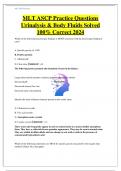
MLT ASCP Practice Questions Urinalysis & Body Fluids Solved 100% Correct 2024
MLT ASCP Practice Questions Urinalysis & Body Fluids Solved 100% Correct 2024 Which of the following macroscopic findings is MOST consistent with the microscopic finding of casts? A. Specific gravity of 1.005 B. Positive protein C. Alkaline pH D. Clear urine [Answer: - B; The following factors promote the formation of casts in the kidney: Larger than normal amounts of plasma proteins entering the tubules Decreased pH Decreased urinary flow rate Increased urine concentration Identify the urine sediment elements present in this acidic urine: A. Cholesterol crystals B. Uric acid crystals C. Amorphous urate crystals D. Cystine crystals [Answer: - C; These urate salts frequently appear in acid or neutral urine in a noncrystalline amorphous form. They have a yellowish-brown granular appearance. They may be seen in normal urine. They are soluble in dilute alkali, and can change to uric acid crystals in the presence of concentrated hydrochloric acid. Which of the following statements are TRUE for specific gravity measured by the reagent strip method? (Select ALL that apply) A. The reagent strip method is based on the relationship between ionic concentration and specific gravity. B. The reagent strip method is based on the fact that light is refracted in proportion to the amount of total solids dissolved in the urine. C. The reagent strip method is not affected by the presence of x-ray contrast media in the urine specimen. D. An alkaline pH would not affect the specific gravity result using a reagent strip method. [Answer: - A & C; There are two correct statements listed in the answer choices which accurately describe specific gravity measurements by the reagent strip method. These statements are: The reagent strip method is based on the relationship between ionic concentration and specific gravity. AND The reagent strip method is not affected by the presence of x-ray contrast media in the urine specimen. A positive leukocyte esterase test indicates the presence in a urine specimen of which of the following? A. Lymphocytes B. Granulocytes C. Erythrocytes D. All of the above [Answer: - B; Leukocyte esterase is an enzyme present in most granulocytic white blood cells (WBCs). When the number of granulocytes in the urine increases significantly (more than 0-2 per field), this screening test pad will become positive on the chemical reagent strip.
Document information
- Uploaded on
- March 4, 2024
- Number of pages
- 25
- Written in
- 2023/2024
- Type
- Exam (elaborations)
- Contains
- Questions & answers


