CDRE - EXAM STUDY QUESTIONS WITH 100% CORRECT ANSWERS
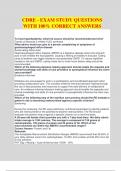
CDRE - EXAM STUDY QUESTIONS WITH 100% CORRECT ANSWERS To treat hyperlipidemia, which fat source should be recommended and why? Canola oil because it inhibits VLDL synthesis What advice would you give to a person complaining of symptoms of gastroesophageal reflux disease Avoid eating before bed Gastroesophageal reflux disease (GERD) is a digestive disease where the stomach acid or bile irritates the food pipeline, causing a feeling of heartburn and pain. Eating close to bedtime can trigger heartburn and potentially GERD. To reduce nighttime heartburn risk and GERD, eating meals two to three hours before sleep should be recommended. Which of the following decision-making approach should enable the separate and shared knowledge and skills of care providers to synergistical influence the client care provided? Evidence-informed Dietitians are encouraged to work in a participatory and coordinated approach when providing collaborative care. This includes evidence-informed decision-making through the use of best practices and resources to support the safe delivery of collaborative care. An evidence-informed decision-making approach should enable the separate and shared knowledge and skills of care providers to synergistically influence the client care provided. Which of the following step of the nutrition care process should the RD evaluate a patient's risk to becoming malnourished against a specific criterion? Screening During the screening, the RD uses preliminary nutritional parameters to identify patients who are malnourished or the potential to become malnourished. The RD should evaluate the patient's status against a specific criterion on a one-time basis. A 28-year-old female client provides you with a 7-day food diary. Her daily caloric intake average is 1534 calories. The average is composed of 155 grams of carbohydrates, 120 grams of protein and 52 grams of fat. Which of her macronutrients are within the AMDR's recommended ranges? Correct Answer: Protein and Fat Rationale The Acceptable Macronutrient Distribution Ranges (AMDR) recommend that 45-65% of your daily calories come from carbohydrates, 10-35% from protein and 20-35% from fat. In this scenario: FAT 52g x 9kcal/g = kcals divide by total (1534) - 30% PROTEIN 120g x 4kcal/g = kcal divide by total - 31% CARBS 155 g x 4kcal/g = kcal divide by total - 40% A RD is working with a 3-year-old female patient with Cystic Fibrosis (CF). During her consultation, you notice that your patient's hair is dry, dull and lacks shine. What is the possible nutritional-related cause of this? EFA deficiency Essential fatty acid deficiency (EFAD) is a sign of protein-energy deficiency. EFAD has been known to occur in CF patients. This deficiency is evident if the patient's hair is dry, dull, lacks shine and can be easily plucked. Julia, a 19-year-old girl who has a BMI of 15.5 and is very active. She is referred to the dietitian because she refuses to consume milk products believing they cause weight gain. Correct Answer: Determine why she is concerned about weight gain Rationale Before making any recommendations about food intake, the dietitian needs to understand the client’s beliefs about weight gain. Julia opens up with the Dietitian about her eating habits and her active life as a gymnast. She expresses a fear of gaining weight and decided to significantly decrease her caloric intake in the days leading up to competition. What eating disorder is Julia most likely experiencing? Anorexia Nervosa What is not related to anorexia nervosa? Anorexic patients may have episodes of binge eating, followed by purging Julia returns two weeks later and tells the dietitian she is currently restricting her diet to 850 calories per day. She also mentions she feeling weak and dizzy today. Which of the following actions should the RD take? Obtain the client's consent to contact the physician The statement "All food service employees must wash their hands before returning to work" is an example of a: Policy A registered dietitian should remove dietary restrictions for which of following patient's diet? Patient's food intake is less than 50% for 72 hours and complains of poor appetite For patients with a poor appetite, overly restrictive diets may limit food choices or provide unfamiliar/unpalatable food items. These practices may result in inadequate food and nutrient intake. By removing dietary restrictions, the patient may eat more food as a result of increase food selections. A registered dietitian that asked himself "will this action compromise my objectivity?". Which type of conflict of interest test is this RD demonstrating? Situational Judgment Test Situational judgement tests tend to determine behavioural tendencies, assessing how a RD will behave in a certain situation, and knowledge potential actions, which evaluates the effectiveness of possible responses. This technology improves safety and extends the shelf life of foods by reducing or eliminating microorganisms and insects by using ionizing radiation to food: Food irradiation When baking at high altitudes, atmospheric pressure is reduced and there are necessary adjustments that need to be made to correct for this. What needs to be adjusted when baking at high altitudes? Decrease baking powder and increase liquid There is an inverse relationship between altitude and pressure (high altitude, low pressure vs. low altitude, high pressure). Cooking in these environmentals requires alterations. Boiling point at high altitudes is decreased and cooking time is decreased, hence, food takes longer to cook. The goal of nutritional education includes enhancing one's knowledge of creating positive attitudes about healthy eating, importance of food, and other lifestyle factors that can prevent common nutrition-related problems. This type of education is most appropriate for which age group? Adolescents During a nutrition-focused physical exam on a 80-year-old male patient, a registered dietitian (RD) closely examines the patient's eyes. The RD notices the patient's eyes are pale and has mucous membranes. Vitamin B-12, folate, iron A patient's lab values show low hemoglobin, high MCV and decreased RBC. Based on these lab values, what can be identified? Correct Answer: The patient has macrocytic anemia Rationale Macrocytic anemia is a type of anemia that causes unusually large red blood cells, low hemoglobin, low hematocrit, high corpuscular hemoglobin (MCH), high corpuscular volume (MCV), decreased RBC, and normal MCHC. What is microcytic anemia? Microcytic anemia is defined as the presence of small, often hypochromic, red blood cells in a peripheral blood smear and is usually characterized by a low MCV (less than 83 micron 3). Iron deficiency is the most common cause of microcytic anemia. When does a patient's discharge plan begin? Correct Answer: On day 1 Rationale Discharge plans begins on day 1 of the patient's hospital stay. A discharge note includes a summary of nutrition therapies and desired outcomes. A(n) _________ shop is a place of work where employees are not required to join the union but all workers (union or nonunion) must pay a fee. Correct Answer: Agency Rationale An agency shop is a form of union security agreement where the employer may hire union or non-union workers. Employees do not need join the union in order to remain employed, however, the non-union worker
Written for
- Institution
- CDRE
- Course
- CDRE
Document information
- Uploaded on
- February 29, 2024
- Number of pages
- 24
- Written in
- 2023/2024
- Type
- Exam (elaborations)
- Contains
- Questions & answers
Subjects
-
cdre exam study questions with 100 correct answ

Also available in package deal