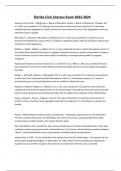
Florida Civic Literacy Exam
Florida Civic Literacy Exam Supreme Court Cases - ANS-Brown v. Board of Education- Brown v. Board of Education of Topeka, 347 U.S. 483, was a landmark U.S. Supreme Court decision in which the Court ruled that U.S. state laws establishing racial segregation in public schools are unconstitutional, even if the segregated schools are otherwise equal in quality McCullouch v. Maryland- McCulloch v. Maryland, 17 U.S. 316, was a landmark U.S. Supreme Court decision that defined the scope of the U.S. Congress's legislative power and how it relates to the powers of American state legislatures. Gibbons v. Ogden- Gibbons v. Ogden, 22 U.S. 1, was a landmark decision in which the Supreme Court of the United States held that the power to regulate interstate commerce, which was granted to Congress by the Commerce Clause of the United States Constitution, encompassed the power to regulate navigation. Hazelwood- Hazelwood School District et al. v. Kuhlmeier et al., 484 U.S. 260, was a landmark decision by the Supreme Court of the United States that held that public school curricular student newspapers that have . Gideon v. Wainright- Gideon v. Wainwright, 372 U.S. 335, was a landmark U.S. Supreme Court decision in which the Court ruled that the Sixth Amendment of the U.S. Constitution requires U.S. states to provide attorneys to criminal defendants who are unable to afford their own. Marbury v Madison- Marbury v. Madison, 5 U.S. 137, was a landmark U.S. Supreme Court case that established the principle of judicial review in the United States, meaning that American courts have the power to strike down laws and statutes that they find to violate the Constitution of the United States Plessy v Ferguson- Plessy v. Ferguson, 163 U.S. 537, was a landmark U.S. Supreme Court decision in which the Court ruled that racial segregation laws did not violate the U.S. Constitution as long as the facilitie History - ANS-Northwest Ordinance (pre-Constitution) - established a government for the Northwest Territory, outlined the process for admitting a new state to the Union, and guaranteed that newly created states would be equal to the original thirteen states Alien and Sedition Acts- passed four laws, known collectively as the Alien and Sedition Acts. These laws raised the residency requirements for citizenship from 5 to 14 years, authorized the president to deport "aliens," and permitted their arrest, imprisonment, and deportation during wartime Judiciary Act of 1789- "An Act to Establish the Judicial Courts of the United States," was signed into law by President George Washington on September 24, 1789. Article III of the Constitution established a Supreme Court, but left to Congress the authority to create lower federal courts as needed.
Document information
- Uploaded on
- February 28, 2024
- Number of pages
- 3
- Written in
- 2023/2024
- Type
- Exam (elaborations)
- Contains
- Questions & answers