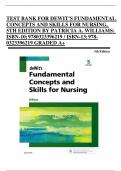
Test Bank For Dewit's Fundamental Concepts And Skills For Nursing, 5Th Edition By Patricia A. Williams: Isbn-10; 9780323396219 / Isbn-13; 9780323396219 Graded A+
TEST BANK FOR DEWIT'S FUNDAMENTAL CONCEPTS AND SKILLS FOR NURSING, 5TH EDITION BY PATRICIA A. WILLIAMS: ISBN-10; 9780323396219 / ISBN-13; 9780323396219 GRADED A+ 5th Edition Table of Contents Chapter 01 Nursing and the Health Care System 2 Chapter 02 Concepts of Health, Illness, Stress, and Health Promotion 13 Chapter 03 Legal and Ethical Aspects of Nursing 24 Chapter 04 The Nursing Process and Critical Thinking 38 Chapter 05 Assessment, Nursing Diagnosis, and Planning 46 Chapter 06 Implementation and Evaluation 56 Chapter 07 Documentation of Nursing Care 64 Chapter 08 Communication and the Nurse-Patient Relationship 74 Chapter 09 Patient Education and Health Promotion 95 Chapter 10 Delegation, Leadership, and Management 106 Chapter 11 Growth and Development Infancy Through Adolescence 120 Chapter 12 Adulthood and the Family 143 Chapter 13 Promoting Healthy Adaptation to Aging 155 Chapter 14 Cultural and Spiritual Aspects of Patient Care 166 Chapter 15 Loss, Grief, and End-of-Life Care 181 Chapter 16 Infection Prevention and Control Protective Mechanisms and Asepsis 193 Chapter 17 Infection Prevention and Control in the Hospital and Home 207 Chapter 18 Safe Lifting, Moving, and Positioning of Patients 220 Chapter 19 Assisting with Hygiene, Personal Care, Skin Care, and the Prevention of Pressure Ulcers 230 Chapter 20 Patient Environment and Safety 243 Chapter 21 Measuring Vital Signs 253 Chapter 22 Assessing Health Status 264 Chapter 23 Admitting, Transferring, and Discharging Patients 276 Chapter 24 Diagnostic Tests and Specimen Collection 286 Chapter 25 Fluid, Electrolyte, and Acid-Base Balance 297 Chapter 26 Concepts of Basic Nutrition and Cultural Considerations 307 Chapter 27 Nutritional Therapy and Assisted Feeding 318 Chapter 28 Assisting with Respiration and Oxygen Delivery 329 Chapter 29 Promoting Urinary Elimination 339 Chapter 30 Promoting Bowel Elimination 349 Chapter 31 Pain, Comfort, and Sleep 360 Chapter 32 Complementary and Alternative Therapies 371 Chapter 33 Pharmacology and Preparation for Drug Administration 382 Chapter 34 Administering Oral, Topical, and Inhalant Medications 392 Chapter 35 Administering Intradermal, Subcutaneous, and Intramuscular Injections 402 Chapter 36 Administering Intravenous Solutions and Medications 412 Chapter 37 Care of the Surgical Patient 422 Chapter 38 Providing Wound Care and Treating Pressure Ulcers 431 Chapter 39 Promoting Musculoskeletal Function 441 Chapter 40 Common Physical Care Problems of the Older Adult 450 Chapter 41 Common Psychosocial Care Problems of Older Adults 459 1 | P a g e Chapter 01: Nursing and the Health Care System Williams: deWit's Fundamental Concepts and Skills for Nursing, 5th Edition MULTIPLE CHOICE 1. Florence Nightingale‘s contributions to nursing practice and education: a. are historically important but have no validity for nursing today. b. were neither recognized nor appreciated in her own time. c. were a major factor in reducing the death rate in the Crimean War. d. were limited only to the care of severe traumatic wounds. ANS: C By improving sanitation, nutrition ventilation, and handwashing techniques, Florence Nightingale‘s nurses dramatically reduced the death rate from injuries in the Crimean War. DIF: Cognitive Level: Knowledge REF: p. 2 OBJ: Theory #1 TOP: Nursing History KEY: Nursing Process Step: N/A MSC: NCLEX: N/A 2. Early nursing education and care in the United States: a. were directed at community health. b. provided independence for women through education and employment. c. were an educational model based in institutions of higher learning. d. have continued to be entirely focused on hospital nursing. ANS: B Because of the influence of early nursing leaders, nursing education became more formalized through apprenticeships in Nightingale schools that offered independence to women through education and employment. DIF: Cognitive Level: Knowledge REF: p. 2 OBJ: Theory #4 TOP: Nursing History KEY: Nursing Process Step: N/A MSC: NCLEX: N/A 3. In order to fulfill the common goals defined by nursing theorists (promote wellness, prevent illness, facilitate coping, and restore health), the LPN must take on the roles of: a. caregiver, educator, and collaborator. b. nursing assistant, delegator, and environmental specialist. c. medication dispenser, collaborator, and transporter. d. dietitian, manager, and housekeeper. ANS: A In order for the LPN to apply the common goals of nursing, he or she must assume the roles of caregiver, educator, collaborator, manager, and advocate. DIF: Cognitive Level: Comprehension REF: p. 3 OBJ: Theory #2 TOP: Art and Science of Nursing KEY: Nursing Process Step: N/A MSC: NCLEX: N/A 4. Although nursing theories differ in their attempts to define nursing, all of them base their beliefs on common concepts concerning:
Document information
- Uploaded on
- February 21, 2024
- Number of pages
- 470
- Written in
- 2023/2024
- Type
- Exam (elaborations)
- Contains
- Questions & answers