PHOTOSYNTHESIS (energy transfer process basis of most life on earth)
Overview.
Photosynthesis is a series of reactions ( including the trapping (fixation) of carbon
dioxide and its subsequent reduction to carbohydrate, using hydrogen from
water.) in which energy transferred as light is transformed into chemical energy.
Energy from light is trapped by chlorophyll (inside chloroplasts) and Is used to :
Split apart strong bonds in H20 (photolysis) and release hydrogen. Oxygen
is waste product.
Produce ATP (chemical energy, for reduction of C02 carbohydrate in
independent R.)
Reduce NADP
1) photosynthesis as an energy transfer process.
Light energy absorbed by the chloroplast pigments in the light dependent stage of
photosynthesis is used to drive reactions of the light independent stage that
produce complex organic compounds.
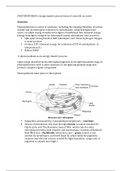
Photosynthesis takes place in chloroplasts .
Organelles surrounded by 2 phospholipid membranes = envelope.
System of membranes also runs through stroma.(contains enzymes for
Calvin cycle, and 70s ribosomes, loop of DNA- which code for some
chloroplast proteins, lipid droplets and starch grana.) Consists of flattened
fluid filled sacs, =thylakoids. which form sacs = grana. Joined to one
another by membranes.( provided large SA, which holds the pigments,
enzymes and electron carriers needed for light dependent. Large num. of
pigments so absorb more light.)
Overview.
Photosynthesis is a series of reactions ( including the trapping (fixation) of carbon
dioxide and its subsequent reduction to carbohydrate, using hydrogen from
water.) in which energy transferred as light is transformed into chemical energy.
Energy from light is trapped by chlorophyll (inside chloroplasts) and Is used to :
Split apart strong bonds in H20 (photolysis) and release hydrogen. Oxygen
is waste product.
Produce ATP (chemical energy, for reduction of C02 carbohydrate in
independent R.)
Reduce NADP
1) photosynthesis as an energy transfer process.
Light energy absorbed by the chloroplast pigments in the light dependent stage of
photosynthesis is used to drive reactions of the light independent stage that
produce complex organic compounds.
Photosynthesis takes place in chloroplasts .
Organelles surrounded by 2 phospholipid membranes = envelope.
System of membranes also runs through stroma.(contains enzymes for
Calvin cycle, and 70s ribosomes, loop of DNA- which code for some
chloroplast proteins, lipid droplets and starch grana.) Consists of flattened
fluid filled sacs, =thylakoids. which form sacs = grana. Joined to one
another by membranes.( provided large SA, which holds the pigments,
enzymes and electron carriers needed for light dependent. Large num. of
pigments so absorb more light.)