

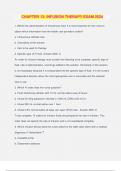
CHAPTER 13: INFUSION THERAPY EXAM 2024
CHAPTER 13: INFUSION THERAPY EXAM 2024 1. Before the administration of intravenous fluid, it is most important for the nurse to obtain which information from the health care provider's orders? a. Intravenous catheter size b. Osmolarity of the solution c. Vein to be used for therapy d. Specific type of IV fluid -Answer-ANS: D An order for infusion therapy must contain the following to be complete: specific type of fluid, rate of administration, and drugs added to the solution. Osmolarity of the solution is not necessary because it is incorporated into the specific type of fluid. It is the nurse's independent decision about the most appropriate vein to cannulate and the catheter size to use. 2. Which IV order does the nurse question? a. Flush Groshong catheter with 10 mL normal saline every 8 hours. b. Infuse 20 mEq potassium chloride in 1000 mL D5W at 50 mL/hr. c. Infuse 500 mL normal saline over 1 hour. d. Infuse 0.9% normal saline at keep vein open (KVO) rate. -Answer-ANS: D To be complete, IV orders for infusion fluids should specify the rate of infusion. This order does not specify the rate of infusion and is not considered complete. 3. Which infusion device does the nurse select for the older adult client with a medical diagnosis of "dehydration"? a. Cassette pump b. Elastomeric balloons c. Volumetric controller d. Syringe pump -Answer-ANS: A An older adult client who has dehydration will require a large fluid volume that is accurately measured by using a cassette pump during the infusion. Volumetric controllers count drops for administered volume and are inherently inaccurate because of variation in drop size. A syringe pump is accurate but not appropriate for a large volume. Elastomeric balloons are used to deliver intermittent medications. 4. A nursing administrator is concerned about the incidence of complications related to IV therapy, including bloodstream infection. Which action by the administrator would have the biggest impact on decreasing complications? a. Investigate initiating a dedicated IV team. b. Require inservice education for all RNs. c. Limit IV starts to the most experienced nurses. d. Perform quality control testing on skin preparation products. -Answer-ANS: A The Centers for Disease Control and Prevention (CDC) recommends having a dedicated IV team to reduce complications, save money, and improve client satisfaction and outcomes. In-service education would always be helpful, but it would not have the same outcomes as an IV team. Limiting IV starts to the most experienced nurses does not allow newer nurses to gain this expertise. The quality of skin preparation products is only one aspect of IV insertion that could contribute to infection. 5. The nurse wants to find written standards for IV therapy. The nursing manager suggests that the nurse investigate publications from which resource? a. IV Therapy Nursing Society b. Infusion Nurses Society c. Nurse's State Board of Nursing d. Hospital's IV solutions vendor -Answer-ANS: B The Infusion Nurses Society publishes guidelines and standards related to IV therapy and offers a national certification examination. The State Board of Nursing publishes legal information related to nursing practice, and the solutions vendor would have written information pertaining only to specific products. The IV Therapy Nursing Society does not exist, and the other organizations listed do not provide standards and guidelines related to IV therapy. 6. The RN assigned a new nurse to a client who was receiving chemotherapy through an intravenous extension set attached to a Huber needle. Which information about disconnecting the Huber needle is most important for the RN to provide to the new nurse? a. "Apply topical anesthetic cream to the area after discontinuing the system." b. "Be aware of a rebound effect when discontinuing the system." c. "Be sure to flush the system with saline after removing the Huber needle." d. "Place pressure over the site to prevent bleeding." -Answer-ANS: B Huber needles are used to access implanted ports placed under the skin. Because the dense septum holds tightly to the needle, a rebound can occur when it is pulled from the septum, often resulting in needle stick injury to the nurse. Topical anesthetic cream can be used when accessing the system. Flushing is carried out when the s
Document information
- Uploaded on
- February 13, 2024
- Number of pages
- 24
- Written in
- 2023/2024
- Type
- Exam (elaborations)
- Contains
- Questions & answers


