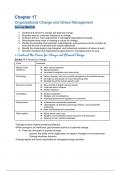
Chapter 17
Organizational Change and Stress Management
Learning Objectives
1. Contrast the forces for change and planned change.
2. Describe ways to overcome resistance to change.
3. Compare the four main approaches to managing organizational change.
4. Demonstrate three ways of creating a culture for change.
5. Identify the potential environmental, organizational, and personal sources of stress at
work and the role of individual and cultural differences.
6. Identify the physiological, psychological, and behavioral symptoms of stress at work.
7. Describe individual and organizational approaches to managing stress at work.
1. Contrast the Forces for Change and Planned Change
Exhibit 17-1 Forces for Change
Force Examples
Nature of the ➔ More cultural diversity
workforce ➔ Aging population
➔ Increased immigration and outsourcing
Technology ➔ Faster, cheaper, and more mobile computers and handheld devices
➔ Emergence and growth of social-networking sites
➔ Deciphering of the human genetic code
Economic shocks ➔ Rise and fall of global housing market
➔ Financial sector collapse
➔ Global recession
Competition ➔ Global competitors
➔ Mergers and consolidations
➔ Increased government regulation of commerce
Social trends ➔ Increased environmental awareness
➔ Liberalization of attitudes toward gay, lesbian, and transgender
employees
➔ More multitasking and connectivity
World politics ➔ Rising health care costs
➔ Negative social attitudes toward business and executives
➔ Opening of new markets worldwide
• Change involves making something different.
• When change is an intentional, goal-oriented activity it is planned change.
➔ There are two goals of planned change:
- Improve the ability of the organization to adapt to changes in its environment.
- Change employee behavior.
• Change agents are those responsible for managing change activities.
, 2. Overcoming Resistance to Change
Exhibit 17-2 Sources of Resistance to Change
Individual Sources
❖ Habit—To cope with life’s complexities, we rely on habits or programmed responses. But when
confronted with change, this tendency to respond in our accustomed ways becomes a source of
resistance.
❖ Security—People with a high need for security are likely to resist change because it threatens
their feelings of safety.
❖ Economic factors—Changes in job tasks or established work routines can arouse economic fears
if people are concerned that they won’t be able to perform the new tasks or routines to their
previous standards, especially when pay is closely tied to productivity.
❖ Selective information processing—Individuals are guilty of selectively processing information in
order to keep their perceptions intact. They hear what they want to hear, and they ignore
information that challenges the world they’ve created.
Organizational Sources
❖ Structural inertia—Organizations have built-in mechanisms—such as their selection processes
and formalized regulations—to produce stability. When an organization is confronted with change,
this structural inertia acts as a counterbalance to sustain stability.
❖ Limited focus of change—Organizations consist of a number of interdependent subsystems. One
can’t be changed without affecting the others. So limited changes in subsystems tend to be
nullified by the larger system.
❖ Group inertia—Even if individuals want to change their behavior, group norms may act as a
constraint.
❖ Threat to expertise—Changes in organizational patterns may threaten the expertise of
specialized groups.
❖ Threat to established power relationships—Any redistribution of decision-making authority can
threaten long-established power relationships within the organization.
• Overcoming Resistance to Change
- Communication
- Participation
- Building support and commitment
- Develop positive relationships
- Implementing changes fairly
- Manipulation and cooptation
- Selecting people who accept change
- Coercion
• The Politics of Change
➔ Change threatens the status quo, making it an inherently political activity.
➔ Politics suggests the impetus for change is more likely to come from:
- Outside change agents.
- Employees new to the organization who have less invested in the status quo.
- Managers slightly removed from the main power structure.
Organizational Change and Stress Management
Learning Objectives
1. Contrast the forces for change and planned change.
2. Describe ways to overcome resistance to change.
3. Compare the four main approaches to managing organizational change.
4. Demonstrate three ways of creating a culture for change.
5. Identify the potential environmental, organizational, and personal sources of stress at
work and the role of individual and cultural differences.
6. Identify the physiological, psychological, and behavioral symptoms of stress at work.
7. Describe individual and organizational approaches to managing stress at work.
1. Contrast the Forces for Change and Planned Change
Exhibit 17-1 Forces for Change
Force Examples
Nature of the ➔ More cultural diversity
workforce ➔ Aging population
➔ Increased immigration and outsourcing
Technology ➔ Faster, cheaper, and more mobile computers and handheld devices
➔ Emergence and growth of social-networking sites
➔ Deciphering of the human genetic code
Economic shocks ➔ Rise and fall of global housing market
➔ Financial sector collapse
➔ Global recession
Competition ➔ Global competitors
➔ Mergers and consolidations
➔ Increased government regulation of commerce
Social trends ➔ Increased environmental awareness
➔ Liberalization of attitudes toward gay, lesbian, and transgender
employees
➔ More multitasking and connectivity
World politics ➔ Rising health care costs
➔ Negative social attitudes toward business and executives
➔ Opening of new markets worldwide
• Change involves making something different.
• When change is an intentional, goal-oriented activity it is planned change.
➔ There are two goals of planned change:
- Improve the ability of the organization to adapt to changes in its environment.
- Change employee behavior.
• Change agents are those responsible for managing change activities.
, 2. Overcoming Resistance to Change
Exhibit 17-2 Sources of Resistance to Change
Individual Sources
❖ Habit—To cope with life’s complexities, we rely on habits or programmed responses. But when
confronted with change, this tendency to respond in our accustomed ways becomes a source of
resistance.
❖ Security—People with a high need for security are likely to resist change because it threatens
their feelings of safety.
❖ Economic factors—Changes in job tasks or established work routines can arouse economic fears
if people are concerned that they won’t be able to perform the new tasks or routines to their
previous standards, especially when pay is closely tied to productivity.
❖ Selective information processing—Individuals are guilty of selectively processing information in
order to keep their perceptions intact. They hear what they want to hear, and they ignore
information that challenges the world they’ve created.
Organizational Sources
❖ Structural inertia—Organizations have built-in mechanisms—such as their selection processes
and formalized regulations—to produce stability. When an organization is confronted with change,
this structural inertia acts as a counterbalance to sustain stability.
❖ Limited focus of change—Organizations consist of a number of interdependent subsystems. One
can’t be changed without affecting the others. So limited changes in subsystems tend to be
nullified by the larger system.
❖ Group inertia—Even if individuals want to change their behavior, group norms may act as a
constraint.
❖ Threat to expertise—Changes in organizational patterns may threaten the expertise of
specialized groups.
❖ Threat to established power relationships—Any redistribution of decision-making authority can
threaten long-established power relationships within the organization.
• Overcoming Resistance to Change
- Communication
- Participation
- Building support and commitment
- Develop positive relationships
- Implementing changes fairly
- Manipulation and cooptation
- Selecting people who accept change
- Coercion
• The Politics of Change
➔ Change threatens the status quo, making it an inherently political activity.
➔ Politics suggests the impetus for change is more likely to come from:
- Outside change agents.
- Employees new to the organization who have less invested in the status quo.
- Managers slightly removed from the main power structure.