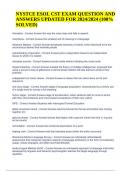
NYSTCE ESOL CST EXAM QUESTIONS AND ANSWERS LATEST (100% VERIFIED)
NYSTCE ESOL CST EXAM QUESTIONS AND ANSWERS LATEST (100% VERIFIED) morpheme - Correct Answer-the smallest unit of meaning in a language Abraham Maslow - Correct Answer-developed hierarchy of needs, which theorized to be the unconscious desires that motivate people subordinating conjunction - Correct Answer-joins a dependent clause to an independent clause to which it is related voiceless sounds - Correct Answer-sounds made without vibrating the vocal cords Howard Gardner - Correct Answer-created the theory of multiple intelligences; proposed that using a person's area of giftedness to demonstrate intellect will help learners achieve their potential independent (or main) clause - Correct Answer-a clause that can stand alone as it's own sequence one-word stage - Correct Answer-stage of language acquisition; characterized by a child's use of a single word to convey a full meaning humor stage - Correct Answer-stage of acculturation; when students start to come to terms with their circumstances and move toward acceptance of their new culture SIFE - Correct Answer-Students with Interrupted Formal Education labial consonant sound - Correct Answer-sound produced by the top and bottom lips coming together (m) gerund phrase - Correct Answer-phrase that begins with a gerund (verbs that end in -ing and act as nouns) connotation - Correct Answer-the emotional association of a word helping verb - Correct Answer-verb that indicates tense (when the action occurred) Woodcock-Muñoz Language Survey - Correct Answer-an individually administered assessment that measures cognitive aspects of language proficiency in the form of vocabulary usage, verbal analogies, and letter-word identification Audio-Lingual Method (ALM) - Correct Answer-an oral-based approach to language instruction developed by linguists and behavior psychologists; teaches the target language through repetition NYSTCE ESOL CST EXAM QUESTION AND ANSWERS UPDATED FOR 2024/2024 (100% SOLVED) phonetics - Correct Answer-the study of the production of sounds in speech silent way - Correct Answer-teaching method based on the idea that language learning should be much like problem-solving and discovery learning; teachers are as silent as possible during lessons in order to promote student participation and experimentation and to concentrate on learning over teaching dependent (or subordinate) clause - Correct Answer-a clause that cannot stand alone as its own sentence inferential item - Correct Answer-a piece of information that requires the test taker to read between the lines in order to determine what an author is implying communicative competence - Correct Answer-the ability to speak a language both appropriately in a social context as well as correctly in terms of rules and structure two-word stage - Correct Answer-stage of language acquisition; children begin to learn words and use word combinations early stage of literacy development - Correct Answer-characterized by the learner's use of multiple strategies to predict and understand words intermediate fluency - Correct Answer-fourth stage of second-language acquisition; learners have acquired a vocabulary of about 6,000 words and are able to speak in more complex sentences and correct many of their own errors free morpheme - Correct Answer-a morpheme that can stand on its own literal item - Correct Answer-information that refers directly back to the content of the reading material where the answer is defined word by word monitor hypothesis - Correct Answer-knowledge that is gained through formal learning that can be used to monitor speech but is not useful in spontaneous speech validity - Correct Answer-indicated how well an assessment measures what it is intended to measure; a test is not considered valid if it is not reliable scaffold - Correct Answer-the support that allows a child to work above their independent level and is gradually removed as the learner gains mastery positive behavioral support - Correct Answer-a social learning approach that assumes all persistent behavior choices are logical, so a persistent misbehavior must serve some purpose Cognitive Academic Language Proficiency (CALP) - Correct Answer-language needed for academic work and study natural order hypothesis - Correct Answer-one of the five hypotheses of the monitor model; posits that language is attained in a foreseeable pattern by all learners classic conditioning - Correct Answer-learning a response to stimuli or the environment assimilation - Correct Answer-when a speech sound changes due to the influence of nearby sounds passive voice - Correct Answer-a sentence construction in which the subject of the sentence is receiving the action of the main verb
Document information
- Uploaded on
- February 12, 2024
- Number of pages
- 30
- Written in
- 2023/2024
- Type
- Exam (elaborations)
- Contains
- Questions & answers