Keeping up standards: Learning aim B: Undertake calorimetry to study cooling curves
Introduction
Calorimetry is measuring the change in heat associated with a reaction. This would measure
the amount of heat that is absorbed or released, leading to a determination in identifying if
the reaction is exothermic or endothermic.
Exothermic reactions release heat to the surroundings whereas endothermic reactions
aboard heat from surroundings.
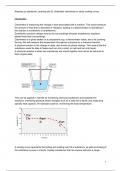
Calorimeter is a glass beaker or a polystyrene cup, a thermometer inside, and a lid covering
the top, this will measure the temperature throughout a physical or a chemical reaction.
A physical reaction is the change in state, also known as phase change. This means that the
substance would be able to freeze and turn into a solid, or melt and turn into liquid.
A chemical reaction is when two substances are mixed together and cannot be returned to
their original state.
This can be applied in real life by monitoring chemical exothermic and endothermic
reactions, monitoring physical phase changes such as a solid into a liquid, and measuring
specific heat capacity. An example could be, monitoring the body temperature.
Par
tA Part
B Part
C
A cooling curve represents the boiling and melting point of a substance, as well as showing if
the substance is pure or impure. Usually substances that are impure will have a range.
1
, Keeping up standards: Learning aim B: Undertake calorimetry to study cooling curves
Cooling curves are also used for exothermic reactions. A cooling curve diagram has three
sections.
Part A, contains the highest temperature difference between the environment and the
substance. This is also where conduction happens at the fastest rate, this is due to the
increase in kinetic energy, therefore making the particles vibrate and transfer energy to
neighbouring particles. Radiation also takes place as the particles do not need to necessarily
touch in order to transfer energy.
Part B, is plateau as bonds are being made, therefore there is a constant equilibrium
between the energy lost and energy released. An exothermic reaction is taking place here,
however it is chemically happening and not physically.
Part C, is where the temperature begins to decrease but at a slow rate. This is due to the
fact that the substance is approaching the same temperature as the environment, therefore it
will cool down slower. Condition still takes place, however not as much as in Part A, this is
due to there being less kinetic energy therefore the particles are not vibrating as much.
Radiation also takes place as the energy is being released without the need of particles to
vibrate and transfer energy, however it is happening at a slower rate, due to the temperature
equilibrium.
The factors that can affect the rate of cooling of a substance are thermal conductivity
(W/mk),heat capacity and temperature of the environment.
Thermal conductivity is how easily the heat can be transferred to a substance. The higher
the thermal conductivity the faster the heat will be transferred, therefore the substance will
cool down at a faster rate. Conduction takes place, and this is the vibration of particles
transferring energy to the neighbouring particles. Particles have more kinetic energy at a
higher temperature, therefore the heat will transfer at a faster rate, therefore more collisions
and a higher rate of thermal conductivity.
Heat capacity is the more heat required to change the temperature of a substance, the
slower it will cool down. This links to specific heat capacity, which is the amount of energy
that is needed to change the temperature of 1kg of a substance by 1°C.
The temperature of the environment refers to the fact that if it is higher than the substance
then the cooling down of the substance will be slower.
Equipment list
- Stearic acid
- Paraffin wax
- Boiling tube
- Beaker (250cm3)
- Thermometer
- Bunsen burner
- Heatproof mat
- Tripod
- Gauze
- Clamp and Stand
- Stop watch
2
Introduction
Calorimetry is measuring the change in heat associated with a reaction. This would measure
the amount of heat that is absorbed or released, leading to a determination in identifying if
the reaction is exothermic or endothermic.
Exothermic reactions release heat to the surroundings whereas endothermic reactions
aboard heat from surroundings.
Calorimeter is a glass beaker or a polystyrene cup, a thermometer inside, and a lid covering
the top, this will measure the temperature throughout a physical or a chemical reaction.
A physical reaction is the change in state, also known as phase change. This means that the
substance would be able to freeze and turn into a solid, or melt and turn into liquid.
A chemical reaction is when two substances are mixed together and cannot be returned to
their original state.
This can be applied in real life by monitoring chemical exothermic and endothermic
reactions, monitoring physical phase changes such as a solid into a liquid, and measuring
specific heat capacity. An example could be, monitoring the body temperature.
Par
tA Part
B Part
C
A cooling curve represents the boiling and melting point of a substance, as well as showing if
the substance is pure or impure. Usually substances that are impure will have a range.
1
, Keeping up standards: Learning aim B: Undertake calorimetry to study cooling curves
Cooling curves are also used for exothermic reactions. A cooling curve diagram has three
sections.
Part A, contains the highest temperature difference between the environment and the
substance. This is also where conduction happens at the fastest rate, this is due to the
increase in kinetic energy, therefore making the particles vibrate and transfer energy to
neighbouring particles. Radiation also takes place as the particles do not need to necessarily
touch in order to transfer energy.
Part B, is plateau as bonds are being made, therefore there is a constant equilibrium
between the energy lost and energy released. An exothermic reaction is taking place here,
however it is chemically happening and not physically.
Part C, is where the temperature begins to decrease but at a slow rate. This is due to the
fact that the substance is approaching the same temperature as the environment, therefore it
will cool down slower. Condition still takes place, however not as much as in Part A, this is
due to there being less kinetic energy therefore the particles are not vibrating as much.
Radiation also takes place as the energy is being released without the need of particles to
vibrate and transfer energy, however it is happening at a slower rate, due to the temperature
equilibrium.
The factors that can affect the rate of cooling of a substance are thermal conductivity
(W/mk),heat capacity and temperature of the environment.
Thermal conductivity is how easily the heat can be transferred to a substance. The higher
the thermal conductivity the faster the heat will be transferred, therefore the substance will
cool down at a faster rate. Conduction takes place, and this is the vibration of particles
transferring energy to the neighbouring particles. Particles have more kinetic energy at a
higher temperature, therefore the heat will transfer at a faster rate, therefore more collisions
and a higher rate of thermal conductivity.
Heat capacity is the more heat required to change the temperature of a substance, the
slower it will cool down. This links to specific heat capacity, which is the amount of energy
that is needed to change the temperature of 1kg of a substance by 1°C.
The temperature of the environment refers to the fact that if it is higher than the substance
then the cooling down of the substance will be slower.
Equipment list
- Stearic acid
- Paraffin wax
- Boiling tube
- Beaker (250cm3)
- Thermometer
- Bunsen burner
- Heatproof mat
- Tripod
- Gauze
- Clamp and Stand
- Stop watch
2