

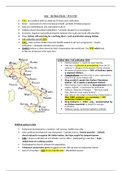
Italy – the liberal State / 1911-1918
1911, new stadium built to celebrate 50 years since unifcaaono
Rome – monument to Victor Emmanuel II built, symbolic of Italian progresso
Italy was celebraang its arts and fashion cultureo
Catholic church boycottd ctltbratoon nocialintn dtridtd it an mtaoiogltnn
Ecooomic, lioguintc aod politcal dinparity bttwtto tht nouth aod oorth ntll prtvailtd.
Many Italians stll searching for a unifying ieeal = Lack of patriotis asong Italiani
Full uoifcatoo oot tll 1870
1911 – Italy’s prime minister Giovanni Giolit worked to set out a programme = inspire
unifcaaon = alongside Catholics and socialistso
Giolitti’i failure is a key reason for Italy’s intervenaon into world war 1 by 1915 which lead
to the rise of fascism in the early 20’so
Unifiee 1861 / full unificaton 1870
Political leaders = could not build identity
Italy was a collection of principalities from the 5th
century = collapse of the western Roman empire.
No sense of being Italian → 99% of Italians spoke
a regional dialect.
Campanilismo was the pride in your region/place
of birth that many Italians felt.
King couldn’t speak the Italian Florentine
dialect / VE II spoke a piedmont dialect.
Many Italians had a desire for Risorgimento which
means ‘rebirth’ = the desire for unifcation.
Politican, Massimo D’Azeglio ~ “We have made
Italy. Now we must make Italians”
Italy was on the verge of becoming a failed state =
May 1898, protests over economy = 100
protestors killed in Milan
King Umberto I – 1900 – July – assassinated by
an Italian anarchist = sought to avenge
protestors
Political / social / economic system in turmoil
Politcal systea in Italy
Parliament dominated by a northern, self-serving, middle class eliteo
Italy’s poliacal development was dampened = Catholic church / Rosan queiton - Catholic
church refuied to recogniie the Italian natonn the Pope iought hii tesporal power.
1886 = Pope Leo XIII did not let Catholics run for ofce / paracipaang in elecaon = Pope
robbed Italy of a unifying iysbol.
Challenging the church: alienate the populaaono
A Natonal conseraatae party struggled to form: did not want to uodtrmiot churcho
Lack of a franchise = 25% of men had the vote = dissaasfed masseso
1911, new stadium built to celebrate 50 years since unifcaaono
Rome – monument to Victor Emmanuel II built, symbolic of Italian progresso
Italy was celebraang its arts and fashion cultureo
Catholic church boycottd ctltbratoon nocialintn dtridtd it an mtaoiogltnn
Ecooomic, lioguintc aod politcal dinparity bttwtto tht nouth aod oorth ntll prtvailtd.
Many Italians stll searching for a unifying ieeal = Lack of patriotis asong Italiani
Full uoifcatoo oot tll 1870
1911 – Italy’s prime minister Giovanni Giolit worked to set out a programme = inspire
unifcaaon = alongside Catholics and socialistso
Giolitti’i failure is a key reason for Italy’s intervenaon into world war 1 by 1915 which lead
to the rise of fascism in the early 20’so
Unifiee 1861 / full unificaton 1870
Political leaders = could not build identity
Italy was a collection of principalities from the 5th
century = collapse of the western Roman empire.
No sense of being Italian → 99% of Italians spoke
a regional dialect.
Campanilismo was the pride in your region/place
of birth that many Italians felt.
King couldn’t speak the Italian Florentine
dialect / VE II spoke a piedmont dialect.
Many Italians had a desire for Risorgimento which
means ‘rebirth’ = the desire for unifcation.
Politican, Massimo D’Azeglio ~ “We have made
Italy. Now we must make Italians”
Italy was on the verge of becoming a failed state =
May 1898, protests over economy = 100
protestors killed in Milan
King Umberto I – 1900 – July – assassinated by
an Italian anarchist = sought to avenge
protestors
Political / social / economic system in turmoil
Politcal systea in Italy
Parliament dominated by a northern, self-serving, middle class eliteo
Italy’s poliacal development was dampened = Catholic church / Rosan queiton - Catholic
church refuied to recogniie the Italian natonn the Pope iought hii tesporal power.
1886 = Pope Leo XIII did not let Catholics run for ofce / paracipaang in elecaon = Pope
robbed Italy of a unifying iysbol.
Challenging the church: alienate the populaaono
A Natonal conseraatae party struggled to form: did not want to uodtrmiot churcho
Lack of a franchise = 25% of men had the vote = dissaasfed masseso


