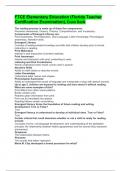
FTCE Elementary Education (Florida Teacher Certification Examination), Exam Bank
FTCE Elementary Education (Florida Teacher Certification Examination), Exam Bank The reading process is made up of these five components: Phonemic Awareness, Fluency, Phonics, Comprehension, and Vocabulary. Components of Emergent Literacy are: Print Awareness, Print Motivation, Oral Language, Letter Knowledge, Phonological awareness, Narrative skills. Emergent Literacy Consists of reading-related knowldge and skills that children develop prior to formal instruction in reading. Print Motivation Interest in and enjoyment of printed materials. Print Awareness Interest and interaction with print; pretending to read. Listening and Oral Vocabularies Words understood when heard; words used in speech. Narrative Skills Ability to retell stories or describe events. Letter Knowledge Understand letter names and shapes. Phonological Awareness Ability to understand the sound of language and manipulate or play with speech sounds. Up to age 5, children are exposed to reading and learn about it without reading. What are some examples of this? Print differs from other visual patterns. Books contain print. Readers glean information from print. Print can be translated into speech. Reading follows certain conventions. Emergent literacy forms the foundation of future reading and writing development. True or False? True Emergent literacy is understood to develop at individual rates. True or False? True Certain criteria that could determine whether or not a child is ready for reading include: Concepts of print, oral language development, and understanding of the alphabetic principle; the relationship between letters (graphemes) and the sounds they represent (phonemes) Grapheme The relationship between letters. Phoneme The sounds that letters represent. Marie M. Clay developed a formal procedure for what? For observing a child's behavior with bookjs to determine the extent of a child's print-related concepts. Marie M. Clay's formal procedures include assessment checks such as? If the child can: Find the title of a book, show where to start reading and locate the last page or end of the book. A critical pre-reading skill is being able to indicate the directionality of what? Print Readers in the U.S. must start where on the page and read to where? The left side of the page and read to the right. How can teachers or parents model directionality in reading? By passing their hands or fingers under the words or sentences as they read aloud. What four dimensions does language have? Speaking, listening, reading, and writing Oral language is the subset of what? Language Oral language has two dimensions, which are: Speaking and listening Listening is the precursor to what? Speaking Children have to _____________ language before they can speak it. Hear Why is oral language important? It provides the mental framework for what words mean and how language works. 1 Oral language starts where? At home What did Hart and Risley investigate in the way of socio/econmic status level? The number and kind of words children heard in terms of their SES. What are the components of oral language? Phonological awareness, semantic understanding, syntactic understanding, and pragmatics. Phonological Awareness A broad understanding of the sound of language and occurs as children begin to hear speech sounds and play with them. Semantic Understanding Understanding the morphology or meanings of words: vocabulary. Syntactic Understanding Understanding the rules for using words in sentences: grammar. Pragmatics Understanding the social and cultural use of langauge. Phonological awareness sub-skills include: Children should be able to distinguish between spoken language from other environmental sounds and focusing on the structure of syllables in words and onset/rime tasks. What happens next when children increase their phonological awareness? They begin to develop their phonemic awareness. How is a phoneme represented? As a letter within slashes (i.e. /b/) Phonemic Isolation Recognition of individual sounds. (What is the first sound in top?) Phonemic Identification Recognition of the same sounds. (What sound is the same in these words? top, ten, tall) Phonemic Categorization Recognition of similar sounds and choosing the different sound. (Which word doesn't beleong? dip, dime, sun) Phonemic Addition / Subtraction Making a new word by adding or subtracting a phoneme. (What word is "stop" without /s/? What word do you get if you add /s/ to the beginning of "top"?) Phonemic Blending Combining phonemes into a word. (What word is /c/ /a/ /t/? ) Phonemic Segmentation Breaking words into separte phonems. (how many sounds are in stop?) Phonemic Substitution Replacing one phoneme with another to make a new word. (What word is formed if the /t/ in tap is replaced with /m/?) When children understand how oral language works, what do they begin to connect? They begin to connect that knowledge to print. Shared reading can help children gain what? It can help children gain an understanding that printed words represent speech. Alphabet knowledge involves understanding what? The relationship between letters and sounds. Alphabetic Principle The understanding that written words are composed of letters and that groups of letters represenet the sounds of spoken words. How many phonemes are in the English Language? 44 The English alphabet has how many letters? 26 There is an exact one-to-one correspondence between letters and sounds. True or False? False. Alphabet knowledge is a precursor to what? Decoding. Decoding is the application of the alphabetic principle to correctly say or read written words with understanding. True or False? True Phonics Application of the alphabetical principle; using letter/sounds relationships. Analogical Word Reasoning Use of words with the same onset of rime as examples. Syllabication Breaking words into syllables. Morphemic Awareness Dividing words into units of meaning. Ease of decoding contripbutes to comprehension. True or False? True. Motivation is defined as? Enthusiasm or the reason for behavior. Motivation in emergent literacy is demonstrated when? Children show interest in print materials and enjoy them. Motivators for emergent literacy include: Family or other adults, a sense of community and rewards. Books read aloud to young children are more likely to be what? Fictional narrrative stories rather than nonfiction informational text. Knowledge of narrative story structure includes what? Understanding that a story has a beginning and an end, setting, plot, chartactetrs, theme, and style. Understanding text structures provide a framework for what? Comprehension. Children begin to see that they can express their own ideas by writing letters once they make a connection between what? Letters and reading. Children need to gain hand-eye coordination to begin to what? Write, usually in crude letter formaitons. Children learn to copy words to prepare for what? For copying patterned sentences. What are the correct components of emerging literacy? Print motivation, print awareness, listening and oral vocabularies, narrative skills, letter knowledge, phonological awareness. Mrs. Jackson's second grade class is working on the following skills: accuracy, automaticcity, rate, and procsody. What aspect of language arts are they learning? Fluency Which type and example of figurative langauge are correctly matched? (A)Alliteration: BRRRR! It's cold. (B)Onomatopoeia: The sun smiled on the sleepy village. (C)Similie: She was like a bull in a china shop. (D)Personification: He was the pciture of health. (C) Simile: She was like a bull in a china shop. Lucy selected a book to read. The book uses animals as characters and ends with a moral. What type of book did Lucy read? Fable Caroline's teacher told her that she needed to work on the convensions of writing. What does her teacher want her to do? Improve spelling, grammar or punctuation. First-grade student Luis wrote the following sentence: He runned up the hill. The use of the word runned is an error of _______________? Syntax Mr. Thompson is using a formative assessment with his 3rd-grade class. What is Mr. Thompson most likely to be using? A feedback prompt. Mr. Stelly is using a tool to grade his students' writing assignments. The tool provides a way to grade or schore writing according to the objectives of the assignment. Mr. Stelly is most likely using a(n) ______________________. Rubric Ms. Carson wants to provide her sixth grade language arts students with a listening guide. What would be her best choice? SLANT (sit, lean, ask, nod, and track) What is an example of a primary source? A diary entry from 1792. Mr. Carson is planning a unit on the U.S. Constitution. He has analyzed the content in terms of quantitative features, qualitative features, and matching reader to text. This analysis focuses on complex informational text. Ms. Lopez is teaching American history from World War II. She invites Mrs. Brandt to come talk to the class about her experiences as a WAVE in the Navy during the war. Use of Mrs. Brandt exemplifies a human resource. The era when machines began to displace human and animal power in the production and distrbution of goods is knownw as the Industrial Revolution In which country did Anne Frank lie and write her story, later known as "The Diary of Anne Frank"? Netherlands Ms. Brown is looking for some materials for her geography class. She finds several types of something to use. The types are conic, cylindrical, interrupted, and plane. What is Ms. Brown examining? Map projections What legal decision laid the groundwork for school desegregation? Brown v. Board of Education of Topeka Mr. Jackson's class is learning about different kinds of goernment. Today they are learning about a weak central government that delegates principal authority to smaller units such as states. What is the focus of the lesson? Confederation Government Who was the first woman to serve on the Supreme Court? Sandra Day O'Conner a country's economy slowed and then continued with increased unemployment. This exemplifies recession. What best describes the study of economic issues specific to a household, firm, or industry? Macroeconomics Which of the following best exemplifies research-based teaching strategies in science? (A) Mr. Smith has divided his third-grade class into groups. Each group has been given an egg and some simple building materials. Each group needs to research, create, and test structures to protect the egg to see which egg can survive the greatest drop. After completing all the drops, students will explain which structure worked best and why. (B) Ms. Van Allen's fifth-grade class is going on a field trip to the local zoo. Each student is told to sketch one animal while she or he is at the zoo. In addition, each student should write a three-page research report describing the animal. (C) Ms. Toll's second-grade class is learning about magnets. Ms. Toll has found three books about magnets. She has assigned groups of students to read one of the books about magnets based on their reading levels. After the students read the books, they will take a test on what they learned. (D) Ms. Camp has examined the Florida Standards for siccenc and si creating a lesson on the Sun for her third-grade class based on teh follwoing standard: S.3.E.5.2 Identify the Sun as a star that emits energy; some of it in the form of light. Ms. Camp will show the class a 3-minute video avout the Sun and then let them draw a picture of the Sun. (A) Mr. Smith has divided his third-grade class into groups. Each group has been given an egg and some simple building materials. Each group needs to research, create, and test structures to protect the egg to see which egg can survive the greatest drop. After completing all the drops, students will explain which structure worked best and why. Ms. Colson is reviewing policies for safety in teaching her students fifth-grade science. Which policy needs to be changed? (A) Replace glass beakers with polyethylene containers. (B) Replace mercury thermometers with alcohol thermometers. (C) Include the use of human cells for microscopic observation. (D) Prevent students from tasting mineral samples. Include the use of human cells for microscopic observation. Mr. Light's fifth-grade class is doing an experiment with plant growth. he divided students into groups. Each group got two daisy seeds from the same package of seeds. The groups all had the same kind of soil and planted them at the same time on the same day. The plants were in the same classroom. each plant got the same amount of liquids each day. However, each plant got a different type of liquid. The students measured the plants each week for six weeks. What was the independent variable? The type of liquid. Mr. Hirumi is using a STEM-based approach with his third-grade class. What would you expect to see students doing in his classroom? Researching and identifying. Which physical science property term is correctly defined? (A) Mass is defined as the space occupied by an object. (B) Weight is defined as how much there is of an object. (C) Density is defined as the ratio of mass to volume. (D) Viscosity is defined as a measure of density. Density is defined as the ratio of mass to volume. Which phase of change of matter is incorrectly matched to its definition? (A) Sublimation occurs when a solid changes to gas through addition of heat. (B) Melting occurs when a gas changes to liquid through subtraction of heat. (C) Evaporation occurs when a liquid becomes a gas through addition of heat. (D) Freezing occurs when a liquid changes to a solid through subtraction of heat. Melting occurs when a gas changes to liquid through subtraction of heat. Mr. Plante is showing his students a readout from a seismograph, which is used to measure earthquakes. Ms. Linden is describing the cryosphere of the Earth. What informaition should Ms. Linden include in her lesson? Why glaciers and polar icecaps are important. Ms. Caprio's class is learning about the integumentary system. What does Ms. Caprio most likely teach? Biology. What is an example of an autotroph? An apple tree. Ms. Ramirez shows a student the a picture of five suns scattered and asks, "Without counting, what do you think is the best answer for the number of items? Two, Five, or Ten?" What is the focus of the question? Subitizing Mr. Hilton will be using Cuisenaire rods with his class today. The content of the lesson is most likely to be basic mathematical operations. Which of the following key phrases is correctly matched with the operation it signals? (A) decreased by; division (B) decreased by a factor of; subtraction (C) how many to each; addition (D) product; division decreased by a factor of; subtraction In terms of number theory concepts and properties, which of the following is true? (A) The multiplicative identity property of 0 and the additive identity property of 1 are key properties of whole numbers. (B) A number is divisible by 6 if it is divisible by both 2 and 3. (C) The only factors of a composite number are the number itself and 1. (D) The factors of any whole number are the results of multiplying that whole number by the counting numbers. A number is divisible by 6 if it is divisible by both 2 and 3. Mr. Foret has written the following on the board: 3.6 x 10^5. Mr. Foret's lesson is most likely on the subject of scientific notation What is true of systems and units of measurement? Capacity is another name for volume. What is true of measures of central tendency? To determine the range, subtract the smallest number in the set from the highest number. A team of 3 students is working on a science project. They need to compare the distrance from the sun to the earth and the heart to the moon in metric units. What unit would be best for them to use? Kilometer What is true of ordered pairs in the four quadrants fo a rectangular coordinate system? The center of he coordinate plate is called the origin. M RQ 9 Which of the following statements are true regarding the ability to interpret tables, graphs, equations, and verbal descriptions of real world situations? I. A bar graph is used to rack one or more subjects, usually over time. II. Aline graph depicts percentages of a particular subject. III. All of the slices within a circle graph show the totality of a quantity. IV. A table organizes large amounts of information. All of the slices within a circle graph show the totality of a quantity. A table organizes large amounts of information. M RQ 10 Mrs. Hilton is teaching her fifth-grade class a strategy for listening. Which of the following is she teaching? A. SQ3R B. SLANT C. i before e, except after c D. Please Excuse My Dear Aunt Sally B. SLANT SLANT is an acronym for "Sit up, Lean forward, Ask Questions, Nod yes and no, and Talk with Teachers." It is a strategy used for improving listening skills. Mr. Sangalli is preparing a lesson for his class using a word processing program and PowerPoint. This saves him time and effort. What kind of software is he using? A. productivity B. administrative C. instructional D. mobile A. productivity Productivity software allows teachers to use tools to increase efficiency and time management. Which of the following is most similar in meaning to the word "genre"? A. theme of a story B. setting of a story C. type of story D. response to story C. type of story A genre is a particular type of written work. What is the literary device used to compare things directly, without use of words such as "like" or "as"? A. simile B. metaphor C. personification D. alliteration B. metaphor A metaphor is used to compare things without using the words "like" or "as." Which of the following is a major component of syntax? A. rules for associating graphemes with phonemes B. rules for describing the meaning of individual words C. rules for determining the correct order of words in sentences D. rules for analyzing the sounds of a language C. rules for determining the correct order of words in sentences Syntax includes rules governing the correct order of words in sentences. Mary, a second grader, reads with very little expression or variability in pitch, and she often introduces pauses at inappropriate places. In what aspect of language does she most clearly need improvement? A. syntax B. semantics C. phonics D. prosody D. prosody Prosody refers to the rhythms, stress patterns, and intonations of speech. What is the purpose of activating students' prior knowledge during a reading exercise? A. Students tend to rely on what they already know rather than new information. B. Students will thereby have more shared experiences to discuss with each other. C. Students already know everything they need to know when encountering most texts. D. Students engage a text more readily when they have a personal connection to it. D. Students engage a text more readily when they have a personal connection to it. Students more readily connect with texts that reflect their own experiences. Which of the following levels is higher than the others in Bloom's Revised Taxonomy? A. understanding B. evaluating C. analyzing D. remembering B. evaluating Evaluating is the second highest level in Bloom's Revised Taxonomy. For a unit on Ancient Greece, the Social Studies and Language Arts teachers plan to collaborate. Which of the following literature would be most suitable for the unit? A. translated poetry by Greek authors B. biographies of famous Greeks C. timelines of Greek history D. maps of ancient Greece B. biographies of famous Greeks Timelines and maps should be eliminated because they reflect dates, rather than people. While poetry may be important, biographies would be most relevant and engaging. Susan is a second-grade student learning to write a paragraph. Which of the following is not involved in this process? A. semantic knowledge B. syntactic knowledge C. large motor skills D. memory C. large motor skills Writing involves small motor skills, not large motor skills. Ms. Kingston is giving her students an assessment to determine if they are developing at the correct pace with the instruction she is currently using. What kind of assessment is Ms. Kingston using? A. screening B. diagnostic C. progress monitoring D. outcome measure C. progress monitoring Progress monitoring is used to assess students' academic progress within the current instructional environment. Mr. Perkins teaches third grade. In teaching today's reading lesson, he begins with brief direct instruction on a "teaching point." Students practice the skill and Mr. Perkins conferences with individual students to coach skills and provide feedback on practice. What strategy is Mr. Perkins using? A. reading workshop B. reading centers C. immediate intensive intervention D. project-based learning A. reading workshop Reading workshops involve a "teaching point," practice, and conferencing with students. Which of the following assessments gives the best review of the needs of a student? A. screenings B. evaluations C. diagnostic evaluation D. progress monitoring D. progress monitoring Progress monitoring is used to assess student's academic performance and evaluate the effectiveness of instruction. Automaticity is most related to A. graphemes B. phonics C. fluency D. alphabetic principle
Document information
- Uploaded on
- February 8, 2024
- Number of pages
- 96
- Written in
- 2023/2024
- Type
- Exam (elaborations)
- Contains
- Questions & answers