Nursing Module 1 Exam
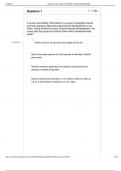
A nurse is providing information to a group of pregnant clients and their partners about the psychosocial development of an infant. Using Erikson’s theory of psychosocial development, the nurse tells the group that infants have which developmental need? Correct! Need to rely on the fact that their needs will be met Must have needs ignored for short periods to develop a healthy personality Need to tolerate a great deal of frustration and discomfort to develop a healthy personality Need to experience frustration, so it is best to allow an infant to cry for a while before meeting his or her needs Rationale: According to Erikson’s theory of psychosocial development, infants struggle to establish a sense of basic trust rather than a sense of basic mistrust in their world, their caregivers, and themselves. If provided with consistent satisfying experiences that are delivered in a timely manner, infants come to rely on the fact that their needs are met and that, in turn, they will be able to tolerate some degree of frustration and discomfort until those needs are met. This sense of confidence is an early form of trust and provides the foundation for a healthy personality. Therefore the other options are incorrect. Test-Taking Strategy: Use the process of elimination. Eliminate the option that contains the closed-ended word “must.” Eliminate the comparable or alike options and indicate that experiencing frustration is necessary. Review Erikson’s theory of psychosocial development as it relates to the infant if you had difficulty with this question. Level of Cognitive Ability: Applying Client Needs: Health Promotion and Maintenance Integrated Process: Teaching and Learning Content Area: Developmental Stages Tell the mother that the infant should be switched from breast milk to formula because the weight gain is inadequate. Rationale: Infants usually double their birth weight by 6 months and triple it by 1 year of age. If the infant is 6 lb 8 oz, at birth, a weight of 13 lb at 6 months of age is to be expected. Semisolid foods are usually introduced between 4 and 6 months of age. Test-Taking Strategy: Use the process of elimination and focus on the data in the question. Recalling that infants double their weight by 6 months of age will direct you to the correct option. Review the growth rate of an infant if you had difficulty with this question. Level of Cognitive Ability: Applying Client Needs: Physiological Integrity Integrated Process: Nursing Process/Implementation Content Area: Developmental Stages Correct! Document these measurements in the infant’s health care record. Rationale: The head circumference growth rate during the first year is approximately 0.4 inch (1 cm) per month. By 10 to 12 months of age, the infant’s head and chest circumferences are equal. Therefore, suspecting the presence of hydrocephalus, telling the mother that the infant is growing faster than expected, and suggesting that a skull x-ray be performed are incorrect. Test-Taking Strategy: Use the process of elimination. Eliminate the comparable or alike options that indicate that the infant has a physiological problem. Review the expected growth rate of an infant if you had difficulty with this question. Level of Cognitive Ability: Applying Client Needs: Health Promotion and Maintenance Integrated Process: Nursing Process/Data Collection Content Area: Developmental Stages Correct! "The immune system of an infant is immature, and the infant is at risk for infection." Rationale: Transplacental transfer of maternal antibodies supplements the infant’s weak response to infection until approximately 3 to 4 months of age. Although the infant begins to produce immunoglobulin (Ig) soon after birth, by 1 year of age, the infant has only approximately 60% of the adult IgG level, 75% of the adult IgM level, and 20% of the adult IgA level. Breast milk transmits additional IgA protection. The activity of T lymphocytes also increases after birth. Even though the immune system matures during infancy, maximal protection against infection is not achieved until early childhood. This immaturity places the infant at risk for infection. Test-Taking Strategy: Use the process of elimination. Eliminate the option containing the closed-ended word "all." Recalling that breastfeeding alone does not protect the infant from infection will assist you in eliminating the option that suggests breastfeeding protects the infant. From the remaining options, use the strategy of selecting the umbrella option to answer correctly. Review the physiological concepts related to the maturity of body systems in an infant if you had difficulty with this question. Level of Cognitive Ability: Applying Client Needs: Safe and Effective Care Environment Integrated Process: Nursing Process/Implementation Content Area: Developmental Stages Correct! The infant says "Mama." The infant smiles and coos. The infant babbles single consonants. Rationale: An 8- to 9-month-old infant can string vowels and consonants together. The first words, such as "Mama," "Daddy," "bye-bye," and "baby," begin to have meaning. A 1- to 3-month-old infant produces cooing sounds. Babbling is common in a 3- to 4-month-old. Single-consonant babbling occurs between 6 and 8 months of age. Test-Taking Strategy: Use the process of elimination and focus on the subject, the developmental milestone of a 9- month-old. Recalling the language development that occurs during infancy will direct you to the correct option. Remember that an 8- to 9-month-old infant can string vowels and consonants together. Review the developmental milestones related to language development in an infant if you had difficulty with this question. Level of Cognitive Ability: Understanding Client Needs: Health Promotion and Maintenance Integrated Process: Nursing Process/Data Collection Content Area: Developmental Stages
Document information
- Uploaded on
- February 5, 2024
- Number of pages
- 131
- Written in
- 2023/2024
- Type
- Exam (elaborations)
- Contains
- Questions & answers