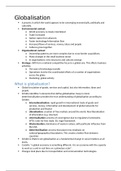
Globalisation
A process in which the world appears to be converging economically, politcally and
culturally.
Environmental context:
o World economy is closely interlinked
o Trade increased
o Naton states from alliances
o Faster technology/informaton fow
o Increased fows of services, money, ideas and people
o Cultures grow together
Organisational context:
o Ownership paterns are more complex due to crossbborder acuuisitons.
o Many changes in the small business sector
o In organisatons: new structures and cultures emerge
Strategy: shift from a natonal compettve focus to a global one. This afects business
actvites.
o The ease of technology transfer
o Operatons involve the coordinated eforts of a number of organisatons
across the globe
o Marketng: global actvity
What is globalisation?
Global circulaton of goods, services and capital, but also informaton, ideas and
people.
Scholte identies s elements that deine globalisaton. Keep in mind,
deterritorialisaton provides the true understanding of globalisaton according to
Scholte.
o Internationalisation: rapid growth in internatonal trade of goods and
services, money, informaton and development of global networks for
producton and inance
o Liberalisation: creaton of free markets around the world. Also liberalisaton
of informaton (e.g. internet)
o Universalisation: process of convergence due to regulatory frameworks.
WTO: rules for free trade. EU: legal framework
o Westernisationn; dominance of western values, with partcular infuence from
the USA
o Deterritorilisation: process that places less emphasis on
natonal/geographical boundaries. This creates a beter fow between
countries
Scholte & Waters see globalisaton as a fundamental change in social relatons at all
levels.
Castells: “a global economy is something diferent: it is an economy with the capacity
to work as a unit in real tme on a planetary scale”.
Changes took place due to transportaton and communicaton technologies.
, The start of globalisation
Michael porter: 19th century: industrialisaton and expansion of trade.
Marx identied that capitalism was concerned with accumulaton
o Firms must increase the scale of producton to contnue to accumulate proit
Also: commodiicaton: broadening the scale of consumpton: develop new goods
and services
As result: irms seek to develop new goods and services and increase sales volumes
Through global producton/global markets, irms achieve economies of scale.
World bank claims we have ‘cyclical variatonss, but also a reducton in trade and
foreign direct investment.
Causes and drives
Importance of ratonal knowledge
o Emphasises knowledge derived from scientic, oboectve methods, and sees
the importance of knowledge to solve problems
Trade growth
o Individual natonal economies have become interconnected through trade
Growth of FDI
o The investment and management of overseas operatons by companies,
leading to the growth of multnatonal companies
Multnatonal corporatons
o Products/drivers of globalisaton.
o They have contributed towards the difusion of technology and ideas, and the
convergence of processes and management practces.
Costs
o Global sales mean that economies of scale in producton can be achieved
o Costs of R&D has risen disproportonally
o Global sourcing: raw materials can be accessed anywhere: price is the key
driver
o Competton increases the cost
Technology innovaton
o Development in computer technology and decrease of cost to store
informaton
o Improvements increase the fow of people, goods, money, informaton and
ideas
World politcs
o Politcal transformaton leads to free market economies
o Changes toward liberalisaton lead to more trade
Changing markets
o Emergence of groups of customers around the world with similar needs
satsied by the global products
Regulatons
o World economy: easier to achieve with an agreement on certain standards
o Standardisaton: e.g. property rights on computers.
A process in which the world appears to be converging economically, politcally and
culturally.
Environmental context:
o World economy is closely interlinked
o Trade increased
o Naton states from alliances
o Faster technology/informaton fow
o Increased fows of services, money, ideas and people
o Cultures grow together
Organisational context:
o Ownership paterns are more complex due to crossbborder acuuisitons.
o Many changes in the small business sector
o In organisatons: new structures and cultures emerge
Strategy: shift from a natonal compettve focus to a global one. This afects business
actvites.
o The ease of technology transfer
o Operatons involve the coordinated eforts of a number of organisatons
across the globe
o Marketng: global actvity
What is globalisation?
Global circulaton of goods, services and capital, but also informaton, ideas and
people.
Scholte identies s elements that deine globalisaton. Keep in mind,
deterritorialisaton provides the true understanding of globalisaton according to
Scholte.
o Internationalisation: rapid growth in internatonal trade of goods and
services, money, informaton and development of global networks for
producton and inance
o Liberalisation: creaton of free markets around the world. Also liberalisaton
of informaton (e.g. internet)
o Universalisation: process of convergence due to regulatory frameworks.
WTO: rules for free trade. EU: legal framework
o Westernisationn; dominance of western values, with partcular infuence from
the USA
o Deterritorilisation: process that places less emphasis on
natonal/geographical boundaries. This creates a beter fow between
countries
Scholte & Waters see globalisaton as a fundamental change in social relatons at all
levels.
Castells: “a global economy is something diferent: it is an economy with the capacity
to work as a unit in real tme on a planetary scale”.
Changes took place due to transportaton and communicaton technologies.
, The start of globalisation
Michael porter: 19th century: industrialisaton and expansion of trade.
Marx identied that capitalism was concerned with accumulaton
o Firms must increase the scale of producton to contnue to accumulate proit
Also: commodiicaton: broadening the scale of consumpton: develop new goods
and services
As result: irms seek to develop new goods and services and increase sales volumes
Through global producton/global markets, irms achieve economies of scale.
World bank claims we have ‘cyclical variatonss, but also a reducton in trade and
foreign direct investment.
Causes and drives
Importance of ratonal knowledge
o Emphasises knowledge derived from scientic, oboectve methods, and sees
the importance of knowledge to solve problems
Trade growth
o Individual natonal economies have become interconnected through trade
Growth of FDI
o The investment and management of overseas operatons by companies,
leading to the growth of multnatonal companies
Multnatonal corporatons
o Products/drivers of globalisaton.
o They have contributed towards the difusion of technology and ideas, and the
convergence of processes and management practces.
Costs
o Global sales mean that economies of scale in producton can be achieved
o Costs of R&D has risen disproportonally
o Global sourcing: raw materials can be accessed anywhere: price is the key
driver
o Competton increases the cost
Technology innovaton
o Development in computer technology and decrease of cost to store
informaton
o Improvements increase the fow of people, goods, money, informaton and
ideas
World politcs
o Politcal transformaton leads to free market economies
o Changes toward liberalisaton lead to more trade
Changing markets
o Emergence of groups of customers around the world with similar needs
satsied by the global products
Regulatons
o World economy: easier to achieve with an agreement on certain standards
o Standardisaton: e.g. property rights on computers.