

Understanding Pathophysiology- Q & A
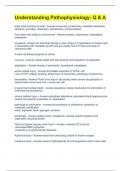
Eight chief functions of cells - Answer-movement, conductivity, metabolic absorption, secretion, excretion, respiration, reproduction, communication Four ways cells adapt to environment - Answer-atrophy, hypertrophy, hyperplasia, metaplasia Dysplasia - Answer-an abnormal change in size, shape or organization of mature cells, is associated with neoplastic growth and are usually found in close proximity of cancerous cells. It does not always progress to cancer necrosis - Answer-cellular death with cell swelling and breakdown of organelles adaptation - Answer-atrophy, hypertrophy, hyperplasia, metaplasia active cellular injury - Answer-immediate response of "entire" cell Loss of ATP, cellular swelling, detachment of ribosomes, autophagy of lysosomes irreversible - Answer-"Point of no return" structurally when severe vacuolization of mitochondria occurs and Ca++ moves into cell programmed cellular death - Answer-apoptosis; cellular destruction for elimination of unwanted cell populations chronic cellular injury - Answer-subcellular alterations; persistent stimuli response may involve only specific organelles or cytoskeleton pathological calcification - Answer-accumulations or infiltrations; dystrophic or metastatic calcification water, pigments, lipids, glycogen, proteins autophagy - Answer-eating of self, cytoplasmic vesicles engulf cytoplasm and organelles, recycling factory What do hypoxic injuries result from? - Answer--reduced O2 in the air -decreased RBC production -respiratory or cardiovascular diseases Asphyxial injury - Answer-result from cells being unable to receive oxygen Infectious injury - Answer-result of pathogenicity of microorganisms which injure cells
Document information
- Uploaded on
- February 3, 2024
- Number of pages
- 2
- Written in
- 2023/2024
- Type
- Exam (elaborations)
- Contains
- Questions & answers


