
TA1: Introduction to Crime and Deviance
Social Construction of Crime
- Definition of Crime
- An illegal act punishable by law and if detected, can result in formal
consequences
- Definition of Deviance
- Behaviour which does not conform to society’s mainstream norms and
values and is likely to receive informal reactions or consequences
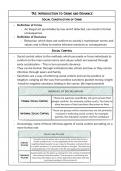
Social Control
- Social control refers to the methods which persuade or force individuals to
conform to the main social norms and values which are learned through
early socialisation - This in turn presents deviance
- They can be formal, through institutions like school and law or they can be
informal, through peers and family
- Sanctions are a way of enforcing social control and can be positive or
negative, ranging all the way from positive sanctions (pocket money, knight
-hood) to negative sanctions (sitting in the corner, life imprisonment)
-
- Increasingly, some of these informal agents of social control are taking on a
more formal role
-
, TA1: Introduction to Crime and Deviance
Alternative Theories on Crime
- Travis Hirschi (1969) - Social Bonds
- An important Functionalist theory, Hirschi focuses on why most
people, most of the time, do not commit crime
- He identified social control being achieved via four ‘bonds of
attachment’ that keep people closely linked to the value consensus
and ensure social control and order
- Deviant activity occurs when members of society do not share the
same norms and values and there is a lack of social bonds that hold
people to society
- There are 4 basic bonds which hold together and prevent us from
committing crimes
-
- Cesare Lombrosso - Biological Explanations of Crime
- Biological and psychological explanations suggest that criminals are
somehow different to the rest of us
- Criminals represented a primitive or subhuman type of man
characterised by physical features, reminiscent of apes, lower primates
and the early man
- He referred to these as ‘throwbacks’
- They had enormous jaws, high cheekbones, low sloping foreheads,
hawk-like noses and fleshy lips, extra nipples + toes and long arms
- Raine et al (1997) - Psychological Explanations of Crime
- Raine wanted to identify brain regions specific to offenders charged
with murder or manslaughter,
, - All of which had pleaded not guilty by reason of insanity
- The sample was 41 murderers (2 female) who had been charged with
murder or manslaughter and had pleaded not guilty by reason of
insanity
- The researchers used a PET scanning method to highlight areas
of brain activity and these results were compared to an age and
gender matched control group
- They found reduced activity for the offender group in areas such as the
prefrontal cortex and the corpus callosum
- Also, there were abnormalities in the activity of the limbic
system, including the amygdala and the thalamus
- Their conclusions was that offenders (specifically violent offenders)
have abnormal brain function when compared to normal controls
- As there is largely reduced activity, it would suggest that the
brains of offenders are slowed and perhaps unable to make the
swift decisions to react appropriately in certain situations
- This is because activity indicates that offenders are unable to
consider the consequences of their actions and control their
behaviour
, TA2: Theories and Crime
Functionalist theory on Crime
- Functionalists think that society is a stable system of shared values, beliefs,
goals and norms which we refer to as the Value Consensus
- Because of this position, it is a structuralist theory
- The functionalist theory is based on two main things socialisation and social
control
- Socialisation - Values and a shared culture is is internalised into its
members and they feel they know what is right and wrong to do in
that society
- Social Control - Rewards and punishment for doing the right and
wrong thing, more opportunities with a clean criminal record, and
prison if you are deviant
- Although crime is generally a bad thing, some Functionalists believe that
crime is inevitable and can be beneficial
- Durkheim says that it is inevitable because some people just are not
socialised adequately because we are all individuals and have different
experiences, influences and circumstances
- Also, modern societies promote a diverse and specialised labour force,
and a diversity of subcultures, which can divide individuals and groups
making the value consensus blurred
- This creates crime and deviance which can then result in Anomie
or a breakdown of norms and values
Functions of Crime
- Boundary Maintenance
- Crime gets reactions from society, members come together against the
criminal
- Punishment serves to strengthen shared values and promote
solidarity
- The courtroom cases which are publicised affirm right and wrong
boundaries
- Adaptation and Change
- All change starts with deviance as change is a deviation from norms
- Individuals with new ideas will naturally challenge existing norms
- If this is not allowed to happen, the society will stagnate
- Too much control would crush revolutionary spirits
Social Construction of Crime
- Definition of Crime
- An illegal act punishable by law and if detected, can result in formal
consequences
- Definition of Deviance
- Behaviour which does not conform to society’s mainstream norms and
values and is likely to receive informal reactions or consequences
Social Control
- Social control refers to the methods which persuade or force individuals to
conform to the main social norms and values which are learned through
early socialisation - This in turn presents deviance
- They can be formal, through institutions like school and law or they can be
informal, through peers and family
- Sanctions are a way of enforcing social control and can be positive or
negative, ranging all the way from positive sanctions (pocket money, knight
-hood) to negative sanctions (sitting in the corner, life imprisonment)
-
- Increasingly, some of these informal agents of social control are taking on a
more formal role
-
, TA1: Introduction to Crime and Deviance
Alternative Theories on Crime
- Travis Hirschi (1969) - Social Bonds
- An important Functionalist theory, Hirschi focuses on why most
people, most of the time, do not commit crime
- He identified social control being achieved via four ‘bonds of
attachment’ that keep people closely linked to the value consensus
and ensure social control and order
- Deviant activity occurs when members of society do not share the
same norms and values and there is a lack of social bonds that hold
people to society
- There are 4 basic bonds which hold together and prevent us from
committing crimes
-
- Cesare Lombrosso - Biological Explanations of Crime
- Biological and psychological explanations suggest that criminals are
somehow different to the rest of us
- Criminals represented a primitive or subhuman type of man
characterised by physical features, reminiscent of apes, lower primates
and the early man
- He referred to these as ‘throwbacks’
- They had enormous jaws, high cheekbones, low sloping foreheads,
hawk-like noses and fleshy lips, extra nipples + toes and long arms
- Raine et al (1997) - Psychological Explanations of Crime
- Raine wanted to identify brain regions specific to offenders charged
with murder or manslaughter,
, - All of which had pleaded not guilty by reason of insanity
- The sample was 41 murderers (2 female) who had been charged with
murder or manslaughter and had pleaded not guilty by reason of
insanity
- The researchers used a PET scanning method to highlight areas
of brain activity and these results were compared to an age and
gender matched control group
- They found reduced activity for the offender group in areas such as the
prefrontal cortex and the corpus callosum
- Also, there were abnormalities in the activity of the limbic
system, including the amygdala and the thalamus
- Their conclusions was that offenders (specifically violent offenders)
have abnormal brain function when compared to normal controls
- As there is largely reduced activity, it would suggest that the
brains of offenders are slowed and perhaps unable to make the
swift decisions to react appropriately in certain situations
- This is because activity indicates that offenders are unable to
consider the consequences of their actions and control their
behaviour
, TA2: Theories and Crime
Functionalist theory on Crime
- Functionalists think that society is a stable system of shared values, beliefs,
goals and norms which we refer to as the Value Consensus
- Because of this position, it is a structuralist theory
- The functionalist theory is based on two main things socialisation and social
control
- Socialisation - Values and a shared culture is is internalised into its
members and they feel they know what is right and wrong to do in
that society
- Social Control - Rewards and punishment for doing the right and
wrong thing, more opportunities with a clean criminal record, and
prison if you are deviant
- Although crime is generally a bad thing, some Functionalists believe that
crime is inevitable and can be beneficial
- Durkheim says that it is inevitable because some people just are not
socialised adequately because we are all individuals and have different
experiences, influences and circumstances
- Also, modern societies promote a diverse and specialised labour force,
and a diversity of subcultures, which can divide individuals and groups
making the value consensus blurred
- This creates crime and deviance which can then result in Anomie
or a breakdown of norms and values
Functions of Crime
- Boundary Maintenance
- Crime gets reactions from society, members come together against the
criminal
- Punishment serves to strengthen shared values and promote
solidarity
- The courtroom cases which are publicised affirm right and wrong
boundaries
- Adaptation and Change
- All change starts with deviance as change is a deviation from norms
- Individuals with new ideas will naturally challenge existing norms
- If this is not allowed to happen, the society will stagnate
- Too much control would crush revolutionary spirits


