
Pathophysiology Exam 1-UT Tyler Questions And Answers
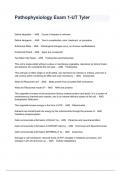
Pathophysiology Exam 1-UT Tyler Questions And Answers Define Idiopathic. - ANS Cause of disease is unknown Define Iatrogenic. - ANS Due to complication, error, treatment, or procedure Subclinical State - ANS Pathological changes occur, no obvious manifestations Prodromal Period - ANS Signs are nonspecific Two Basic Cell Types - ANS Prokaryotes and Eukaryotes This cell is single-celled without nucleus or membrane organelles, reproduce by binary fission, and bacteria are considered this cell type. - ANS Prokaryotes This cell type is either single or multi-celled, can reproduce by meiosis or mitosis, and have a cell nucleus within containing its DNA and outer membrane. - ANS Eukaryotes What do Ribosomes do? - ANS Make protein from encoded DNA instructions What are Ribosomes made of? - ANS RNA and proteins This organelle is known as the production factory (makes proteins and lipids). It is a system of membraneous channels and vesicles, and is an internal delivery system of the cell. - ANS Endoplasmic Reticulum This organelle houses energy in the form of ATP. - ANS Mitochondria Nutrients are transformed into energy by the mitochondria through the process of - ANS Oxidative phosphorylation Cells communicate information LOCALLY by - ANS Paracrine and neurotransmitters Cells communicate information to DISTANT sites by - ANS Hormones and Neurohormones Cells communicate information INTERNALLY by - ANS Autocrines Damage to cell membrane, reduced levels of ATP, changes in metabolic processes, and changes in pH are all known as. - ANS Cellular Adaptations What two cellular changes are known to be normal alterations? - ANS Hypertrophy and Atrophy What cellular change is known to be disease-related? - ANS Ischemia or cellular hypoxia Ischemia or cellular hypoxia is a result of what factor? - ANS Decreased oxygen This is known as 'programmed cell death' and is associated with aging. - ANS Apoptosis This condition is due to ischemia or reduced blood supply to the tissue and is the most common cause of cell injury. - ANS Hypoxia This term is known as the death of a group of cells. - ANS Necrosis This term refers to the are of dead cells due to lack of oxygen. - ANS Infarction Water and solutes move from area of high to low concentration (blood to interstitial fluid). - ANS Diffusion Water from low concentration to higher concentration (ISF to blood). - ANS Osmosis Responses to low fluid volume are controlled by receptors in the hypothalamus. These are also known as: - ANS Osmoreceptors When ADH is found in the body in abundance it is to result in: - ANS Less water loss and deceased urine output
Document information
- Uploaded on
- January 31, 2024
- Number of pages
- 9
- Written in
- 2023/2024
- Type
- Exam (elaborations)
- Contains
- Questions & answers


