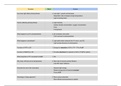
Question Marks Answer
How does light affect photosynthesis 3 Less light = growth will decrease
Respiration rate increases at high temperature
Light is limiting factor
Factors affecting photosynthesis 4 Light intensity
Carbon dioxide concentration, oxygen concentration
Time
Temperature
What happens to pH in photosynthesis 2 pH increases, less acidic
CO2 removed in photosynthesis
What happens in photolysis? 2 Light splits water molecule into H+ and e- and O2
Light excites electrons to photosystem
Function of ATP in LIR 1 Energy for reduction of GP to TP + TP to RuBP
Function of NADPH in LIR 1 Provides electrons for reduction of GP to TP (P for plants)
What proportion of TP converted to RuBP 1 5/6
Why does LIR slow at low temperatures 2 Slow rate of enzyme activity Rubisco
Less KE, fewer collisions
Describe the role of the chlorophyll Absorbs light energy
Raises energy level of electrons/excited
Forms ATP
Advantage of deep pigments? 2 More colours absorbed
More efficient photosynthesis at depths
,Adaptations of chloroplasts 4 Large SA to absorb as much sunlight as possible
Thin, more light absorbed within first few micrometers
Transparent cuticle to let light through mesophyll cells
Stomata open and close in response to light intensity
ATP properties for efficiency 4 ATP released in small manageable
Small soluble molecule, easily transported around cell
Easily broken down, energy instantaneous
Molecules made more reactive, phosphorylation
What is the compensation point? 1 Rate of photosynthesis = rate of respiration
Light Dependent Reaction 5 Light energy excites electrons in PS2, electrons move down ETC
Photolysis produces water, electrons, H+. Replaces e- from ETC
Excited e-'s go down ETC, produces energy to transport proton
Produces proton gradient, ATP synthase in membrane for ATP
Electrons transferred to NADP, to form NADPH (chemiosmosis)
Light Independent Reaction 3 CO2 enters, combines w RuBP via rubisco. Produces GP
ATP reduces GP to TP, uses H+ from NADPH , TP to glucose
5/6 TP regenerated RuBP, uses ATP from LDR
Adaptations of stroma 2 DNA + RER to make proteins
Fluid has enzymes to reduce CO2
Explain why GP increases after plant in dark 2 Accumulates as cannot be converted to TP
Requires ATP/NADP from light-dependent reaction
Explain role of water in LDR 2 Protons for reduction of NADP
Provides electrons replace those lost from PS2
, Explain why plants can't use ATP only 2 Plants need light to form ATP
ATP cannot be transported
How does light energy make ATP? 5 Chlorophyll excited; electrons raised to higher energy level
Electrons emitted from chlorophyll
Down electron transport chain
Causes loss of energy
Energy lost used to synthesise ATP from ADP + Pi
Importance of proton conc grad 2 Down conc grad into stroma via ATP synthase
Energy combines ADP + Pi
What does cyclic photophosphorylation form? 1 ATP only
What happens to electrons in non-cyclic? 1 Transferred to NADP + proton from stroma, forms NADPH
What are photosynthetic pigments? 1 Coloured substances absorbing light energy for photosynthesis
What is photophosphorylation? 1 Adding a phosphate group using light
What is the electron transfer chain? 1 Chain of proteins where excited electrons flow
Equation for formation of TP 1 2 x GP + 2ADP + 2NADPH → TP - reduction
Role of ATP in Calvin Cycle 2 Energy for reduction of GP to TP
Energy to regeneration of RuBP from TP
How are carbs + lipids made in Calvin cycle 2 Carbs: 2 x TP joined forming hexose, carbs made by joining hexose
Lipids: Glycerol via TP, fatty acids made by GP. Joined together
How does light affect photosynthesis 3 Less light = growth will decrease
Respiration rate increases at high temperature
Light is limiting factor
Factors affecting photosynthesis 4 Light intensity
Carbon dioxide concentration, oxygen concentration
Time
Temperature
What happens to pH in photosynthesis 2 pH increases, less acidic
CO2 removed in photosynthesis
What happens in photolysis? 2 Light splits water molecule into H+ and e- and O2
Light excites electrons to photosystem
Function of ATP in LIR 1 Energy for reduction of GP to TP + TP to RuBP
Function of NADPH in LIR 1 Provides electrons for reduction of GP to TP (P for plants)
What proportion of TP converted to RuBP 1 5/6
Why does LIR slow at low temperatures 2 Slow rate of enzyme activity Rubisco
Less KE, fewer collisions
Describe the role of the chlorophyll Absorbs light energy
Raises energy level of electrons/excited
Forms ATP
Advantage of deep pigments? 2 More colours absorbed
More efficient photosynthesis at depths
,Adaptations of chloroplasts 4 Large SA to absorb as much sunlight as possible
Thin, more light absorbed within first few micrometers
Transparent cuticle to let light through mesophyll cells
Stomata open and close in response to light intensity
ATP properties for efficiency 4 ATP released in small manageable
Small soluble molecule, easily transported around cell
Easily broken down, energy instantaneous
Molecules made more reactive, phosphorylation
What is the compensation point? 1 Rate of photosynthesis = rate of respiration
Light Dependent Reaction 5 Light energy excites electrons in PS2, electrons move down ETC
Photolysis produces water, electrons, H+. Replaces e- from ETC
Excited e-'s go down ETC, produces energy to transport proton
Produces proton gradient, ATP synthase in membrane for ATP
Electrons transferred to NADP, to form NADPH (chemiosmosis)
Light Independent Reaction 3 CO2 enters, combines w RuBP via rubisco. Produces GP
ATP reduces GP to TP, uses H+ from NADPH , TP to glucose
5/6 TP regenerated RuBP, uses ATP from LDR
Adaptations of stroma 2 DNA + RER to make proteins
Fluid has enzymes to reduce CO2
Explain why GP increases after plant in dark 2 Accumulates as cannot be converted to TP
Requires ATP/NADP from light-dependent reaction
Explain role of water in LDR 2 Protons for reduction of NADP
Provides electrons replace those lost from PS2
, Explain why plants can't use ATP only 2 Plants need light to form ATP
ATP cannot be transported
How does light energy make ATP? 5 Chlorophyll excited; electrons raised to higher energy level
Electrons emitted from chlorophyll
Down electron transport chain
Causes loss of energy
Energy lost used to synthesise ATP from ADP + Pi
Importance of proton conc grad 2 Down conc grad into stroma via ATP synthase
Energy combines ADP + Pi
What does cyclic photophosphorylation form? 1 ATP only
What happens to electrons in non-cyclic? 1 Transferred to NADP + proton from stroma, forms NADPH
What are photosynthetic pigments? 1 Coloured substances absorbing light energy for photosynthesis
What is photophosphorylation? 1 Adding a phosphate group using light
What is the electron transfer chain? 1 Chain of proteins where excited electrons flow
Equation for formation of TP 1 2 x GP + 2ADP + 2NADPH → TP - reduction
Role of ATP in Calvin Cycle 2 Energy for reduction of GP to TP
Energy to regeneration of RuBP from TP
How are carbs + lipids made in Calvin cycle 2 Carbs: 2 x TP joined forming hexose, carbs made by joining hexose
Lipids: Glycerol via TP, fatty acids made by GP. Joined together