Chapter 3- Scientists and Experiments Qs&As
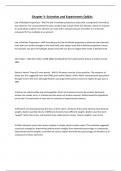
Chapter 3- Scientists and Experiments Qs&As Law of Multiple Proportions - ANS-The law of multiple proportions states that a compound is formed by two elements. The second element's ratios combine with 1 gram of the first element, which are reduced to small whole numbers. One element can react with a constant amount of another in a 2 element compound if it has multiples in an amount. Law of Definite Proportions - ANS-According to the law of definite proportions, whenever two elements react with one another (oxygen in the initial test), they always react with a definite proportion of mass. For example, two parts of hydrogen always react with one part of oxygen when water is being formed. John Dalton - ANS-John Dalton () developed the first useful atomic theory of matter around 1803. Dalton's Atomic Theory (5 main points) - ANS-1) All matter consists of tiny particles. The existence of atoms was first suggested more that 2000 years before Dalton's birth. Atoms remained pure speculation through most of this time, although Newton used arguments based on atoms to explain the gas laws in 1687. 2) Atoms are indestructible and unchangeable. Atoms of an element cannot be created, destroyed, broken into smaller parts, or transformed into atoms of another element. Dalton based this hypothesis on the law of conservation of mass and on centuries of experimental evidence. 3) Elements are characterized by the mass of their atoms. All atoms of the same element have identical weights, Dalton asserted. Atoms of different elements have different weights. (Dalton used the word "weight" rather than mass, and chemists have called atomic masses "atomic weights" ever since). 4) When elements react, their atoms combine in simple, whole-number ratios. This postulate suggested a practical strategy for determining relative atomic weights from elemental percentages in compounds. Experimental atomic weights could then be used to explain the fixed mass percentages of elements in all compounds of those elements!
Document information
- Uploaded on
- January 27, 2024
- Number of pages
- 3
- Written in
- 2023/2024
- Type
- Exam (elaborations)
- Contains
- Questions & answers