NUR 3028 Ch 28- Infection Control Chapter Review Questions and Answers graded A
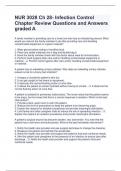
A family member is providing care to a loved one who has an infected leg wound. What would you instruct the family member to do after providing care and handling contaminated equipment or organic material? 1. Wear gloves before eating or handling food. 2. Place any soiled materials into a bag and double bag it. 3. Have the family member check with the doctor about need for immunization. 4. Perform hand hygiene after care and/or handling contaminated equipment or material. - 4. Perform hand hygiene after care and/or handling contaminated equipment or material. A patient has an indwelling urinary catheter. Why does an indwelling urinary catheter present a risk for urinary tract infection? 1. It keeps a incontinent patient's skin dry. 2. It can get caught in the linens or equipment. 3. It obstructs the normal flushing action of urine flow. 4. It allows the patient to remain hydrated without having to urinate. - 3. It obstructs the normal flushing action of urine flow. A patient is isolated for pulmonary tuberculosis. The nurse notes that the patient seems to be angry, but he knows that this is a normal response to isolation. Which is the best intervention? 1. Provide a dark, quiet room to calm the patient. 2. Reduce the level of precautions to keep the patient from becoming angry. 3. Explain the reasons for isolation procedures and provide meaningful stimulation. 4. Limit family and other caregiver visits to reduce the risk of spreading infection. - 3. Explain the reasons for isolation procedures and provide meaningful stimulation. A patient's surgical wound has become swollen, red, and tender. You note that the patient has a new fever and leukocytosis. What is the bed immediate intervention? 1. Notify the health care provider and use surgical technique to change the dressing. 2. Reassure the patient and recheck the would later. 3. Notify the health care provider and support the patient's fluid and nutritional needs. 4. Alert the patient and caregivers to the presence of an infection to ensure care after discharge. - 3. Notify the health care provider and support the patient's fluid and nutritional needs. Identify the interval when a patient progresses from nonspecific signs to manifesting signs and symptoms specific to a type of infection. 1.Illness stage 2. Convalescence 3. Prodromal stage 4. Incubation period - 3. Prodromal stage If an infectious disease can be transmitted directly from one person to another, it is a: 1. Susceptible host 2. Communicable disease. 3. Port of entry to a host 4. Port of exit from the reservoir - 2. Communicable disease.
Document information
- Uploaded on
- January 26, 2024
- Number of pages
- 4
- Written in
- 2023/2024
- Type
- Exam (elaborations)
- Contains
- Questions & answers