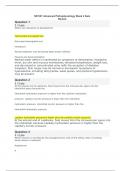
NR 507 Advanced Pathophysiology Week 2 Quiz Review
Which are indications of dehydration? Tachycardia and weight loss Decreased hemoglobin and hematocrit Muscle weakness and decreased deep tendon reflexes Polyuria and hyperventilation Marked water deficit is manifested by symptoms of dehydration: headache, thirst, dry skin and mucous membranes, elevated temperature, weight loss, and decreased or concentrated urine (with the exception of diabetes insipidus). Skin turgor may be normal or decreased. Symptoms of hypovolemia, including tachycardia, weak pulses, and postural hypotension, may be present. At the arterial end of capillaries, fluid moves from the intravascular space into the interstitial space because the interstitial hydrostatic pressure is higher than the capillary hydrostatic pressure. capillary oncotic pressure is lower than the interstitial hydrostatic pressure. interstitial oncotic pressure is higher than the interstitial hydrostatic pressure. capillary hydrostatic pressure is higher than the capillary oncotic pressure. At the arterial end of capillaries, fluid moves from the intravascular space into the interstitial, because capillary hydrostatic pressure is higher than the capillary oncotic pressure. Which enzyme is secreted by the juxtaglomerular cells of the kidney when circulating blood volume is reduced? Angiotensin II Aldosterone Angiotensin I Renin When circulating blood volume or blood pressure is reduced, renin, an enzyme secreted by the juxtaglomerular cells of the kidney, is released in response to sympathetic nerve stimulation and decreased perfusion of the renal vasculature. In hyperkalemia, cardiac rhythm changes are a direct result of Correct Answer cardiac cell hypopolarization. cardiac cell repolarization. cardiac cell hyperexcitability. depression of the sinoatrial (SA) node. If extracellular potassium concentration increases without a significant change in intracellular potassium, the resting membrane potential becomes more positive (i.e., changes from –90 to –80 mV) and the cell membrane is hypopolarized (the inside of the cell becomes less negative or partially depolarized [increase excitability]). (Electrical properties of cells are discussed in Chapter 1.) Why are infants susceptible to significant losses in total body water (TBW)? Because they are unable communicate adequately when they are thirsty Because more than half of an infant’s body weight is water Because an infant’s kidneys are not mature enough to counter fluids losses Because infants have a slow metabolic rate Infants are particularly susceptible to significant changes in TBW because of their high metabolic rate and the accelerated turnover of body fluids caused by their greater body surface area in proportion to total body size. Loss of fluids from diarrhea can represent a significant proportion of body weight. Renal mechanisms that regulate fluid and electrolyte conservation may not be mature enough to counter the losses, so dehydration may develop rapidly.
Written for
- Institution
- NR 507 ADVANCED PATHOPHYSIOLOGY
- Course
- NR 507 ADVANCED PATHOPHYSIOLOGY
Document information
- Uploaded on
- January 25, 2024
- Number of pages
- 17
- Written in
- 2023/2024
- Type
- Exam (elaborations)
- Contains
- Questions & answers
Subjects
-
nr 507 advanced pathophysiology week 2 quiz review

Also available in package deal