
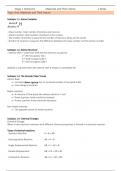
Stage 1 Chemistry Materials and Their Atoms L Notes
Topic One: Materials and Their Atoms
Subtopic 1.1: Atomic Notation
𝑚𝑎𝑠𝑠#
𝐴𝑡𝑜𝑚𝑖𝑐 #
H
- Mass number: total number of protons and neurons
- Atomic number: total number of protons in the nucleus
- The number of protons is equal to the number of electrons (they are the same)
- Number of neutrons is equal to the difference between the mass number and the atomic number
Subtopic 1.2: Atomic Structure
- Valence shell = outermost shell that has electron occupancy
1st shell occupancy (2e-)
2nd shell occupancy (8e-)
3rd shell occupancy (18e-)
Stability is achieved when the valence shell is empty or completely full.
Subtopic 1.3: The Periodic Table Trends
Atomic Radii
→ Increases down a group due to increased number of occupied shells
→ Core charge is constant
Metal reactivity
→ A measure of how easily the valence electron is ‘lost’
→ Down a group: metal reactivity increases
→ Across a period: metal reactivity decreases
Non-metal reactivity
→ The opposite trends of metal reactivity
Subtopic 1.4: Chemical Changes
Chemical Change:
When a new chemical substance with different chemical properties is formed in a chemical reaction.
Types of chemical reactions:
Synthesis Reaction A + B = AB
Decomposition Reaction AB = A + B
Single Displacement Reaction AB + C = AC + B
Double Displacement AB + CD = AD + BC
Combustion Reaction AB + O2 = AO + BO


