
Anatomy and Physiology 101 Final Exam Ivy Tech (2023/2024) Already Passed
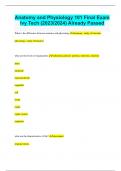
Anatomy and Physiology 101 Final Exam Ivy Tech (2023/2024) Already Passed What is the difference between anatomy and physiology anatomy- study of structure physiology- study of function what are the levels of organization subatomic particle- protons, electrons, neutrons atom molecule macromolecule organelle cell tissue organ organ system organism what are the characteristics of life? movement responsiveness respiration absorption secretion digestion assimilation- changing of absorbed substances into chemically different forms circulation reproduction growth what are the requirements of life? water food heat pressure oxygen define homeostasis maintaining of a stable enviroment what is a homeostatic mechanism monitors aspects of internal environment and corrects as needed *negative feedback mechanism define matter anything that takes up space and has mass element composed of chemically identical atoms atom smallest particle of atom, basic unit of matter what are structure of an atom nucleus protons neutron electrons define nucleus, proton, electron, neutron nucleus- central part of atom proton- positive charge electron- negative charge neutron- no electrical charge ionic bond formed when electrons are transferred from one atom to another what are covalent bonds when two molecules share electron hydrogen bond formed between water molecule, attraction between positive end of polar molecule and negative end of another polar molecule define synthesis, decomposition, and exchange reactions Synthesis- A+B=AB Decomposition- AB=A+B exchange- AB+CD=AD+BC define reactant starting materials of reactions product ending material define catalyst a substance that speeds up a chemical reaction what is an acid dissociates with water base combines in water what happens to salts when dissolved in water and what is produced? The salt molecules are "torn apart" by the water, and are reduced to sodium (Na+) and chlorine (Cl-) ions. what is the pH scale? what ions are involved in the
Document information
- Uploaded on
- January 24, 2024
- Number of pages
- 31
- Written in
- 2023/2024
- Type
- Exam (elaborations)
- Contains
- Questions & answers


