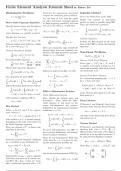
Finite Element Analysis Formula Sheet by Ruben Tol
Minimization Problems Construct the approximate functional, Galerkin Method
compute the stationary point condition
u = arg min J(v) Derive the Weak Form of the PDE
v∈Σ Use the form of J(u) with the small-
Reduce the amount of derivatives
est order derivatives (original equation
Derive Euler-Lagrange Equations present as much as possible using IBP.
or Euler-Lagrange equation), and sum
Then, the weak form is given by
Identify Solution Space and Boundaries over all j’s for which ui is unknown: Z Z
Σg := {u ∈ C n (Ω) : u|δΩ = g} ∂J ˜ G(u)η dΩ = f η dΩ ∀η ∈ V0 ,
˜
J(u) := J(ũ), = 0, j = 0, . . . , m−1 Ω Ω
g(x) a function, g a variable, or just 0. ∂uj
V0 := {η ∈ C s (Ω) : η|δΩ = 0}.
Identify Test Function Useful identities:
Galerkin Equations
n
η ∈ Σ0 := {η ∈ C (Ω) : η|δΩ = 0} ∂ ∂
∇ũ = ∇φj , ũ = φj . Perform the Ritz method on the weak
Notation implies what holds for u holds ∂uj ∂uj form of the PDE to obtain the Galerkin
for η, now with η|δΩ = 0. equations.
Move any summation signs outside the
Perform Variational Analysis integral signs, move any boundary con-
ditions to the right-hand side, and inter- Non-Linear Problems
d
J(u + ϵη) = 0, ∀η ∈ Σ0 change η = φj if needed: {xk }∞
dϵ ϵ=0 k=0 , lim xk = x
k→∞
n−1
For multivariable functions: X Z Z
Brouwer Fixed Point Theorem
d ∂F ∂a ∂F ∂b ui G(φi , φj ) dΩ = f φj dΩ,
F (a(ϵ), b(ϵ)) = + i=0 Ω Ω Given g(x) ∈ C(I), ∀x ∈ Ω, with I
dϵ ∂a ∂ϵ ∂b ∂ϵ a compact and convex domain (so I is
j = 0, . . . , m − 1.
Obtain Euler-Lagrange Equations closed and bounded), then x has at least
one fixed point in Ω.
Z
Express in matrix form Lu = f, with:
G(u)η dΩ = 0, ∀η ∈ Σ0
Ω Z
L = G(φi , φj ) dΩ, Banach Fixed Point Theorem
Use integration by parts (IBP): ij
Z Z I Ω If a contraction mapping g(x) : I → I
u·∇v dΩ = − ∇u·v dΩ+ uv·n dΓ. u = (u0 , . . . , un−1 )T , for γ ∈ [0, 1] such that
Ω Ω δΩ=Γ
Z
Dubois-Reymond theorem then tells us: fj = f φj dΩ. d(g(x), g(y)) ≤ γ d(x, y) , ∀x, y ∈ I
Ω
→ |g(x) − g(y)| ≤ γ|y − x|, ∀x, y ∈ I
Z I
f (x)η dΩ + h(x)η dΓ = 0,
Ω Γ PDE to Minimization Problem
exists, then the fixed point x is the only
→ f (x) = 0 on Ω ∨ h(x) = 0 on Γ, Check Differential Operator fixed point in I.
with boundary conditions (BC’s) First, identify the solution space and
u|δΩ = g(x). boundaries. Then, define the differ- Picard Method
ential operator L and prove its lin-
If Brouwer’s and Banach’s fixed point
Ritz Method earity, self-adjointness and positive-
theorems hold, then the Picard iteraton
definiteness for homogeneous boundary
Define a discrete space Σ̃ for approxi- conditions u, v ∈ Σ0 : xk+1 = g(xk ), k = 0, 1, . . .
mate solution ũ
L(αu + βv) = αLu + βL + v,
V := C s → Ṽn := span{φi }n−1 i=0 ⊂ V, Z Z converges to the fixed point x for all ini-
u(Lv) dΩ = (Lu)v dΩ, tial guesses x0 ∈ I.
with smallest s so C is smooth enough,
Ω Ω
depending on the order of derivatives in Z Z
Newton Method
the Euler-Lagrange equations. uLu dΩ ≥ γ u2 dΩ, γ > 0.
Ω Ω
Write any element of Ṽ n as linear com- If Brouwer’s and Banach’s fixed point
2 df
binations of the basis: To prove self-adjointness, use IBP; to theorems hold, f (x) ∈ C (I), dx > 0
n−1
X prove positive-definiteness, use homoge- (Jf invertible), then f (x) = 0 is approx-
ũ = ui φi ∈ Ṽ n . neous boundary conditions. imated for x by any initial guess x0 ∈ I
i=0
Then, for any homogeneous PDE (Σ0 ) by using Newton-Rapshon’s method:
Prescribe essential boundary conditions of the form Lu = f , u is given by solv-
on ũ according to any boundaries B: xk+1 = xk − (Jf (xk ))−1 f(xk ),
ing the minimization problem for
u|δΩ = g(x), Ṽ = Ṽ0 ⊕ B, Z
1 where f(xk ) = (f (x1 ), . . . , f (xn ))T , and
m−1 n−1 J(u) = uLu − f u dΩ,
Ω 2
X X ∂f1 ∂f1
→ ũ = ui φi + g(xi )φi ∈ Ṽ n . ∂x1 . . . ∂x n
i=0 i=m and for any non-homogeneous PDE (Σg ) Jf = ... .. .. .
. .
Essential BC’s (u|δΩ = g(x)), explicitly Z ∂f n ∂f
. . . ∂xnn
need their own series to be solved; nat- 1 ∂x1
J(u) = (u − v)L(u + v) − f u dΩ.
ural BC’s (∇u · n|δΩ = h(x)) are ”natu- Ω 2
rally” satisfied and grouped with u ∈ Ω.