Summary COUN 505 Study Guide Latest
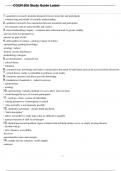
COUN 505 Study Guide Latest 1. quantitative research: maintain distance between researcher and participants - common lang and model of scientific understanding 2. qualitative research: close interaction between researcher and participants - less structures and are more flexible and creative 3. mixed methodology inquiry: -variations data collection leads to greater validity -answers from # of perspectives -ensures no gaps of info 4. philosophies of science: -ontology (nature of reality) -epistemology (gaining knowledge) -axiology (values) -rhetoric (words and phrases) -methodology (designs) 5. postmodernism: - constructivism - critical theory - feminism 6. constructivism: knowledge and truth is constructed in the minds of individuals and can be accessed about discussion 7. critical theory: reality is embedded in political, social reality 8. feminism: emotions and affect goes into knowledge 9. foundations of qualitative: - inductive process - epistemology - axiology 10. epistemology: includes methods we use to know what we know - world through the eyes of research participants 11. axiology: values systems of individuals - valuing perspective of participants is critical - value neutrality is not humanely possible 12. qualitative advantage: - greater depth and detail - "thick description" - allows researchers to study topics that are difficult to quantify - natural extension of skill set of therapist 13. identifying research problem: topics of interest that will help initiate, revise, or clarify existing theories - flexible with q's - time, finances, accessibility -lit review -operationalize terms and concepts 14. sample and site selection: -small samples -selection -voice of people not typically acknowledged -generalizability is not the goal 15. role of researcher: - how involved? - solo or team? - time away and self care 16. researcher bias: - race, age, gender - experience - personal connection to topic 17. purposive sampling: enlisting participants who can provide maximum insight and understanding of the topic under investigation 18. data collecting methods: - interviews - observation - document analysis 19. interviewing: - one to one, dyadic, groups - structures, semistructured, unstructured - focus groups 20. focus groups: gather info about attitudes, opinions, and preferences of selected groups - generate many ideas on topic and achieve consensus - useful in marketing, survey development 21. observation: natural setting, extended period of time, supplement to interview data 22. participant observer: part of the cultural or context that is being observed - large time commitment - months or years 23. document analysis: -public records - personal documents - physical materials - researcher generated documents 24. data management: - contact sheets - document summary forms 25. contact sheets: one page summary of events of the day - common themes pop up 26. document summary forms: all contact sheets put into one big summary 27. trustworthiness: - credibility - transferability - dependability - confirmability
Document information
- Uploaded on
- January 22, 2024
- Number of pages
- 8
- Written in
- 2023/2024
- Type
- Summary