
WGU - Applied Healthcare Statistics Exam Guide 2024 Questions and Answers
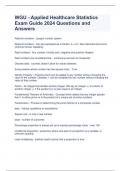
Rational numbers - Largest number system Rational numbers - Can be expressed as a fraction. 4 = 4/1. Also decimals that end or continue forever repeating. Real numbers - Any number; Include zero, negative and positive integers. Real numbers are considered this. - continuous and can be measured. Discrete data - counted; doesn't allow for values between. Every positive whole number has two square roots. - True Identity Property - Property that 0 can be added to any number without changing the value of the number. Likewise, 1 can be multiplied by any number without changing the value of that number. Factor - An integer that divides another integer. We say an integer, x, is a factor of another integer, y, if the quotient y/x is also equal to an integer. Fundamental Theorem of Arithmetic - Concept which states that any integer greater than 1 is either prime or is the product of a unique set of prime numbers. Factorization - Process of determining the prime factors of a composite number. data - Values; qualitative or quantitative. Square root - is only a real number base - number of outcomes Percentage proportion is always set up to express percentage value - over 100 conditional proportion - proportion where one part of a proportion is a variable, or unknown quantity. cross multiplying - method used to prove that a proportion is true. rate - ratio that compares two quantities having different units of measure. unit multiplier - fraction that contains two equivalent quantities but in two different units, used in order to convert units. unit conversion - method used to change between measurement systems. all real numbers with a fixed value, prime, composite, odd, even, rational, or irrational. - constants 0 - expression known as a constant. 1 - expression known as linear. 2 - expression known as quadratic. 3 - expression known as cubic. False - Process for undoing multiplication and division operations will always work, even if one of the numbers is zero. A variable with an exponent of 0 is equal to - 1 root of a number - non-linear most simple algebraic equations are - linear equations two terms or expressions with an equals sign between them is - an equation origin; where x and y intersect. - 0, 0 linear; degree 1 - straight line slope-intercept form - y = mx + b point-slope form - y - y1 = m(x - x1) large coefficient - steep line small coefficient - gentle slope algebraic expression - String of terms connected by division, addition, and subtraction. variance - A measure of spread within a distribution (the square of the standard deviation).
Document information
- Uploaded on
- January 19, 2024
- Number of pages
- 7
- Written in
- 2023/2024
- Type
- Exam (elaborations)
- Contains
- Questions & answers


