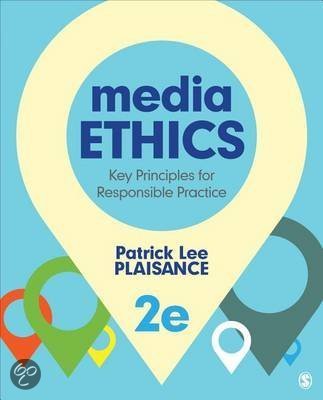
Media Ethics
Key Principles for Responsible Practice
Summary
Communicatie Ethiek/Communication Ethics (CE)
Plaisance, P.L. (2013). Media ethics: Key principles for responsible practice (2nd ed.). Los Angeles,
CA: Sage. ISBN 978-1-4522-5808-9
, 1 – Ethics Theory: An Overview
Ethics is a branch of moral philosophy. Modern moral philosophers continue to understand how we
know right and wrong, how rightness and goodness should be defined, and whether these qualities are
intrinsic in acts and objects or whether the concepts are products of our intuitions.
Ethical VS Moral Dilemmas
Ethical = deals with issues or questions that are not clear-cut. Ethics are typically not concerned
with black-and-white questions, they have much bigger and more difficult fish to try.
Ethical dilemma = a form of inquiry concerned with the process of finding rational
justifications for our actions when the values that we hold come into conflict. The work of ethics
has always been epistemic (= focused on questions of how we actually know what we claim te
know). Ethical decision making can provide a strong basis for making moral claims, but ethics and
morality are not the same.
Ethics deals with our struggle to justify doing or not doing something when various values of
our belief system clash. Ethics refers to our efforts to articulate our reasons for putting greater
weight on some moral claims than others in certain dilemmas. Focuses on the rightness of a given
action. Ethics isn’t concerned about making moralistic claims, but about the deliberation we have
to go through to properly balance the competing claims.
Ethics is about our thinking process. It is concerned with asking the right questions. The focus
is on the quality of the deliberative process and not on the outcome. Most ethical dilemmas don’t
present any fully acceptable solutions and instead offer several options that are unsatisfactory in
some way. The trick is to figure out which one is most justifiable as you see it and which
embodies key values.
Morality = a set of beliefs that we embrace to help us understand what is good and what is bad in
the world. For moral philosophers, questions about what exactly makes claims of goodness true
are of critical interest. Focuses on the quality of goodness.
We want knowledge both of what we should do and of why we should do it. Epistemic completeness
(= why these claims should motivate us) is needed for a theory to give us the comprehensive moral
guidance we seek as moral agents. Normative completeness (= what we ought to do) is needed to
enable us to explain and correspondingly justify the moral judgments we arrive at on the basis of the
facts that indicate our obligations. – Audi (2004)
Ethics is based on rational justifications = when faced with a dilemma, many of us may have gut
instincts that suggest what the right thing to do is. But in ethics, that’s just the beginning. When
exactly would it be okay to withhold the truth or deceive someone to prevent certain types of harm?
2
, Good ethical decisions can be defended with solid, evidence-based reasoning, not just a series
of moral claims. Ethics is not about pleasing everyone, because true dilemmas can plausibly be dealt
with in opposite ways.
The art of the uneasy compromise – ethics helps us negotiate among conflicting values.
Honesty/truth telling – Avoiding harm to others (= classical conflict)
Privacy – Belonging to/participating in a community
Courage – Camaraderie
Loyalty – Independence
Cultures and societies generally have a list of widely agreed-upon values that are all important to us.
Differences lie in the relative priority given to single values in certain circumstances. It is not that
these values ever become unimportant, it is just that we choose which ones should be favored to help
solve a given problem.
Aristotle (384 – 322 B.C.)
Aristotle argued that human goodness requires using our rationality to live a life of virtue. His idea of
virtue refers to two categories:
Intellectual = wisdom, understanding, and prudence.
Moral = courage, justice, and truthfulness. Require us to search for a proper intermediate point
between extreme examples of excess or deficiency. The balancing point between two extremes is
known as Aristotle’s Doctrine of the Mean.
Another key element of Aristotle’s virtue ethics is his claim that all of our actions should not
only reflect the virtues as discussed; they should also promote and maintain human flourishing, or
the capacity of every human to strive to reach his or her potential.
Immanuel Kant (1724 – 1804)
Kant proposed a complex system that detailed the duties we have as moral agents. At the core of his
system is the claim that our human capacity for reason enables us to know these duties and that
freedom enables us to act on them.
On these two pillars (rationality & liberty) rest his central claim that we are obligated to act
morally as the only way to carry out our duties to others.
By moral action, Kant meant that we test our decisions by asking whether they can be
universalized (= whether it would be acceptable if everyone applied the decision as a standard of
behavior). Such requirements were categorically imperative (= they were among the core moral
obligations that all of us must meet).
3
Key Principles for Responsible Practice
Summary
Communicatie Ethiek/Communication Ethics (CE)
Plaisance, P.L. (2013). Media ethics: Key principles for responsible practice (2nd ed.). Los Angeles,
CA: Sage. ISBN 978-1-4522-5808-9
, 1 – Ethics Theory: An Overview
Ethics is a branch of moral philosophy. Modern moral philosophers continue to understand how we
know right and wrong, how rightness and goodness should be defined, and whether these qualities are
intrinsic in acts and objects or whether the concepts are products of our intuitions.
Ethical VS Moral Dilemmas
Ethical = deals with issues or questions that are not clear-cut. Ethics are typically not concerned
with black-and-white questions, they have much bigger and more difficult fish to try.
Ethical dilemma = a form of inquiry concerned with the process of finding rational
justifications for our actions when the values that we hold come into conflict. The work of ethics
has always been epistemic (= focused on questions of how we actually know what we claim te
know). Ethical decision making can provide a strong basis for making moral claims, but ethics and
morality are not the same.
Ethics deals with our struggle to justify doing or not doing something when various values of
our belief system clash. Ethics refers to our efforts to articulate our reasons for putting greater
weight on some moral claims than others in certain dilemmas. Focuses on the rightness of a given
action. Ethics isn’t concerned about making moralistic claims, but about the deliberation we have
to go through to properly balance the competing claims.
Ethics is about our thinking process. It is concerned with asking the right questions. The focus
is on the quality of the deliberative process and not on the outcome. Most ethical dilemmas don’t
present any fully acceptable solutions and instead offer several options that are unsatisfactory in
some way. The trick is to figure out which one is most justifiable as you see it and which
embodies key values.
Morality = a set of beliefs that we embrace to help us understand what is good and what is bad in
the world. For moral philosophers, questions about what exactly makes claims of goodness true
are of critical interest. Focuses on the quality of goodness.
We want knowledge both of what we should do and of why we should do it. Epistemic completeness
(= why these claims should motivate us) is needed for a theory to give us the comprehensive moral
guidance we seek as moral agents. Normative completeness (= what we ought to do) is needed to
enable us to explain and correspondingly justify the moral judgments we arrive at on the basis of the
facts that indicate our obligations. – Audi (2004)
Ethics is based on rational justifications = when faced with a dilemma, many of us may have gut
instincts that suggest what the right thing to do is. But in ethics, that’s just the beginning. When
exactly would it be okay to withhold the truth or deceive someone to prevent certain types of harm?
2
, Good ethical decisions can be defended with solid, evidence-based reasoning, not just a series
of moral claims. Ethics is not about pleasing everyone, because true dilemmas can plausibly be dealt
with in opposite ways.
The art of the uneasy compromise – ethics helps us negotiate among conflicting values.
Honesty/truth telling – Avoiding harm to others (= classical conflict)
Privacy – Belonging to/participating in a community
Courage – Camaraderie
Loyalty – Independence
Cultures and societies generally have a list of widely agreed-upon values that are all important to us.
Differences lie in the relative priority given to single values in certain circumstances. It is not that
these values ever become unimportant, it is just that we choose which ones should be favored to help
solve a given problem.
Aristotle (384 – 322 B.C.)
Aristotle argued that human goodness requires using our rationality to live a life of virtue. His idea of
virtue refers to two categories:
Intellectual = wisdom, understanding, and prudence.
Moral = courage, justice, and truthfulness. Require us to search for a proper intermediate point
between extreme examples of excess or deficiency. The balancing point between two extremes is
known as Aristotle’s Doctrine of the Mean.
Another key element of Aristotle’s virtue ethics is his claim that all of our actions should not
only reflect the virtues as discussed; they should also promote and maintain human flourishing, or
the capacity of every human to strive to reach his or her potential.
Immanuel Kant (1724 – 1804)
Kant proposed a complex system that detailed the duties we have as moral agents. At the core of his
system is the claim that our human capacity for reason enables us to know these duties and that
freedom enables us to act on them.
On these two pillars (rationality & liberty) rest his central claim that we are obligated to act
morally as the only way to carry out our duties to others.
By moral action, Kant meant that we test our decisions by asking whether they can be
universalized (= whether it would be acceptable if everyone applied the decision as a standard of
behavior). Such requirements were categorically imperative (= they were among the core moral
obligations that all of us must meet).
3