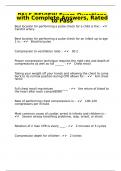
PALS REVIEW Exam Questions with Complete Answers, Rated to Pass
Best location for performing a pulse check for a child is the: - Carotid artery Best location for performing a pulse check for an infant up to age 1 is: - Brachial pulse Compression to ventilation ratio: - 30:2 Proper compression technique requires the right rate and depth of compressions as well as full ______ - Chest recoil Taking your weight off your hands and allowing the chest to come back to its normal position during CPR allows for: - Full chest recoil Full chest recoil maximizes __________ - the return of blood to the heart after each compression Rate of performing chest compressions is: - 100-120 compressors per minute Most common cause of cardiac arrest in infants and children is: - Severe airway breathing problems, resp. arrest, or shock Rotation of 2 man CPR Is every ____ - 2 minutes or 5 cycles Compression depth for children - 2 inches Compression depth for the infant - 1.5 inches True or false: Some victims may continue to demonstrate agonal or gasping breaths for several minutes after a cardiac arrest, but these breaths are too slow or shallow and will not maintain oxygenation. - TRUE: If there is a pulse, administer rescue breaths. True or false: Over inflating the lungs is not harmful for the victim. - FALSE. Over-inflating the lungs causes the positive pressure in the chest that is created by rescue breaths to decrease venous return to the heart. This limits the refilling of the heart, so it will reduce cardiac output created by subsequent chest compressions. Immediate CPR and defibrillation with no more than ____ to ___ minutes gives a person in sudden carried arrest the best chance of survival. - 3, 5 True or false: The AED is used on adults, children, and infants. - TRUE True or false: If pediatric pads are unavailable you cannot use the AED. - FALSE. Use the adult pads if it is the only thing you have. True or false: CPR may not save the life of sudden cardiac arrest victim. Early defibrillation is needed. - TRUE. True or false: If a shock is not advised, leave the pads on and continue CPR, beginning with compressions. - TRUE What is the definition of a clear airway: - Airway is open and unobstructed for normal breathing. What is the definition of a maintainable airway: - Airway is obstructed but can be maintained by simple measures (head tilt- chin lift). What is the definition of a not maintainable airway: - Airway is obstructed and cannot be maintained without advanced interventions (intubation). True or false: A consistent resp. rate of less then 10 or more then 60 breaths/min in a child of any age is abnormal and suggests the presence of a potentially serious problem. - TRUE. Head bobbing can often indicate that the child has increased risk for: - deterioration. Head bobbing is caused by use of the neck muscles to assist breathing and is most frequently seen in infants. This is a sign of ________: - Respiratory failure. True or false: A child may be in Respiratory distress yet maintain normal oxygen saturation. - TRUE. By increasing respiratory rate and effort, especially if supplemental oxygen is given. Normal Respiratory rate infants (less than 1 year): - 30-60 breaths/min Normal Respiratory rate in toddler (1-3): - 24-40 breaths/min Normal Respiratory rate in preschooler (4-5): - 22-34 breaths/min Normal Respiratory rate in school age (6-12): - 18-30 breaths/min Normal Respiratory rate in adolescent (13-18): - 12-16 breaths/ minute Normal heart rate in newborn- 3 months: (awake, sleeping, mean) - Awake: 85-205 sleeping: 80-160 Mean: 140 Normal heart rate in 3 months- 2 years:(awake, sleeping, mean) - Awake: 100-190 Sleeping: 75-160 Mean: 130 Normal heart rate in 2 years- 10 years:(awake, sleeping, mean) - Awake: 60-140 Sleeping: 60-90 Mean: 80 Normal heart rate in 10 years:(awake, sleeping, mean) - Awake: 60-100 Sleeping: 50-90 Mean: 75 Children 1 to 10 years: Definition (formula) of hypotension by systolic blood pressure : - 70 + (age in years x2)= hypotension Definition of hypotension by systolic blood pressure in neonates (0-28 days): - 60 Definition of hypotension by systolic blood pressure in infants (1-12 months): - 70 Definition of hypotension by systolic blood pressure in children 10: - 90 4 Categories of respiratory problems: - 1. Upper airway obstruction 2. lower airway obstruction 3. Lung tissue (parenchymal) disease 4. Disordered control of ventilation The following are signs of Respiratory. distress or Respiratory failure? -Tachypnea, increased Resp. effort, grunting, stridor, wheezing, seesawing, abdominal breathing, head bobbing. - Signs of respiratory distress
Document information
- Uploaded on
- January 18, 2024
- Number of pages
- 13
- Written in
- 2023/2024
- Type
- Exam (elaborations)
- Contains
- Questions & answers