
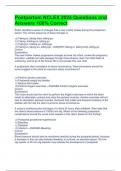
Postpartum NCLEX 2024 Questions and Answers 100% Correct
Rubin identified a series of changes that a new mother makes during the postpartum period. The correct sequence of these changes is a) Taking-in, taking-hold, letting-go b) Taking, holding-on, letting-go c) Taking-in, holding-on, letting-go d) Taking-in, taking-on, letting-go - ANSWER-Taking-in, taking-hold, letting-go
Correct Explanation: The new mother makes progressive changes to know her infant, review the pregnancy and labor, validate her safe passage through these phases, learn the initial tasks of mothering, and let go of her former life to incorporate this new child.
A postpartum client complains of stress incontinence. What information should the nurse suggest to the client to overcome stress incontinence? a) Perform aerobic exercises b) Frequently empty the bladder c) Reduce fluid intake d) Perform Kegel's exercises - ANSWER-Perform Kegel's exercises
Correct Explanation: The nurse should ask the client to perform the Kegel's exercises in which the client needs to alternately contract and relax the perineal muscles. Aerobic exercises will not help to strengthen perineal muscles. Reduced fluid intake and frequent emptying of the bladder will not help the client overcome stress incontinence.
A nurse is monitoring the vital signs of a client 24 hours after childbirth. She notes that the client's blood pressure is 100/60 mm Hg. Which of the following postpartum complications should the nurse most suspect in this client, based on this finding? a) Postpartal gestational hypertension b) Bleeding c) Diabetes d) Infection - ANSWER-Bleeding
Correct Explanation: Blood pressure should also be monitored carefully during the postpartal period, because
a decrease in this can also indicate bleeding. In contrast, an elevation above 140 mm Hg systolic or 90 mm Hg diastolic may indicate the development of postpartal gestational hypertension, an unusual but serious complication of the puerperium. An infection would best be indicated by an elevated oral temperature. Diabetes would be indicated by an elevated blood glucose level.
Bonding between a mother and her infant can be defined how? a) An ongoing process in the year after delivery b) The skin to skin contact that occurs in the delivery room c) A process of developing an attachment and becoming acquainted with each other d) Family growing closer together after the birth of a new baby - ANSWER-A process of
developing an attachment and becoming acquainted with each other
Correct Explanation: Bonding in the maternal-newborn world is the attachment process that occurs between a mother and her newborn infant. This is how the mother and infant become engaged with each other and is the foundation for the relationship. Because bonding is a process
and not a single event, option B is incorrect. The process of bonding is not a year-long process, so option C is incorrect. The family growing closer together after the birth of a new baby is not bonding, so option D is incorrect.
The process by which the reproductive organs return to the nonpregnant size and function is termed what? a) Evolution b) Involution c) Decrement d) Progression - ANSWER-Involution
Correct Explanation: Involution is the term used to describe the process of the return to nonpregnancy size and function of reproductive organs. Evolution is change in the genetic material of a population of organisms from one generation to the next. Decrement is the act or process of decreasing . Progression is defined as movement through stages such as the progression of labor. Options A, C, and D are distracters for this question.
The nurse is caring for a client in the postpartum period. The client has difficulty in voiding and is catheterized. The nurse then would monitor the client for which of the following? a) Loss of pelvic muscle tone b) Stress incontinence c) Urinary tract infection d) Increased urine output - ANSWER-Urinary tract infection
Correct Explanation:
Rubin identified a series of changes that a new mother makes during the postpartum period. The correct sequence of these changes is a) Taking-in, taking-hold, letting-go b) Taking, holding-on, letting-go c) Taking-in, holding-on, letting-go d) Taking-in, taking-on, letting-go - ANSWER-Taking-in, taking-hold, letting-go
Correct Explanation: The new mother makes progressive changes to know her infant, review the pregnancy and labor, validate her safe passage through these phases, learn the initial tasks of mothering, and let go of her former life to incorporate this new child.
A postpartum client complains of stress incontinence. What information should the nurse suggest to the client to overcome stress incontinence? a) Perform aerobic exercises b) Frequently empty the bladder c) Reduce fluid intake d) Perform Kegel's exercises - ANSWER-Perform Kegel's exercises
Correct Explanation: The nurse should ask the client to perform the Kegel's exercises in which the client needs to alternately contract and relax the perineal muscles. Aerobic exercises will not help to strengthen perineal muscles. Reduced fluid intake and frequent emptying of the bladder will not help the client overcome stress incontinence.
A nurse is monitoring the vital signs of a client 24 hours after childbirth. She notes that the client's blood pressure is 100/60 mm Hg. Which of the following postpartum complications should the nurse most suspect in this client, based on this finding? a) Postpartal gestational hypertension b) Bleeding c) Diabetes d) Infection - ANSWER-Bleeding
Correct Explanation: Blood pressure should also be monitored carefully during the postpartal period, because
a decrease in this can also indicate bleeding. In contrast, an elevation above 140 mm Hg systolic or 90 mm Hg diastolic may indicate the development of postpartal gestational hypertension, an unusual but serious complication of the puerperium. An infection would best be indicated by an elevated oral temperature. Diabetes would be indicated by an elevated blood glucose level.
Bonding between a mother and her infant can be defined how? a) An ongoing process in the year after delivery b) The skin to skin contact that occurs in the delivery room c) A process of developing an attachment and becoming acquainted with each other d) Family growing closer together after the birth of a new baby - ANSWER-A process of
developing an attachment and becoming acquainted with each other
Correct Explanation: Bonding in the maternal-newborn world is the attachment process that occurs between a mother and her newborn infant. This is how the mother and infant become engaged with each other and is the foundation for the relationship. Because bonding is a process
and not a single event, option B is incorrect. The process of bonding is not a year-long process, so option C is incorrect. The family growing closer together after the birth of a new baby is not bonding, so option D is incorrect.
The process by which the reproductive organs return to the nonpregnant size and function is termed what? a) Evolution b) Involution c) Decrement d) Progression - ANSWER-Involution
Correct Explanation: Involution is the term used to describe the process of the return to nonpregnancy size and function of reproductive organs. Evolution is change in the genetic material of a population of organisms from one generation to the next. Decrement is the act or process of decreasing . Progression is defined as movement through stages such as the progression of labor. Options A, C, and D are distracters for this question.
The nurse is caring for a client in the postpartum period. The client has difficulty in voiding and is catheterized. The nurse then would monitor the client for which of the following? a) Loss of pelvic muscle tone b) Stress incontinence c) Urinary tract infection d) Increased urine output - ANSWER-Urinary tract infection
Correct Explanation:


