
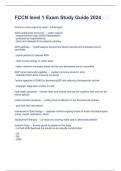
FCCN level 1 Exam Study Guide 2024
minimum urine output for adult - 0.5mL/kg/hr ADH (antidiuretic hormone) - - water retainer - vasoconstrictor (also called Vasopressin) - produced by hypothalamus - store and released from posterior pituitary ADH pathway - - hypothalamus senses low blood volumed and increased serum osmolality - signal pituitary to release ADH - ADH causes kidney to retain water - water retention increases blood volume and decreases serum osmolality ANP (atrial natriuretic peptide) - - cardiac hormone stored in atria - released when atrial pressure increases *works opposite of RAAS by decreasing BP and reducing intravascular volume - important diagnostic marker in CHF hydrostatic pressure - - forces fluids and solutes through the capillary wall and into the tissue spaces colloid osmotic pressure - - pulling force of albumin in the intravascular spaces - pull fluid into vasculature maintenance fluid therapy - - replaces normal ongoing losses of water and electrolytes (urine, sweat, respiration, stool) replacement therapy - - corrects any existing water and or electrolyte deficits isotonic fluids - - tonicity equal to plasma in the body - no fluid shifts because the solutions are equally concentrated - LR - NS - D5W hypotonic fluids - - lower concentration of solutes in the vasculature than in the cell - fluid shifts into the cell to dilute the electrolytes (CELL SWELLS) - 0.45NS hypertonic fluid - - higher concentration of solutes in the vasculature than in the cell - pulls fluid out of cells and into the vessels (CELL SHRINKS) - D5 .45NS - D5NS - D5LR - 3%, 7%, 23.4% NaCl colloids - - pull fluid into bloodstream Albumin - 5% is osmotically equal to plasma - 25% draws 4 times the normal volume into the circulation blood - - not a risk free fluid replacement - this is liquid transplant third spacing - - fluid is not lost from the body but the fluid is not available for use in the intracellular or extracellular compartments (fluid is in between tissues/cells) - this patient is intravascularly dry and still needs more fluid - can you give platelets through the ranger - - no it will aggreggate the platelets hyponatremia - - less than 135 -145 - weakness - abdominal cramping/leg cramps - dizzy - change in LOC - seizures different ways to treat hyponatremia - - hypovolemic (give IV fluid) - euvolemic (fluid restriction) - hypervolemic (diuretic) severe hyponatremia - - EMERGENCY
Document information
- Uploaded on
- January 11, 2024
- Number of pages
- 13
- Written in
- 2023/2024
- Type
- Exam (elaborations)
- Contains
- Questions & answers


