
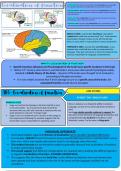
MOTOR AREA= the motor area is located in the frontal lobe and is responsible
for voluntary movements by sending signals to the muscles in the body
SOMATOSENSORY AREA= this area is located in the parietal lobe and receives
incoming sensory info from the skin to produce sensations related to pressure,
pain and temp etc
VISUAL AREA= the occipital lobe is the visual area that receives and processes
visual info e.g. colour, shape and movement
AUDITIORY AREA= located in the temporal lobe and is responsible for analysing
and processing acoustic information. It processes loudness, tempo and pitch.
BROCA’S AREA= named after Paul Broca. His patient
‘patient tan’ could only say the word “tan”. Post-mortem
examination showed a lesion on the left frontal lobe
(Broca’s area) which is responsible for speech production.
WERNICKE’S AREA= named after Carl Wernicke. It was
patients who could talk but could not understand the
language. They also had lesions to their left temporal lobe
and was responsible for language comprehension.
WHAT IS LOCALISATION OF FUNCTION?
Specific functions (physical and Psychological) of the brain have specific locations in the brain
Before 19th Century when Broca’s and Wernicke’s areas were discovered Psychologists widely
adopted a holistic theory of the brain – all parts of the brain were thought to be involved in
processing of thought and action.
It is now widely assumed that if brain damage occurs to a specific area of the brain, the
associated function would also be damaged.
CASE STUDIES
PATIENT ‘TAN’- BROCA’S AREA
PHINEAS GAGE
Broca’s Aphasia is an impaired ability to produce
Gage survived but the damage to his brain had left a mark
on his personality – by all accounts he had turned from language, as seen in Tan who had lesions in Broca’s
someone who was calm and reserved to someone who was area.
quick-tempered, rude and ‘no longer Gage’. Such case studies provide evidence to support the
Gage is seen as a landmark case in science as the change in idea that certain elements of language production and
his temperament following the accident suggests that the comprehension are localised in the Broca’s and
frontal lobe may be responsible for regulating mood Wernicke’s areas. Can be seen as idiographic
INDIVIDUAL DIFFERENCES
Some psychologists argue that theories of localisation fail to consider individual differences
For example, HERASTY found that women have proportionally larger Broca’s and Wernicke’s areas
than men, which may explain why women tend to use language more than men.
This matters because we are therefore unable to generalise research into localisation of functions
to males and females equally.
This would suggest that different considerations are required when studying the different genders
in regard to localisation of function. (POSSIBLE GENDER BIAS)
This suggests that the theory has beta bias, as the differences between men and women have
been ignored and that variations in the size of the areas and the language activities are not
considered.
, ANALYTIC THOUGHT, HOLISTIC THOUGHT, Brain is divided into two symmetrical halves called left and
LOGIC, LANGUAGE, INTUITION, CREATIVITY, right hemispheres
SCIENCE& MATH ART& MUSIC
Some functions are dominated by one hemisphere
(lateralisation)
The outer layer of both hemispheres is called the cerebral
ACTIVITY ON THE RIGHT ACTIVITY ON THE LEFT cortex, a 3mm layer covering the inner parts of the brain.
SIDE OF THE BODY IS SIDE OF THE BODY IS WHAT YOU SEE RECOGNITION BY TOUCH
DESCRIBING This separates us from other animals as the cortex is
1968 BY THE
CONTROLLED CONTROLLED BY THE
LEFT
HEMISPHERE
a QUASI experiment (IV are naturally occurring) RIGHT HEMISPHERE developed. It appears grey If– patients
grey matter.
are shown an object in their left
When a picture of an object was shown
visual field, they can pick up the object (from
11 participants to a patient’s right visual field, they
a selection hidden behind a screen) with
could easily describe what was seen.
The ppts were epileptics who could not be treated
HEMISPHERIC LATERALISATION
their left hand. They couldn’t verbalise what
they were selecting though.
● with drugs
The assumption that two halves or hemispheres of the brain are WhenCORPUS
a pictureCALLOSUM
was presented to the
Thefunctionally
ppts already had her corpus callosum split
different. left field of vision,Athey
bundle of nerve
could not fibres which joinsThe
theleft
two halves
hand of the
was also able brain
to select an
● (noCertain
describe it (they A commissurotomy
often reported that is the division ofobject
the two
mosthemispheres
closely associateddonewithby
the
ethicalmental
issue)processes are controlled by one hemisphere. E.g.,
Language (left) localised to Broca’s area. there was nothingsurgery,
there). which has been occasionally done
object to improve
presented (e.g., epilepsy.
select an ashtray
The left and right side communicatewhen shownthe
between a cigarette)
corpusto the left visual
callosum
● left is dominant for language, right is dominant for visual motor tasks field.
Two different objects placed in each hand -
then hidden for retrieval in pile of items
PROCEDURE Each hand searches for its own object
but ...If the left hand picks up the object
● The participant gazes at a fixation point on an which the right hand is looking for, the
upright translucent screen VISUAL object is rejected… but the other hand
continues to search
● slides are projected either side of the fixation point
(into one visual field or the other) at a rate of one
FIELD=
picture per 1/10 second EVERYTHING
COMPOSITE WORDS DRAWINGS
● Tactile tasks (tasks with objects) were carried out
YOU
Composite SEE
words: TO
If two words were A picture is shown to the left or right
with the ppts hands underneath a screen so the
ppts themselves couldn’t see what they were ONE SIDE OF
presented simultaneously, one on
either side of the visual field (for
visual field and the patient is asked
to draw it.
doing. They had to use ‘feel’ only. YOUR
example key to leftNOSE
visual field and ring
to the right visual field) , they would
The drawings were consistently
better when drawn by the left hand
say ring and they would be able to pick (controlled by the right hemisphere)
up the key with their left hand.
This was despite the patients
Sperry conducted a number of different variations alongside actually being right-handed.
a number of different findings.
1) Describing what you see MAGUIRE ET AL 2000- taxi drivers have to
2) Recognition by touch learn a lot of routes and roads- supports
3) Composite words brain plasticity
4) Matching faces
● PLASTICITY= Plasticity refers to how flexible something is
● BRAIN PLASTICITY = the brain’s ability to modify its own structure and
function as a result of experience ● A limitation of the research into lateralisation is flawed
● FUNCTIONAL RECOVERY= the recovery of abilities and mental processes thatbecause the split-brain procedure is rarely carried out
have been compromised as a result of brain injury now, meaning patients are difficult to come by. (have to
be naturally occurring to avoid ethical issues)
● Research has consistently shown that the brain can adapt very quickly to new PRUNING AND BRIDGING
● For example, studies that use split-brain patients often
situations PRUNING- where connections are lost due to lack of
include very few participants, and often the research
● Different life experiences can affect different areas of the brain, due to practice use
takes an idiographic
approach.
BRIDGING- where new connections are created due to
and trainingFUNCTIONAL
– and MAGNETIC
also due to injury.
RESONANCE IMAGING excellent excellent Correlation not
No use and new stimulus
● Measure changes in blood flow in causation
particular areas of the brain, which ● Therefore, any conclusions drawn are representative only
indicates increased neural activity in
VIDEO GAME RESEARCH those areas. of those individuals who had a confounding physical
● If a particular area of the brain MEDITATION RESEARCH disorderFUNCTIONAL
that madeRECOVERY
the procedure necessary.
AFTER TRAUMA
●fRMI
Kuhn (2014) got increased
participants
demandto forplay
EEG
becomes more active, there is an
oxygen in that
ERP POST-MORTEM
●
Meditation involves training the mind to find relief, ● 1960’s - researchers started to study stroke
area
Super Mario for at least 30 minutes contentment, enlightenment and peace ● This is problematic as such results cannot be generalised
victims who were able to regain brain function
per day
Expensive
ELECTROENCEPHALOGRAM
over
●
a Electrodes placed on the scalpdetectNon-invasive
2-month period. They poor can to the wider
provide a population.
measure
excellent VitalCan during the early
differentiate
● It is practiced through silent focus and contemplation
then compared
Practical (easytheir
smallto brain
use,
electrical charges (action Can differentiate
No of processing of ● stimuli
A stroke damages/destroys
days brain
of cells
psychology
between different
development topotentials)
a control group
resulting fromwho
the activity ● Tibetan monks practice meditation frequently, so
even when there isThe
nobrain can re-wirebefore
most hospitals have
of brain cells. between
they different
make a good research sample ● technology
time so somewas
neurological
itself over
conditions
were not playingAnvideo games theover
them) ● EEG measures amplitude and
neurological conditions behavioural change. level of function can or behavioural
developed.
be regained E.g states.
Broca
●that 2-month period
frequency of the electrical activity in
The main advantage of brain lateralisation is that it increases neuralet al (2004)
Davidson
Theprocessing
limited capacity
space
the brain.and or behavioural
Compared states-. controls.
ERP research is much and Wernicke
(the ability to perform multiple tasksTibetan monks to non-meditation
simultaneously).


