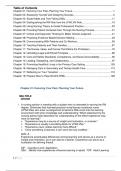
TEST BANKS FOR LPN TO RN TRANSITION BY LORA CLAYWELL 4TH EDITIONTable of Contents Chapter 01: Honoring Your Past, Planning Your Future ............................................................ 1 Chapter 02: Assessing Yourself and Designing Success .......................................................... 5 Chapter 03: Study Habits and Test-Taking Skills .................................................................... 11 Chapter 04: Distinguishing the RN Role from the LPN/LVN Role ............................................ 16 Chapter 05: Using Nursing Theory to Guide Professional Practice ......................................... 23 Chapter 06: Providing Patient-Centered Care Through the Nursing Process .......................... 31 Chapter 07: Critical and Diagnostic Thinking for Better Clinical Judgment .............................. 41 Chapter 08: Practicing Evidence-Based Decision Making ....................................................... 49 Chapter 09: Communicating With Patients and Co-Workers ................................................... 59 Chapter 10: Teaching Patients and Their Families .................................................................. 67 Chapter 11: The Nurses, Ideas, and Forces That Define the Profession................................. 76 Chapter 12: Upholding Legal and Ethical Principles ................................................................ 80 Chapter 13: Care and Safety Standards, Competence, and Nurse Accountability .................. 90 Chapter 14: Leading, Delegating, and Collaborating ............................................................... 97 Chapter 15: Promoting Healthful Living in the Primary Care Setting ..................................... 105 Chapter 16: Managing Care in Secondary and Tertiary Health Care .................................... 113 Chapter 17: Reflecting on Your Transition ............................................................................ 119 Chapter 18: Prepare Now to Pass NCLEX-RN® ................................................................... 128
Chapter 01: Honoring Your Past, Planning Your Future
MULTIPLE CHOICE
1. A nursing advisor is meeting with a student who is interested in earning her RN degree. She knows that licensed practical nurse/license vocational nurse (LPN/LVNs) who enter nursing school to become RNs come into the learning environment with prior knowledge and understanding. Which statement by the nursing advisor best describes her understanding of the effect experience may have on learning? a. “Experience may be a source of insight and motivation, or a barrier.” b. “Experience is usually a stumbling block for LPN/LVNs.” c. “Experience never makes learning more difficult.” d. “Once something is learned, it can never be truly modified.”
ANS: A Experience accentuates differences among learners and serves as a source of insight and motivation, but it can also be a barrier. Experience can serve as a foundation for defining the self.
DIF: Cognitive Level: Application OBJ: Identify how experiences influence learning in adults. TOP: Adult Learning
1 | P a g e2. There is a test on the cardiovascular system on Friday morning, and it is now
Wednesday night. The student has already taken a vacation day from work
Thursday night so that she can stay home and study. She is considering skipping her
exercise class on Thursday morning to go to the library to prepare for the test.
Which response best identifies the student’s outcome priority?
a. Exercise class
b. Going to the library
c. Avoiding work by taking a vacation
d. Doing well on the test on Friday
N
ANS: D
The outcome priority is the essential issue or need to be addressed at any given
time within a set of conditions or circumstances.
DIF: Cognitive Level: Application
OBJ: Identify motivations and personal outcome priorities for returning
to school. TOP: Motivation to Learn
3. A nurse who has been an LPN/LVN for 10 years is meeting with an advisor to
discuss the possibility of taking classes to become an RN. The advisor interprets
which statement by the nurse as the driving force for returning to school?
a. “I’ll need to schedule time to attend classes.”
b. “I’ll have to budget for paying tuition.”
c. “I’ll have to rearranging my schedule.”
d. “There is a possibility of advancement into administration.”
ANS: D
Driving forces are those that push toward making the change, as opposed to
restraining forces, which are those that usually present a challenge that needs to be
overcome for the change to take place or present a negative effect the change may
initiate.
DIF: Cognitive Level: Application
OBJ: Identify motivations and personal outcome priorities for returning
to school. TOP: Motivations for Change
4. An RN is caring for a diabetic patient. The patient appears interested in changing her
lifestyle and has been asking questions about eating better. The nurse can interpret
this behavior as which stage of Lewin’s Change Theory?
a. Moving
b. Unfreezing
c. Action
d. Refreezing
ANS: B
The patient is in the first phase of Lewin’s Change Theory, known as unfreezing. This
phase involves determining that a change needs to occur and deciding to take action.
Moving is the second phase and involves actively planning changes and taking
action on them. Refreezing is the last stage, and it occurs when the change has
become a part of the person’s life.
DIF: Cognitive Level: Analysis
OBJ: Understand Change Theory and how it applies to
becoming an RN. TOP: Change Theory
2 | P a g e5. An LPN is talking with her clinical instructor about her decision to return to school to
become an RN. The clinical instructor interprets the LPNs outcome priority based on
which statement?
a. “My family wanted me to go back to school.”
b. “I want to better my financial situation.”
c. “I really enjoy school.”
d. “I would like to advance to a teaching role someday.”
ANS: B
The outcome priority is the essential need that must be addressed, determined by
internal and external factors, such as needing to better a financial situation. The
other statements indicate reasons for returning to school, but they are not essential
needs or issues to be addressed.
DIF: Cognitive Level: Analysis
OBJ: Identify how experiences influence learning in adults. TOP: Adult Learning
6. A nurse notices a posting for a management position for which she is qualified. If the
nurse is in the moving phase of Lewin’s Change Theory, which statement reflects the
action she is most likely to take?
a. Does nothing to obtain the position
b. Applies for the position
c. Identifies that change is needed
d. Settles into the routine of her job
ANS: B
Unfreezing begins when reasons for change are identified. The moving phase
involves active planning and action. Moving also means you are dealing with both
positive and negative forces as they ebb and flow, and you are making
modifications to your plan as needed.
Refreezing occurs after the change has become routine.
DIF: Cognitive Level: Application
OBJ: Understand Change Theory and how it applies to
becoming an RN. TOP: Change Theory
7. An Orthopedic Nurse is contemplating changes in her professional life and
identifying goals. Which action should the nurse take if she is interested in pursuing
a long-term goal?
a. Studies for a telemetry exam scheduled for next week
b. Enrolls in a Nurse Practitioner program
c. Attends a seminar to become a charge nurse
d. Continues to work on the orthopedic floor full-time
ANS: B
A short-term goal is one that can be attained in a period of 6 months or less. Short-
term goals include becoming a charge nurse and passing the telemetry exam. A
long-term goal is attained in greater than 6 months and includes studying to become a
Nurse Practitioner. Continuing to work on the orthopedic floor does not represent
either a short-term or a long-term goal.
DIF: Cognitive Level: Application
OBJ: Identify both short- and long-term personal and
3 | P a g eprofessional goals. TOP: Setting Goals
8. The RN is talking with the unit manager about ways to improve patient care. The
manager introduces the concept of a cohort. Which statement by the RN indicates
that the teaching has been effective?
a. “A cohort is a web of connections”.
b. “A cohort is a group of people who share common experiences with each other”.
c. “A cohort is a group linked together for common purposes”.
d. “A cohort consists of groups of individuals that make up a whole”.
ANS: B
A cohort is a group of people who share common experiences with each other. A
scheme is a web of connections, a team is a group linked together for common
purposes, and a unit consists of groups or individuals that make up a whole.
DIF: Cognitive Level: Evaluation
OBJ: Identify how experiences influence learning in adults. TOP: Adult Learning
9. The nurse educator is presenting a lecture to a group of new RNs. Which statement
by one of the RNs indicates that teaching has been effective?
a. “Experience is a stepping stone to new learning”.
b. “Experience can be a barrier to new learning”.
c. “Experience can be an avenue to new learning”.
d. “Experience can be a detour to new learning”.
ANS: B
Experience accentuates differences among learners, serves as a source of insight
and motivation, can be a barrier to new learning, and serves as a foundation for
defining the self.
DIF: Cognitive Level: Evaluation
OBJ: Identify motivations and personal outcome priorities for returning
to school. TOP: Adult Learning
10. The nurse educator is presenting a lecture on experience and learning to a
group of RNs. Which statement by one of the RNs indicates that teaching has
been effective?
a. “Experiences always help educational endeavors”.
b. “The process of unlearning is easier than the initial learning”.
c. “Learning can often be more difficult if previous knowledge is contradicted”.
d. “Experiences rarely serve the student in the learning process”.
ANS: C
Experiences may either help or hinder both present and future educational
endeavors (Knowles et al., 2015). Experience may serve as a chain to which new
learning may be linked, making concepts understandable within your personal
context. Conversely, some experiences make learning more difficult in that new
information may contradict previously accepted information and make it necessary to
unlearn it. The process of unlearning is more difficult than initial learning.
DIF: Cognitive Level: Evaluation
OBJ: Delineate both positive and negative effect experiences. TOP: Adult
Learning
4 | P a g eMULTIPLE RESPONSE
1. A student nurse and the staff RN are discussing recent changes on the nursing unit.
Which of the following are examples of change processes? (Select all that apply.)
a. Coercive
b. Collaborative
c. Technocratic
d. Planned
e. Organized
ANS: A, C, D
Coercive is a type of change that is forced or pushed on another. A decision for
change made by the most knowledgeable person is known as technocratic. Planned
change involves careful thought and decision-making. Collaborative and organized
are not considered to be types of change.
DIF: Cognitive Level: Application
OBJ: Understand Change Theory and how it applies to
becoming an RN. TOP: Change Theory
Chapter 02: Assessing Yourself and Designing Success
MULTIPLE
CHOICE
1. After a particularly challenging examination, a student is overheard in the hallway
exclaiming, “That instructor just grades too hard! She only gave me a B on the
test!” This student is exhibiting traits of a(n)
a. external locus of control.
b. internal locus of control.
c. perfectionist.
d. realist.
ANS: A
Persons with an external locus of control often do not take responsibility for what
happens to them. Persons with an internal locus of control take responsibility for
what happens to them. A perfectionist strives for perfection in all that he or she
does, which is a self-defeating behavior. A realist accepts the world as it is and
handles it accordingly.
DIF: Cognitive Level: Application
OBJ: Interpret the role of locus of control on personal
empowerment. TOP: Locus of Control
2. A student must come back to the learning laboratory to repeat the skills and check for
insertion of a nasogastric tube. The instructor overhears the student saying, “I know
I can do this, I know I can do this!” The instructor interprets this behavior as
a. a self-defeating behavior.
b. positive self-talk.
c. perfectionism.
N
5 | P a g ed. blaming.
ANS: B
The student is expressing positive self-talk by telling herself, “I know I can do this.”
Stating “I can’t do this” is an example of a self-defeating behavior. A student expecting
to perform tasks perfectly is striving for perfectionism. Blaming is not occurring here
because the student is taking responsibility for his/her own actions.
DIF: Cognitive Level: Analysis
self-talk. TOP: Self-Talk
OBJ: Explain the impact of positive
3. A clinical instructor notices that one of her students worries a lot, expects negative
outcomes for most situations, strives for perfection, and seems to look for the tiniest
faults in her work.
The clinical instructor interprets these behaviors as
a. commitment to learning.
b. assuming an external locus of control.
c. self-directedness.
d. self-defeating behaviors.
ANS: D
The student may be committed to learning, but she is showing signs of self-
defeating behaviors. Self-defeating behaviors include pessimism, nit-picking,
worrying, perfectionism, and blaming. Assuming an external locus of control means
believing that action or inaction lies outside of oneself. Assuming ownership of
learning defines self-directedness.
DIF: Cognitive Level: Analysis
OBJ: Describe self-defeating
behaviors. TOP: Self-Defeating Behaviors and Empowerment
4. A nursing professor is grading an assignment on self-defeating behavior. The
professor can expect to find which statement written by the student who has a
good understanding of perfectionism?
a. Perfection is impossible to attain, and therefore constantly falling
short of perfection leads to negative feelings and beliefs about
oneself.
b. Perfection is the ultimate goal, and it is not a self-defeating behavior to
demand it of oneself.
c. Perfectionism is the only means by which we can truly improve.
d. Perfectionism is a character flaw and cannot be addressed.
ANS: A
Perfection is impossible to obtain. Students who strive for perfection set
themselves up for negative feelings and beliefs about themselves.
DIF: Cognitive Level: Analysis
OBJ: Describe self-defeating
behaviors. TOP: Self-Defeating Behaviors
5. The nurse understands that there are four key habits for managing the work of
success. Which action by the nurse demonstrates her understanding?
a. Participating in a yoga class
b. Analyzing case studies on her day off
c. Taking time at the beginning of the work shift to make a plan for her day
d. Setting short- and long-term goals
6 | P a g eANS: C
The nurse understands that there are four key habits of success when she makes a
plan for her day. Joining a yoga class, analyzing case studies, and setting short- and
long-term goals are not defined as one of the four key habits.
DIF: Cognitive Level: Application
OBJ: Explain four key work habits that contribute to
success. TOP: Managing the Work of Success
6. A student has a large reading assignment that must be completed in order to be
prepared for the next class. Which action by the student would be ineffective in the
planning process?
a. Put off the assignment until later so more content is remembered.
b. Examine your schedule to determine time frames for study sessions.
c. Determine a study environment fitting your learning style.
d. Divide the assignment into manageable chunks, and take notes as you read.
ANS: A
The time to begin to plan how to accomplish an assignment is the moment one is
made aware of the assignment.
DIF: Cognitive Level: Application
OBJ: Explain four key work habits that contribute to
success. TOP: Managing the Work of Success
7. The roommate of a nursing student buys tickets to the student’s favorite play.
The student realizes that the play is the night before her final exam. When the
student turns down the tickets, the roommate interprets the student’s dedication
to school as
a. dedication to the plan until other mounting responsibilities interfere.
b. total dedication, even in the face of other attractive opportunities.
c. total dedication until resolve begins to wane.
d. discipline to change the plan as needed.
ANS: B
Commitment requires discipline to maintain resolve even when other
responsibilities or attractive opportunities begin to mount.
DIF: Cognitive Level: Analysis
OBJ: Explain four key work habits that contribute to
success. TOP: Managing the Work of Success
8. A nursing student is learning about effective time management in her first semester
of nursing school. Which action by the student indicates that she understands the first
critical step?
a. Setting goals based on the desired outcome
b. Prioritizing goals in order of simple to complex
c. Prioritizing tasks in chronological order
d. Assessing the reality of the complete situation
ANS: D
Assessing the complete situation is the first step in time management. One must be
clear about the reality of the current set of tasks and schedule in order to begin to
manage the time associated with the tasks.
7 | P a g eDIF: Cognitive Level: Application
OBJ: Explain four key work habits that contribute to
success. TOP: Managing the Work of Success
9. Stress reduction while in nursing school is an important part of maintaining one’s
health. Holistic cognitive theory for stress reduction has four steps. The student
shows that he or she understands the first step to achieving awareness by doing
which of the following?
a. Becomes aware of the early physical signs of stress
b. Concentrates on placing himself or herself as the center of everything
c. Mentally filters perceptions
d. Disqualifies the positive in the experience
ANS: A
The awareness step is a time of understanding how the student feels under stress,
coming to know the symptoms, and taking steps to neutralize the symptoms.
DIF: Cognitive Level: Application OBJ: Identify steps that aid in stress
reduction. TOP: Stress Reduction
10. A student exclaims, “I have to make a 100% on this test because anything less is
just like failing in my book. I either know it or I don’t and if I don’t know it now, I
never will.” This student is obviously stressed, and the statements represent
a. awareness reduction.
b. cognitive distortions.
c. positive coping mechanisms.
d. acceptance of reality.
ANS: B
Cognitive distortions are illogical, irrational thoughts; those in this
question are “all-or-nothing thinking” and “emotional reasoning.”
DIF: Cognitive Level: Application OBJ: Identify steps that aid in stress
reduction. TOP: Stress Reduction
11. A lab instructor is observing placement of a Foley catheter by a senior nursing
student. If the student is in the active experimentation phase of Kolb’s Theory of
Experiential Learning, what action can the lab instructor expect from the student?
a. The student will need to observe placement before proceeding.
b. The student assists the instructor in placing the catheter.
c. The student places the Foley catheter without assistance.
d. The student verbalizes beginning to understand catheter placement.
ANS: C
According to Kolb’s Theory of Experiential Learning, the student is in the active
experimentation phase. When the student nurse places the Foley catheter, he or she
is actively involved in the experience. Concrete experience occurs when the student
is actively involved in a new experience. Reflectiveobservation begins when the
student observes the experience. Abstract conceptualization occurs when the student
begins to understand the process of
placing the Foley catheter.
DIF: Cognitive Level: Analysis
OBJ: Describe how learning style affects the learning process. TOP: Learning
Style
8 | P a g e12. A lab instructor is preparing to teach a group of students. After reading
questionnaires filled out by the students in her group, she notes that the students
would best learn by reflective observation. What activity should the instructor plan so
that the students have the best chance of success?
a. Set up stations so that the students can try to “figure it out for themselves.”
b. Allow the students to observe a presentation.
c. Present the information in a lecture while students take notes.
d. Present information and allow the students to be directly involved in a
hands-on setting.
ANS: B
Learning by observing is what Kolb terms reflective observation. Concrete
experience involves hands-on learning. In active experimentation, students learn by
trying to figure it out for themselves. Abstract conceptualization is the process of
learning through data collection, such as lecture.
DIF: Cognitive Level: Application
OBJ: Describe how learning style affects the learning process. TOP: Learning
Style
13. A nurse is trying to manage success in the workplace. Which action
demonstrates that she understands key habits that must be developed and
maintained?
a. Carefully list and organize the day’s tasks.
b. Complete a task over again because it wasn’t done perfectly the first time.
c. Avoid difficult tasks because they won’t be done correctly.
d. Blame others for lack of organization.
ANS: A
Carefully listing and organizing the day’s tasks demonstrates that the nurse
understands key habits needed for success, such as time management.
Completing tasks over again, avoiding tasks, and blaming others are all self-
defeating behaviors that do not help manage success.
DIF: Cognitive Level: Application
OBJ: Explain four key work habits that contribute to success.
Success
14. A nurse is listening to a lecture on self-awareness. Which statement by the nurse
indicates that the teaching has been effective?
a. “Self-confidence involves knowing oneself”.
b. “Competence involves knowing oneself”.
c. “Understanding involves knowing oneself”.
d. “Self-awareness involves knowing oneself”.
ANS: D
Self-awareness involves understanding and being conscious of oneself. This
involves being aware of one’s strengths and weaknesses. Self-confidence,
competence, and understanding do
not encompass this.
DIF: Cognitive Level: Evaluation OBJ: Identify personal gifts and
9 | P a g e
TOP: Habits forbarriers. TOP: Self-Awareness
15. The student is listening to a lecture on self-defeating behaviors. Which
statement by the student indicates that teaching has been effective?
a. “Nit-picking is viewing situations from a negative aspect.”
b. “Pessimism is looking for all imperfections.”
c. “Worrying is being concerned over issues that may or may not be in your control.”
d. “Perfectionism is rejecting responsibility for actions or inactions.”
ANS: C
Worrying means to be concerned over issues that may or may not be in your
control. Pessimism occurs when situations are viewed from a negative aspect. Nit-
picking means to look for all imperfections. Perfectionism means to continuously
strive to be perfect or do things perfectly.
DIF: Cognitive Level: Evaluation OBJ: Describe self-defeating
behaviors. TOP: Self-Defeating Behaviors
MULTIPLE RESPONSE
1. Which actions or statements can the nurse take to eliminate self-defeating
behaviors? (Select all that apply.)
a. Say, “I know that I can do this.”
b. Accept responsibility for his or her actions.
c. Worry about things that are out of his or her control.
d. Strive for perfection.
e. Believe that his or her actions are out of his or her control.
ANS: A, B
Stating “I know I can do this” and accepting responsibility for his or her actions are
actions and statements that the nurse can take to eliminate self-defeating
behaviors. Worrying, striving for perfection, and believing that his or her actions
are out of his or her control are examples of self-defeating behaviors.
DIF: Cognitive Level: Application OBJ: Describe self-defeating
behaviors. TOP: Self-Defeating Behaviors
2. A group of nursing students is discussing how their lives have changed since
beginning nursing school. The student who understands the second step of holistic
cognitive theory for stress reduction recognizes which comments as descriptive of
automatic thoughts? (Select all that apply.)
a. “My lab instructor doesn’t like me. I had to repeat my cardiac assessment
when no one else did.”
b. “After studying for hours, I finally remembered all the steps to insert a
Foley catheter. I will use this method again.”
c. “My child is having behavioral issues in preschool. I know it is because I am in
school right now.”
d. “Right after I turned in my test I knew there were at least two answers that I
should have changed. I know I failed the test.”
e. “Everything is falling apart in my life. I never should have come to school.”
ANS: A, C, D, E
Automatic thoughts are immediate; without reflection; usually negative, with words
such as should and never; and irrational and not based in reality. The correct options
reflect automatic thoughts because they include the words “should” and “never.”
10 | P a g eStudying for hours would not be considered an automatic thought.
DIF: Cognitive Level: Application OBJ: Identify steps that aid in stress
reduction. TOP: Stress Reduction
3. A patient is learning to improve her personal empowerment skills after going through
a tough divorce. Which actions can she take to accomplish this? (Select all that
apply.)
a. Practice positive self-talk.
b. Manage the work of success.
c. Develop an external locus of control.
d. Eliminate self-defeating behaviors.
e. Manage good health.
ANS: A, B, D, E
Practicing positive self-talk, managing the work of success, eliminating self-defeating
behaviors, and managing good health are all ways that the patient can improve her
personal empowerment skills. A person with an external locus of control believes that
responsibility for actions lies outside of himself or herself.
DIF: Cognitive Level: Application OBJ: Explain the impact of positive
self-talk. TOP: Personal Empowerment Skills
4. A student is listening to a lecture on stress reduction and coping mechanisms.
Which statement by the student indicates that the teaching has been effective?
(Select all that apply.)
a. “Relaxation is a positive coping mechanism.”
b. “Catharsis is a form of stress reduction.”
c. “Reframing would aide in stress reduction.”
d. “Distraction is the most helpful form of stress reduction.”
e. “Adrenaline rush prevents stress.”
ANS: A, B, D
The relaxation and catharsis generated by laughter are positive coping mechanisms.
Distraction takes the student’s mind off the stress for a while so that she can be
recharged and handle it positively at another time. Reframing means looking at the
situation from a different perspective. An adrenaline rush is considered a time waster,
not a stress reduction technique.
DIF: Cognitive Level: Evaluation OBJ: Identify steps that aid in stress
reduction. TOP: Stress Reduction
Chapter 03: Study Habits and Test-Taking Skills
MULTIPLE CHOICE
1. A first semester student is struggling in class and did not do well on her last exam.
She has determined the problem to be her lack of skill in note taking. What can the
student do in order to take more effective notes during lecture?
a. Focus on writing key words and phrases.
b. Photocopy someone else’s notes.
11 | P a g ec. Write verbatim all that is said.
d. Practice memorization in class instead of taking notes.
ANS: A
The student should focus on writing key words and phrases in order to be more
effective at note taking. Photocopying someone else’s notes, writing verbatim, and
memorizing lecture will not help the student with effective note taking.
DIF: Cognitive Level: Application OBJ: Describe the components of effective
listening. TOP: Note-Taking
2. A student nurse feels that his reading skills are not adequate. Which action would
he take in order to have effective reading skills?
a. Focus on improving reading speed.
b. Read slowly and thoroughly.
c. Ask his friends and family read to him.
d. Passively engage in reading.
N
ANS: A
Evidence relates reading speed to comprehension; the faster you read, the
more you understand what you are reading.
DIF: Cognitive Level: Application OBJ: Describe how to improve reading
skills. TOP: Effective Reading
3. A struggling student admits that she is reading the same paragraph over and over
when she tries to read the text. The instructor recognizes this as inhibitory to her
comprehension of the material. Which suggestion could the instructor make to the
student to help correct the situation?
a. “Just keep trying. Maybe you need to read it over a few times to get it.”
b. “Maybe you are waiting too late at night to study. Try studying earlier in the day.”
c. “Try putting your finger under the words one at a time.”
d. “If the words are a stumbling block, study them alone first, and then as
you read, you will be less likely to stumble over them and regress.”
ANS: D
Regression, or rereading what was just read, may be caused by stumbling over
unfamiliar terms that cause reading to slow and decrease.
DIF: Cognitive Level: Application OBJ: Describe how to improve reading
skills. TOP: Effective Reading
4. The student is listening to a lecture on the SQRRR method. Which statement
indicates that teaching has been effective?
a. “The appropriate way to use the method is to scan, skim, survey,
read, recite, review”.
b. “The appropriate way to use the method is to scan, skim, read, recite,
review, reread”.
c. “The appropriate way to use the method is to survey, question,
read, recite, review”.
d. “The appropriate way to use the method is to survey, question, read,
review, reread”.
ANS: C
SQRRR is a tried and true method: survey, question, read, recite, and review.
12 | P a g eDIF: Cognitive Level: Evaluation
OBJ: Prepare to study effectively using the SQRRR method.
Your Study Skills
TOP: Improving
5. A nursing student is preparing for her first day of lecture. She knows that in order to
succeed, she should
a. skip the first day of class and read the material at home.
b. sit in the front of the room, away from distractions.
c. take notes from the book during lecture time.
d. sit in the back of the class, next to her best friend.
ANS: B
Students should sit in the front of the classroom for optimal learning, away from
distractions.
DIF: Cognitive Level: Application
OBJ: Describe positive face-to-face and online class
strategies. TOP: General Face-to-Face Classroom
Behaviors
6. A patient comes to the emergency department with complaints of crushing chest
pain that radiates down his left arm. While reviewing his health history with the RN,
the patient states that he has been getting over a cold. He also has seasonal
allergies and is allergic to peanuts.
The nurse interprets the major detail for the patient’s ER visit as the patient
a. has a peanut allergy.
b. is experiencing crushing chest pain.
c. is getting over a cold.
d. has seasonal allergies.
ANS: B
The major detail in this scenario is the patient’s crushing chest pain, which brought
him into the ER. All other are minor details.
DIF: Cognitive Level: Analysis
details. TOP: Major/Minor Details
OBJ: Distinguish between major and minor
7. The RN is performing an assessment on a patient being admitted for back pain.
The nurse interprets which of the patient’s statements as a minor detail?
a. The patient has not been able to void in 12 hours.
b. The patient ate 90% of his meal.
c. The patient reports being unable to walk.
d. The patient was involved in a car accident 2 days ago.
ANS: B
Minor details support the major details and peripherally support the main idea. In
this scenario, the patient eating 90% of his meal is a minor detail. The other
choices are major details.
DIF: Cognitive Level: Analysis
OBJ: Describe how to improve reading
skills. TOP: Relating Details to a Main Idea
8. A student has been out of school for a number of years. She is concerned that she
13 | P a g emay not be able to study effectively. What action can the student take that will
increase her ability to focus on her studies?
a. Study for 1 hour a night.
b. Study in a loud coffee shop.
c. Stay up all night before tests to make sure she is proficient.
d. Study with the TV off.
ANS: D
The student should learn ways to study effectively in order to succeed in school.
Studying for only 1 hour per night, studying in a loud coffee shop, and staying up all
night to study are not ways to study effectively.
DIF: Cognitive Level: Application
OBJ: Prepare to study effectively using the SQRRR method.
Strategies
TOP: More Study
9. A student is reviewing new material for an upcoming test. She has decided to
highlight so that she can come back later to easily review the material. How can she
use highlighting to be
successful?
a. She should highlight the first time she reads the material.
b. She should highlight no more than 20% of the material.
c. She should use only one method of highlighting.
d. She should highlight the entire chapter.
ANS: B
The student should read the material at least once before she begins highlighting.
Highlighting during the first read through, using only one method of highlighting, and
highlighting the entire chapter would not assist the student in being successful.
DIF: Cognitive Level: Application OBJ: Describe how to improve reading
skills. TOP: Highlighting Appropriately
10. The student is listening to a lecture on better study habits. Which statement
indicates that teaching has been effective?
a. “I should study for 3 to 4”.
b. “I should study for 2 to 3”.
c. “I should study for 4 to 5”.
d. “I should study for 5 to 6”.
ANS: B
For every hour of class the student should spend 2 to 3 hours studying in
order to be successful.
DIF: Cognitive Level: Evaluation
OBJ: Prepare to study effectively using the SQRRR method.
Your Study Skills
TOP: Improving
11. The student is attending a lecture on improving test taking. Which statement
indicates that the teaching has been effective?
a. “Multiple incorrect options on a test are stems”.
b. “Multiple incorrect options on a test are structured responses”.
c. “Multiple incorrect options on a test are distracters”.
d. “Multiple incorrect options on a test are negative indicators”.
14 | P a g eANS: C
Multiple incorrect options on a test are known as distracters.
DIF: Cognitive Level: Evaluation OBJ: Incorporate strategies to improve
test taking. TOP: Test-Taking Skills
MULTIPLE
RESPONSE
1. A nursing student knows that effective listening requires attention and
preparation. What actions can she take to ensure that she is proficient? (Select
all that apply.)
a. Read over the assigned material before class begins.
b. Read over the material as soon as class is over.
c. No special attention or preparation is required.
d. Read the material during class.
e. Study independently during discussion time.
ANS: A, B
To listen effectively, prepare for what you will hear before class. In class maintain
concentration and actively engage in the discussion, and then after class review
notes and add clarifying comments.
DIF: Cognitive Level: Application OBJ: Describe the components of effective
listening. TOP: Effective Listening
2. You are a first semester nursing student and have just received your first reading
assignment for class tomorrow. You know that in order to succeed you will need to
practice effective listening. Which actions would prepare you for class tomorrow?
(Select all that apply.)
a. Read over the assigned material tonight.
b. Scan over the material before class, looking at the main points and subpoints.
c. Read the text during class instead of listening to lecture.
d. Review your notes immediately after class.
e. Do not review anything before class.
ANS: A, B, D
In order to be prepared for class you should: Read over assigned material the night
before; scan over the material before class, looking at both main points and
subpoints; and review notes immediately after class. Practicing effective listening
includes giving the instructor your undivided attention. Often instructors emphasize
points that they do not want students to miss. These points often end up on exams.
DIF: Cognitive Level: Application OBJ: Describe the components of effective
listening. TOP: Effective Listening
3. A student is studying for an upcoming test. She has read the assigned text once
and is now ready to highlight. Which actions by the student indicate that she
understands how to highlight? (Select all that apply.)
a. Uses circles to highlight key words or phrases
b. Draws an asterisk next to an important paragraph or sentence
c. Underlines sentences of importance
d. Draws squares around words for emphasis
15 | P a g ee. Marks a section with a star for future reference
ANS: A, B, C, E
Circles, asterisks, underlines, and stars are all acceptable ways of highlighting
that would indicate differences in the material.
DIF: Cognitive Level: Application OBJ: Describe how to improve reading
skills. TOP: Highlighting
4. A student has just listened to a lecture on better strategies for studying. Which of the
student’s actions indicate understanding? (Select all that apply.)
a. Wait until the evening to study.
b. Begin with the most difficult subjects.
c. Create a conducive study environment.
d. Record the lectures and listen to them in your car.
e. Begin to study the day before an exam.
ANS: B, C, D
Beginning study sessions with the most difficult subjects, creating a conducive
study environment, and listening to lectures in your car are all ways to create
better strategies for studying.
DIF: Cognitive Level: Application
OBJ: Prepare to study effectively using the SQRRR method.
Your Study Skills
Chapter 04: Distinguishing the RN Role from the LPN/LVN Role
MULTIPLE
CHOICE
1. A nurse manager is discussing the RN’s scope of practice with a new hire. Which
statement, made by the new hire, is not true of the RN’s scope of practice?
a. “A nurse may be disciplined by the Board of Nursing for practicing beyond
his or her scope of practice.”
b. “Scope of practice is legally defined by the American Nurses Association (ANA).”
c. “Scope of practice defines the responsibilities of nurses.”
d. “Scope of practice can be found in state nurse practice acts.”
ANS: B
The RN’s scope of practice is legally defined by state nurse practice acts, not the
ANA. A nurse may be disciplined by the Board of Nursing. The scope of practice
defines the responsibilities of nurses and can be found in state nurse practice
acts.
DIF: Cognitive Level: Application
OBJ: Compare and contrast the scope of practice for the LPN/LVN
and the RN. TOP: Scope of Practice
MSC: NCLEX: Safe and Effective Care Environment: Management of Care
2. The nursing student is reviewing the different organizations that provide services for
nurses.
16 | P a g e
TOP: ImprovingShe interprets the American Nurses Credentialing Center as
a. an association that provides accreditation for baccalaureate and
higher degree nursing education programs.
b. the unifying body for the state boards of nursing.
c. an association that offers certification in many nursing specialties.
d. an organization that offers the national licensure examination.
ANS: C
The American Nurses Credentialing Center offers certification in many nursing
specialties. The Commission on Collegiate Nursing Education provides nursing
school accreditation. The National Council of State Boards of Nursing is the unifying
body for the state boards of nursing. NCLEX is the national licensure examination
implemented by the National Council of State Boards of Nursing.
DIF: Cognitive Level: Analysis
OBJ: Recognize the differences in the educational preparation of the
LPN/LVN and RN. TOP: Educational Preparation
MSC: NCLEX: Safe and Effective Care Environment: Management of Care
3. The student is studying the history of nursing education. She is able to identify which
nursing degree program as the first one in the United States for RNs?
a. Associate’s degree
b. Bachelor’s degree
c. Diploma degree
d. Master’s degree
ANS: C
The first nursing degree program in the United States was the diploma, which began
in 1872. The associate’s, bachelor’s, and master’s nursing programs came later.
DIF: Cognitive Level: Synthesis
OBJ: Recognize the differences in the educational preparation of the
LPN/LVN and RN. TOP: Educational Preparation
MSC: NCLEX: Safe and Effective Care Environment: Management of Care
4. Which function falls within the LPN/LVN’s scope of practice?
a. Formulating the plan of care
b. Collecting data
c. Selecting nursing diagnoses
d. Setting goals, objectives, and outcomes
ANS: B
One of the many functions of the LPN/LVN is that of data collector. Formulating the
plan of care; selecting nursing diagnoses; and setting goals, objectives, and
outcomes are not in the scope of practice for the practical nurse and must be
performed by an RN.
DIF: Cognitive Level: Application
OBJ: Compare and contrast the professional roles of the LPN/LVN
and the RN. TOP: Professional Roles
MSC: NCLEX: Safe and Effective Care Environment: Management of Care
5. Which of the following is an example of professional advocacy in nursing?
a. Charting and writing up a medication error
b. Writing up a nursing assistant for excessive absences
17 | P a g ec. Writing one’s senator concerning mandatory overtime
d. Mentoring a new graduate RN who is new to the unit
ANS: C
Writing one’s senator concerning mandatory overtime is professional advocacy.
Charting and writing up a medication error, writing up a nursing assistant, and
mentoring a new graduate are expectations of the RN.
DIF: Cognitive Level: Application
OBJ: Describe various role elements that are inherent in the scope of registered
nursing practice. TOP: Role Elements
MSC: NCLEX: Safe and Effective Care Environment: Management of Care
6. The RN is caring for the following patients. Which patient and task are most
appropriate to assign to the LPN/LVN?
a. A 34-year-old female patient who will need discharge teaching
b. A 40-year-old postoperative male patient who needs a dressing change
c. A 64-year-old female patient who needs a bed bath
d. A 79-year-old patient whose plan of care needs to be updated
ANS: B
The LPN/LVN is skilled in dressing changes. The nursing assistant is skilled in giving
a bed bath. Discharge teaching and updating the plan of care are tasks that must be
performed by the RN.
DIF: Cognitive Level: Application
OBJ: Compare and contrast the scope of practice for the LPN/LVN
and the RN. TOP: Professional Roles
MSC: NCLEX: Safe and Effective Care Environment: Management of Care
7. The charge nurse is creating assignments for the oncoming shift. She notices that
today staffing consists of three RNs and one LPN. Which assignment would be most
appropriate for the LPN?
a. Acute MI: needs preparation for the catheter lab
b. Flu-like symptoms: needs reassessment of vital signs every hour
c. Possible stroke: needs anticoagulation therapy
d. Dehydration: needs IVF boluses and IV antiemetic
ANS: B
The most appropriate assignment for the LPN would be the patient with flu-like
symptoms. The LPN can perform basic assessment and data collection and can
meet the basic needs of the patient. The RNs should be assigned the patients with
acute MI, possible stroke, and dehydration, all of whom require critical thinking and
a higher level of care.
DIF: Cognitive Level: Application
OBJ: Compare and contrast the scope of practice for the LPN/LVN
and the RN. TOP: Professional Roles
MSC: NCLEX: Safe and Effective Care Environment: Management of Care
8. The RN understands that the National League for Nursing (NLN) delineates three
professional roles of the associate degree nurse when she lists all of the following
except
a. manager of care.
b. team player.
18 | P a g ec. provider of care.
d. member of profession.
ANS: B
The NLN delineates the following as professional roles of the associate degree nurse:
manager of care, provider of care, and member of the profession. For all three of
these roles, the nurse follows the nursing process. The NLN does not delineate being
a team player as a professional role.
DIF: Cognitive Level: Application
OBJ: Compare and contrast the scope of practice for the LPN/LVN
and the RN. TOP: Registered Nursing
MSC: NCLEX: Safe and Effective Care Environment: Management of Care
9. An LPN/LVN in RN school is experiencing frustration because the expectations of
her as a nurse at work are very different from her role as a student in nursing
school, and fulfilling both is confusing at times. She has an appropriate
understanding of her situation when she states that it is known as
a. role conflict.
b. dissociative behavior.
c. coping mechanism.
d. license confusion.
ANS: A
Role conflict may occur when expectations or requirements of competing
roles are incompatible.
DIF: Cognitive Level: Application
OBJ: Discuss the concept of role transition from practical nurse to
registered nurse. TOP: Role Transition MSC: NCLEX: Psychosocial
Integrity
10. A nurse manager is teaching a class about the different role elements of RNs. If
she has an adequate understanding, she can state that a care provider is
a. “a nurse who medically manages patients.”
b. “an RN who carries out interventions that assist patients to meet
positive outcomes.”
c. “a nurse who seeks out new endeavors.”
d. “a nurse who seeks out positive changes in the best interest of his or her patients.”
ANS: B
Care provider is the role element of the RN when interventions are provided.
DIF: Cognitive Level: Application
OBJ: Describe various role elements that are inherent in the scope of registered
nursing practice. TOP: Role Transition MSC: NCLEX: Caring
11. A student is preparing for an exam on the different role elements of an RN. She is
prepared for the exam when she can state that all of the following are elements of
the RN role except
a. collaborator.
b. manager.
c. counselor.
d. therapist.
19 | P a g eANS: D
Although there are many therapists involved in the collaborative care of the patient,
RNs are not therapists. Collaborator, manager, and counselor are identified
elements of the RN role.
DIF: Cognitive Level: Application
OBJ: Describe various role elements that are inherent in the scope of registered
nursing practice. TOP: Role Transition MSC: NCLEX: Caring
12. An RN has called the physician to explain that the patient is having second
thoughts about a procedure and would like to learn more about the alternatives
before proceeding. In this instance the RN is enacting the element of the RN role
known as
a. counselor.
b. researcher.
c. advocate.
d. mentor.
ANS: C
The registered nurse’s role as advocate requires the nurse to be a protector willing
to shield the client and family from harm. In assuming this duty, the nurse chooses
to provide complete, honest information to those in his or her care and to speak up
against any harmful or unnecessary forces that could impede progress toward a
healthy state. A client advocate agrees to “take the side” of the health care recipient
and “stand up for” the patient’s rights to autonomy and self-determination.
DIF: Cognitive Level: Application
OBJ: Describe various role elements that are inherent in the scope of registered
nursing practice. TOP: Role Transition
MSC: NCLEX: Safe and Effective Care Environment: Management of Care
13. An RN student is discussing formal role socialization with her nursing professor.
The professor believes the RN student has a good understanding when she states
that formal role socialization
a. “can occur in any informal setting.”
b. “occurs during patient teaching.”
c. “does not occur in the classroom setting.”
d. “only occurs spontaneously.”
ANS: B
Formal professional role socialization is planned rather than happening spontaneously
or vicariously. It involves planned educational experiences, such as performing
physical assessment, developing nursing diagnoses for a patient’s care plan, or doing
patient teaching.
DIF: Cognitive Level: Application
OBJ: Describe the process of professional socialization from practical nurse to
that of registered nurse. TOP:
Role Transition MSC: NCLEX:
Psychosocial Integrity
14. The student understands that the LPN/LVN role differs from the RN role in many
areas. She shows understanding when she can state that the LPN/LVN and RN are
similar in which area?
20 | P a g ea. Educational preparation
b. Thinking skills
c. Assessment skills
d. Basic psychomotor skills
ANS: D
LPN/LVNs and RNs have similar preparation in basic psychomotor skills such as
wound care, urinary catheterization, patient hygiene, and so on. It is the critical
thinking and assessment skills that go beyond the basic task that make a difference.
DIF: Cognitive Level: Application
OBJ: Compare and contrast differences in role responsibilities of practical and
registered nurses. TOP: RN to LPN/LVN Role Comparison MSC: NCLEX:
Nursing Process
15. A student in an LPN to RN transition program is at the clinical site, monitoring the
vital signs of a patient receiving blood. At 15 minutes into the infusion, the patient
begins to complain of itching and shortness of breath. It is evident that the student
nurse is developing critical thinking skills when she does which of the following?
a. Stops the infusion, calls for the patient’s nurse, and reports a possible
reaction to the blood.
b. Calls for the patient’s nurse and asks whether she can slow the infusion down.
c. Continues with routine monitoring and reports the patient’s
condition as unremarkable.
d. Calls for the patient’s nurse and asks whether she can speed up the
infusion to deliver the blood faster.
ANS: A
The student nurse is developing critical thinking skills of an RN when she connects
the idea that the shortness of breath and itching are linked to the infusion and
quickly takes action to prevent further harm to the patient.
DIF: Cognitive Level: Application
OBJ: Discuss the concept of role transition from practical nurse to
registered nurse. TOP: Role Transition
MSC: NCLEX: Safe and Effective Care Environment: Management of Care
16. Which action defines the nurse as a care provider in an inpatient setting?
a. Holding an information session on diabetes management and prevention
b. Running a blood pressure screening in the lobby of the hospital
c. Assisting new parents after the delivery of preterm twins
d. Handing out pamphlets on how to lower cholesterol
ANS: C
The nurse who assists new parents after the delivery of preterm twins is an example
of a care provider role within the inpatient setting. Outpatient care provider roles
include promotion and restoration of health through the use of screenings and
interventions.
DIF: Cognitive Level: Application
OBJ: Describe various role elements that are inherent in the scope of registered
nursing practice. TOP: Care Provider Role
MSC: NCLEX: Safe and Effective Care Environment: Management of Care
21 | P a g e17. The nurse would assume the care provider role of educator during which action?
a. Leading a hand washing initiative to reduce infection rates
b. Answering a new mother’squestions about breastfeeding
c. Working with colleagues to transfer a patient into a rehab center
d. Requesting more pain medications for a patient who is recovering from a
total hip replacement
ANS: B
The nurse assumes the care provider role of educator when she answers a new
mother’s questions about breastfeeding. Leading a hand washing initiative refers
to a change agent. Working with colleagues to transfer a patient refers to the
collaborator role. The nurse functions as an advocate when he or she requests
more medication for a patient recovering from surgery.
DIF: Cognitive Level: Application
OBJ: Describe various role elements that are inherent in the scope of registered
nursing practice. TOP: Role Elements
MSC: NCLEX: Safe and Effective Care Environment: Management of Care
18. A nurse on a postsurgical unit is alarmed by the number of postoperative infections
that have been reported for her unit over the last year. The nurse acquires data from
other hospitals and begins observing the health care team to determine the hand
washing rates. This nurse is functioning in which care provider role?
a. Manager
b. Change agent
c. Researcher
d. Counselor
ANS: C
The nurse who researches the infection rate and begins data gathering by
observing is functioning in the researcher role. Managers oversee change, change
agents initiate change, and counselors assist patients and families with
psychosocial needs.
DIF: Cognitive Level: Application
OBJ: Describe various role elements that are inherent in the scope of registered
nursing practice. TOP: Role Elements MSC: NCLEX: Nursing Process
19. The RN utilizes problem-solving skills to do all of the following except
a. establish mutual goals with the patient and family.
b. formulate a care plan.
c. assist patients to achieve expected outcomes in the plan of care.
d. oversee implementation and evaluation of the plan.
ANS: C
The LPN/LVN typically assists patients to achieve expected outcomes in the plan of
care. The RN utilizes problem-solving skills to formulate a plan of care, establish
mutual goals, and oversee the implementation and evaluation of the plan.
DIF: Cognitive Level: Application
OBJ: Compare and contrast the scope of practice for the LPN/LVN
and the RN. TOP: Care Planning
MSC: NCLEX: Safe and Effective Care Environment: Management of Care
22 | P a g eMULTIPLE RESPONSE
1. The registered nurse takes on different care provider roles in the health care
setting. Which roles could the nurse assume when caring for a patient who has
just been diagnosed with cancer? (Select all that apply.)
a. Counselor
b. Educator
c. Advocate
d. Collaborator
e. Medical power of attorney
ANS: A, B, C, D
The nurse functions in the care provider roles of counselor, educator, advocate,
and collaborator when caring for this patient. The nurse would not take on the
role of medical power of attorney for the patient.
DIF: Cognitive Level: Application
OBJ: Describe various role elements that are inherent in the scope of registered
nursing practice. TOP: Role Elements
MSC: NCLEX: Safe and Effective Care Environment: Management of Care
Chapter 05: Using Nursing Theory to Guide Professional Practice
MULTIPLE
CHOICE
1. Which of the following are the concepts common among most nursing philosophies,
models, and theories?
a. Person, nurse, health, and environment
b. Person, physician, health, and environment
c. Person, nurse, health, and culture
d. Person, nurse, environment, and culture
ANS: A
Person, nurse, health, and environment are the four universal concepts central to
nursing practice. The physician and culture are not considered to be among the four
universal concepts. These themes are described, defined, ordered, and interrelated
in distinctive, meaningful, and powerful ways as nursing theorists endeavor to
continue the development of nursing’s unique body of knowledge.
DIF: Cognitive Level: Analysis
OBJ: Apply the four universal concepts central to nursing
practice. TOP: Nursing Theory
MSC: NCLEX: Safe and Effective Care Environment: Management of Care
2. What skills would a nurse demonstrate if the nurse reached the “competent stage”
of Patricia Benner’s theory of skill acquisition?
a. Relies on more experiencednurses for guidance
b. Can multitask, set goals, and think analytically
c. Can see the whole picture and recognizes subtle changes in condition
d. Recognizes patterns and responds automatically
ANS: B
23 | P a g eThe competent nurse is able to multitask, set goals, and think analytically. The
advanced beginner is the new graduate nurse with marginally acceptable
performance who relies on other experienced nurses. The proficient nurse sees the
whole and focuses on long-term goals, and the level of expert nurse is reached after
considerable experience (recognizes patterns and has responses that are automatic
and integrated).
DIF: Cognitive Level: Application
OBJ: Compare and contrast the nursing philosophies, theories, models, and
frameworks discussed in this chapter. TOP: Nursing Theory
MSC: NCLEX: Safe and Effective Care Environment: Management of Care
3. A group of nursing students was discussing the functions of nursing theories. Which
statement below would give the impression a student requires more review of the
material?
a. “Nursing theories help guide professional practice by interpreting evidence.”
b. “Nursing theories have little effect on decision-making in practice.”
c. “Nursing theories are influenced by personal values and beliefs.”
d. “Nursing theories influence professional behaviors.”
ANS: B
The statements that nursing theories serve as guidelines for professional practice,
nursing theories are influenced by values and beliefs, and nursing theories influence
professional behaviors are true about nursing theories. The statement that nursing
theories have little effect on decision-making is incorrect because nursing theories do
have a significant effect on decision-making.
DIF: Cognitive Level: Application
OBJ: Discuss the role of nursing theory to the practice of
nursing. TOP: Nursing Theory
MSC: NCLEX: Safe and Effective Care Environment: Management of Care
4. What criterion would the nurse use to support Hildegard Peplau’s Theory of
Interpersonal Relations?
a. The relationship between nurse and doctor
b. The mutual caring relationship
c. Meeting the needs of nurse and patient
d. The relationship between nurse and patient
ANS: D
The nurse–patient relationship is the focus of Hildegard Peplau’s theory. The doctor–
nurse relationship, the mutual caring relationship, and meeting the needs of the
nurse and patient are not the focus of Hildegard Peplau’s theory.
DIF: Cognitive Level: Evaluation
OBJ: Compare and contrast the nursing philosophies, theories, models, and
frameworks discussed in this chapter. TOP: Nursing Theory
MSC: NCLEX: Safe and Effective Care Environment: Management of Care
5. The nurse providing teaching on a weight loss program to the obese patient is applying
which
nursing model developed by Nola Pender?
a. Interpersonal relations
b. Health promotion
24 | P a g ec. Conservation
d. Adaptation
ANS: B
Pender’s Health Promotion Model emphasizes the importance of the patient to
manage his or her own health actively and focuses on wellness. Interpersonal
relations is the theory developed by Hildegard Peplau. The Conservation Model was
developed by Myra Levine, and the Adaptation Model was developed by Sister
Callista Roy.
DIF: Cognitive Level: Application
OBJ: Compare and contrast the nursing philosophies, theories, models, and
frameworks discussed in this chapter. TOP: Nursing Theory
MSC: NCLEX: Safe and Effective Care Environment: Management of Care
6. What changes in nursing practice did Florence Nightingale make to improve the
personal care of patients?
a. Behaviors
b. Environment
c. Culture
d. Communication
ANS: B
Florence Nightingale’s theory of nursing primarily focused on the environment. It
described in detail the concepts of light, cleanliness, ventilation, warmth, diet, and
noise. Behaviors, culture, and communication were not her primary focus.
DIF: Cognitive Level: Synthesis
OBJ: Compare and contrast the nursing philosophies, theories, models, and
frameworks discussed in this chapter. TOP: Nursing Theory
MSC: NCLEX: Safe and Effective Care Environment: Management of Care
7. Betty Neuman’s Systems Model for nursing emphasizes the holistic aspects of
nursing from a systems-based perspective. Which of the following is not an example
of the clinical application of this theory?
a. Caring for the patient at the primary, secondary, and tertiary levels of care
b. Evaluating patient stability
c. Focusing on the nurse–patient relationship
d. Evaluating the effect of stressors on the patient
ANS: C
Focusing on the nurse–patient relationship is the focus of Hildegard Peplau’s Theory
of Interpersonal Relations. Caring for the patient at the primary, secondary, and
tertiary levels of care; evaluating patient stability; and evaluating the effect of
stressors on the patient are examples of the clinical application of Neuman’s theory.
The Neuman’s Systems Model focuses on responses of patient systems to actual or
potential stressors and uses primary, secondary, and tertiary nursing interventions
for optimal wellness.
DIF: Cognitive Level: Application
OBJ: Compare and contrast the nursing philosophies, theories, models, and
frameworks discussed in
this chapter.
TOP: Nursing Theory
MSC: NCLEX: Safe and Effective Care Environment: Management of Care
25 | P a g e8. Which statement by a nurse reflects an accurate understanding of systems theory?
a. “My patient has anemia reflected by low RBC, Hgb, and Hct values, so I
have to monitor for fatigue, dyspnea, and tachycardia.”
b. “It is my responsibility to provide my patients with basic human needs
including food, water, and sleep.”
c. “Would you like me to call the chaplain for you to discuss your feelings
about your upcoming surgery?”
d. “My patient’s daughter makes all decisions and living arrangements for my
patient such as reserving a home health aide and Meals on Wheels during
the week.”
ANS: A
“A change in one part of the whole will have an effect on another” is an accurate
understanding of systems theory. “Humans have certain basic needs” explains
Maslow’s
Theory of the Hierarchy of Needs. “One must consider how humans cope or do not
cope with stress” is an example of Betty Neuman’s Healthcare Systems Model. “Roles
change over a
lifetime” illustrates role theory.
DIF: Cognitive Level: Evaluation
OBJ: Compare and contrast the nursing philosophies, theories, models, and
frameworks discussed in this chapter. TOP: Nursing Theory
MSC: NCLEX: Safe and Effective Care Environment: Management of Care
9. The nurse is listening to a lecture on nursing conceptual models. Which statement
indicates that the teaching has been effective?
a. “Nursing conceptual models provide a broad explanation of the world”.
b. “Nursing conceptual models are composed of a defined and
interrelated set of concepts”.
c. “Nursing conceptual models are abstract concepts that propose outcomes”.
d. “Nursing conceptual models are related constructs that broadly
explain a phenomenon of interest”.
ANS: D
“Nursing conceptual models are related constructs that broadly explain a phenomenon
of
interest” is true of nursing conceptual models. “Nursing conceptual models provide a
broad explanation of the world” is true of nursing philosophies, and “Nursing
conceptual models are composed of a defined and interrelated set of concepts” and
“Nursing conceptual models are abstract concepts that propose outcomes” are true
of nursing theories.
DIF: Cognitive Level: Evaluation
OBJ: Compare and contrast the nursing philosophies, theories, models, and
frameworks discussed in this chapter. TOP: Nursing Theory
MSC: NCLEX: Safe and Effective Care Environment: Management of Care
10. Which of the following is an example of the application of Levine’s Conservation
Model to the clinical setting?
a. Teaching the patient to self-administer insulin
b. Encouraging the patient to ambulate
c. Obtaining a wheelchair forthe patient
d. Arranging for the patient’s family to visit
26 | P a g eANS: C
Obtaining a wheelchair for the patient is a correct example of the application of
Levine’s Conservation Model. Teaching the patient to self-administer insulin and
encouraging the patient to ambulate will not facilitate rest, and arranging for the
patient’s family to visit may or may not further stress the patient.
DIF: Cognitive Level: Application
OBJ: Compare and contrast the nursing philosophies, theories, models, and
frameworks discussed in this chapter. TOP: Nursing Theory
MSC: NCLEX: Safe and Effective Care Environment: Management of Care
11. Select the scientific theory used in several nursing theo