CALT Exam Study Set with Researchers Questions with Correct Solutions Graded A+
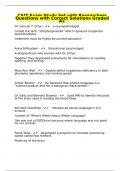
Dr. Samuel T. Orton - a neuropathologist coined the term "strephosymbolia" which replaced congenital word blindness treatment must be highly structured education Anna Gillingham - Educational psychologist A diagnostician who worked with Dr. Orton. Together they developed procedures for remediation or reading, spelling, and writing. Mary Ann Wolf - Double-deficit hypothesis-deficiency in both phoneme awareness and naming speed Arthur Benton - He believed that written language is a "cultural product and not a biological characteristic." Dr. Sally and Bennett Shawitz - Used MRI to identify the parts of the brain used in reading (by blood flow) Kenneth Goodman - *Introduced whole language in U.S. schools *author of "What's Whole About Whole Language" *He was not a GOODman because whole language was not good for our schools. Paula Tallal - Developed a program to increase processing speed called Fast forWord Plasticity of the brain Louisa Moats - Site director of NICHD Early Interventions Project in Washington, D.C. Notable Writings: LETRS, Teaching IS Rocket Science Brought phonics to CA Aylett Cox - Developed Alphabetic Phonics curriculum with Dr. Lucius Waites and staff of Texas Scottish Rite Hospital Reid Lyon - Neuropsychologist in charge of NIH research Confirmed importance of phonological awareness Dr. Macdonald Critchley - National Federation of Neurology Established the term "developmental dyslexia" Dr. Barbara Bateman - Study that discovered a person without learning difficulties requires 5-15 repetitions for retention; those with learning difficulties may require 500-1500. LOTS OF REPITION University of Oregon Dr. Norman Geschwind - Linked male left-handness and autoimmune disease to dyslexia Adolph Kussmaul - Coined word "word blindness" to an isolated condition affecting the ability to recognize and read text Bruce Pennington - Twin study in Boulder, Colorado and found that dyslexia is both familial and heritable. Linked dyslexia to 6th and 15th chromosome James Hinshelwood - "Congenital word blindness" Ophthalmologist from Scotland Thought left hemisphere was affected in reading difficulties Dr. Albert Galaburda - Neuroanatomical anomalies in brains with developmental dyslexia Confirmed dyslexia is an organic disorder Confirmed in dyslexic brain that both sides of brain are equal Abnormal migration of neural cells Isabella Liberman - Studying phonological processing deficits affecting the ability to make use of letter-sound associations as an effect of rapid retrieval problems Marilyn Jager Adams - Known for work in phonological awareness author of many children's books Dr. Johann Schmidtt - Earliest recorded case of word blindness describing a 65 yr. old man who lost ability to read following a stroke - a condition termed acquired alexia Rudolph Berlin - German physician First person to use word "dyslexia" to describe loss of ability to read due to brain injury Dr. W. Pringle Morgan - England Captured the basic elements underlying what we refer to today as developmental dyslexia Wrote about congenital word blindness to describe school children unable to learn to read but were otherwise bright and of average intelligence Bessie Stillman - Colleague of Gillingham who worked with Orton to develop teaching approach. They together wrote the Gillingham manuals. Jeanne Chall - Stages of Reading. "The Great Debate" 1967 on phonics vs. whole word. Three Layers of the English Language - Anglo-Saxon, Latin, and Greek Percentage of English Language that is Anglo-Saxon - 20-25% Percentage of the English Language that is Latin - 60%
Document information
- Uploaded on
- January 9, 2024
- Number of pages
- 19
- Written in
- 2023/2024
- Type
- Exam (elaborations)
- Contains
- Questions & answers