
ISSP-SA Chapter 1 Questions and Answers Latest Updated 2024
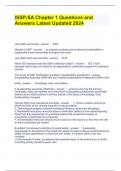
ISSP-SA Chapter 1 Questions and Answers Latest Updated 2024 year ISSP was formed 2007 Mission of ISSP to empower professionals to advance sustainability in organizations and communities throughout the world Brainpower Read More Previous Play Next Rewind 10 seconds Move forward 10 seconds Unmute 0:13 / 0:15 Full screen year ISSP exam was launched 2016 Which ISO standard does the ISSP certification follow? ISO 17024 standard, which sets out criteria for an organization's certification program for individual persons Two levels of ISSP Certification available to sustainability practitioners Sustainability Associate (ISSP-SA) and Certified Sustainability Professional (ISSP-CSP) KSAs Knowledge, skills, and abilities A Sustainability Associate (ISSP-SA) someone who has the minimal knowledge, skills, and abilities of an entry-level sustainability professional, specifically defined as the KSAs outlined in the first domain of the Body of Knowledge, Core Sustainability Concepts. Herman Daly's four operational principles 1. Human systems have to be within the limits of the carrying capacity of natural systems 2. Technological progress requires increasing efficiency rather than throughput 3. Renewable resources cannot be driven to extinction (either by over extracting/using faster than they regenerate or by emitting wastes that exceed the capacity of ecosystems to assimilate the emissions) 4. Nonrenewable resources should only be used at a rate equal to or less than the rate at which substitutes are created Bruntland Commission's definition of sustainability Sustainable development is development that meets the needs of present without compromising the ability of future generations to meet their own needs. It contains within it two key concepts: (1) the concept of 'need', in particular the essential needs of the world's poor, to which overriding priority should be given; and (2) the idea of limitations imposed by the state of technology and social organization on the environment's ability to meet present and future needs Foundations of most definitions of sustainability - equity and fairness - operating within the limits of the world's ecosystems - having a long term (100 years) view - understanding the interconnections between the economy, society, and environment Four types of capital (as suggested in Natural Capitalism book) - financial capital - manufactured capital - human capital - natural capital weak sustainability the concept that manufactured capital of equal value can take the place of natural capital strong sustainability the concept that the existing stock of natural capital must be maintained and enhanced because the functions it performs cannot be duplicated by manufactured capital. ecosystem services valuation of the potentially irreplaceable services of healthy natural systems (e.g. nature's ability to purify air and water, protection from the sun's harmful ultraviolet waves, and aesthetic beauty and intellectual stimulation that lift the human spirit) limits to growth Published by the Club of Rome in 1972. The team used computer modeling to simulate the impact on the biosphere of continued economic and population growth. Their findings showed that the carrying capacity of the earth could not withstand the then-current rates beyond 2100, without experiencing irreversible collapse. 'The Limits to Growth', 1972 book by Herman Daly et al In any finite system there must be constraints that can act to stop exponential growth. These constraints are negative feedback loops. IPAT equation I=P x A x T (society's negative impact on the ecosphere = population size X affluence of average individual X technology and services driving consumption) the tragedy of the commons common resources that are shared by all and owned by none (e.g. the atmosphere, clean air, ocean currents) "needs" inborn requirements that need to be satisfied in order for people to remain healthy--physically, mentally and socially (e.g. subsistence, protection, affection, understanding, participation, recreation, creation, identity, and freedom) Social justice refers to fair wages or lack of access to social and economic assets by all people - giving to each what he or she is due environmental justice will be achieved when everyone enjoys the same degree of protections from environmental and health hazards, and equal access to the decision-making process to have a healthy environment in which to live, learn and work food security food and nutrition security exists when all people, at all times, have physical, social and economic access to sufficient, safe and nutritious food to meet their dietary needs and food preferences for an active and healthy life GHGs • Carbon dioxide (CO2) • Methane (CH4) • Nitrous oxide (N2O) • Sulphur hexafluoride (SF6) • Hydrofluorocarbons (HFCs) • Perfluorinated compounds (PFCs) Global warming potential based on the carbon dioxide equivalent, a measure used to compare the emissions from various greenhouse gases ocean acidification when the pH balance of seawater drops as a result of becoming supersaturated with calcium carbonate. coral bleaching occurs when the ocean water is too warm and the corals expel the algae that live in the coral tissue, giving it color. two climate mechanisms that cause sea level rise (1) seawater expansion due to rising ocean temperatures (2) melting glaciers percent of ecosystem services that have been degraded in the past 50 years 60% bioaccumulation toxins that become concentrated as predators consume prey, or by persisting over long periods of time Persistent Organic Pollutants (POPs) - remain intact for exceptionally long periods of time - become widely distributed throughout the environment - accumulate in the fatty tissue of living organisms - are toxic to both humans and wildlife VOCs volatile organic compounds (e.g. formaldehyde) 2001 Stockholm Convention on Persistent Organic Pollutants (POPs) identified 12 chemicals that human health and the environment need particular protection from; 11 additional added in 2015 ozone a major component of smog, formed by VOCs interacting with nitrogen dioxide emissions and ambient oxygen ozone depleting substances e.g. Chlorofluorocarbons, halon, carbon tetrachloride, methyl bromide Vienna Convention for the Protection of the Ozone Layer and the Montreal Protocol agreements that called for phasing out the use of chemical compounds with a high ozone depleting potential (ODP) externalities large indirect costs that affect people but are not captured in the prices (e.g. carbon emissions) life cycle cost practice of looking at the relative benefits and drawbacks of a given financial decision based on the full range of related expenditures over the long-term 'short-termism' in investment markets major obstacle to companies embedding sustainability in their strategic planning and capital investment decisions problems with Gross Domestic Product (GDP) - measures income, but not equality - measures growth, but not destruction - ignores values like social cohesion and the environment - encourages activities that are counter to long-term community wellbeing Genuine Progress Indicator (GPI) adjust GDP by measures of economic welfare (e.g. income distribution, cost of commuting, loss of farmland and wetlands) Ecological Footprint a measure of the yearly biocapacity of the planet compared to humanity's yearly use of natural capital and ecosystem services. The Happy Planet Index measures individual well-being, life expectancy, inequality of outcomes, and ecological footprints
Document information
- Uploaded on
- January 8, 2024
- Number of pages
- 5
- Written in
- 2023/2024
- Type
- Exam (elaborations)
- Contains
- Questions & answers


