

NGN TEST REVIEW|VERIFIED ANSWERS
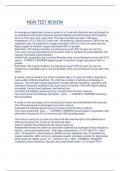
NGN TEST REVIEW An emergency department nurse is caring for a 5-year-old child who was just brought in by ambulance with partial-thickness (second-degree) and full-thickness (third-degree) burns to their face, neck, and chest. The client is awake and alert. Vital signs: temperature, 97.2°F (36.2°C); heart rate, 148 beats/min; blood pressure, 68/39 mm Hg; respiratory rate, 32 breaths/min; oxygen saturation, 90% on 2 liters by nasal cannula. Apply oxygen to maintain oxygen saturations 95% or greater. Administer 100 mcg/kg morphine via intravenous push (IVP) for pain prn q4 hour. The nurse receives prescriptions for the client. Click to highlight the prescription(s) that requires immediate implementation. Initiate fluid resuscitation per Lund and Browder chart using Parkland formula with 0.9% saline. - CORRECT ANSWER-Apply oxygen to maintain oxygen saturations 95% or greater. Administer 100 mcg/kg morphine via intravenous push (IVP) for pain prn q4 hour. Initiate fluid resuscitation per Lund and Browder chart using Parkland formula with 0.9% saline. A school nurse is called to the school cafeteria after a 13-year-old child is reported to have sudden difficulty breathing. The child has a history of asthma and allergies to peanuts. The focused nursing assessment reveals difficulty breathing, inspiratory and expiratory wheezing, swelling of lips, and a rash on the face. The child reports feeling nauseated, having chest tightness, and feeling faint. Complete the following sentence(s) by choosing from the lists of options. The nurse should first address the child's....then..... - CORRECT ANSWER-wheezing then lip swelling
Document information
- Uploaded on
- January 5, 2024
- Number of pages
- 3
- Written in
- 2023/2024
- Type
- Exam (elaborations)
- Contains
- Questions & answers


