

AQA (A-Level Sociology) - Families & Households
Study online at https://quizlet.com/_2yq3r3
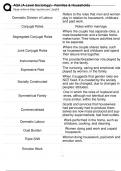
Refers to the roles that men and women
Domestic Division of Labour play in relation to housework, childcare
and paid work.
Conjugal Roles Roles within marriage.
Where the couple has separate roles, a
male breadwinner and a female home-
Segregated Conjugal Roles
maker/carer. Their leisure activities tend
to be seperate.
Where the couple shares tasks, such
Joint Conjugal Roles as housework and childcare and spend
their leisure time together.
The provider/breadwinner role played by
Instrumental Role
men, in the family.
The nurturing, caring and emotional role
Expressive Role
played by women, in the family.
When it suggests that gender roles are
NOT fixed. It is created by the society
Socially Constructed
and can be changed, due to changes in
peoples' attitudes.
One in which the roles of husband and
Symmetrical Family wives, although not identical are now
more similar, within the family.
Goods and services that housewives
had perviously had to produce them-
Commercialised
selves are now mass-produced and sup-
plied by supermarkets, fast food outlets.
Work performed in the home, such as
Domestic Labour
childcare, cooking, and cleaning.
Women doing paid work and unpaid
Dual Burden
housework.
Women doing housework, paid work and
Triple Shift
emotion work.
Emotion Work
, AQA (A-Level Sociology) - Families & Households
Study online at https://quizlet.com/_2yq3r3
The work whose main feature is the man-
agement of one's own and other people's
emotions.
In this view, the division of labour is de-
termined by patriarchal norms and val-
ues that shape the gender roles in the
Cultural Explanation of Inequality culture. Women perform domestic labour
simply because that is what society ex-
pects them to do and has socislied them
to do.
In this view, the fact that women gener-
ally earn less than men means it is eco-
nomically rational for women to do more
Material Explanation of Inequality
of the housework and childcare while
men spend more of thier time earning
money.
Any incident or pattern of incidents
of controlling, coercive or threatening
behaviour, violence or abuse between
those aged 16 or over who have been
Domestic Violence
intimate partners or family members re-
gardless of gender or sexuality. This in-
cludes physical, psychological, sexual
emotional & financial violence or abuse.
Emphasise the role of patriarchal ideas,
Radical Feminist View
cultural values and institutions.
Emphasise economic factors, such as
Materialist View
lack of resources.
Childhood A socially defined age-status.
When the term 'childhood' is created and
Social Construction of 'Childhood'
defined differently by the society.
Childhood here is seen as a clear and
Separateness distinct life stage with children occupying
a separate status from adults.
When the child goes through happiness
Childhood as 'Golden Age'
and is innocence.
, AQA (A-Level Sociology) - Families & Households
Study online at https://quizlet.com/_2yq3r3
Suggests that we have moved from the
world that did not see childhood as in any
Cult of Childhood way special, to the world that is obsessed
with childhood. It describes the 20th cen-
tury as 'the century of the child.'
The shift from an agricultural economy to
Industrialisation
one based on factory production.
The idea that society has responsibility
Welfare View
for looking after children.
Argues that children are unable to control
Control View
their anti-social tendencies.
Argues that over the past few centuries
the position of children in Western so-
March of Progress View
cieties has been steadily improving and
today it is better than it has ever been.
Argues that some adult control over chil-
dren is justified. There is age patriarchy,
Child Liberationists as children cannot make rational deci-
sions and so are unable to safeguard
their interests themselves.
Argues that we must take the perspective
The 'New Sociology of Childhood'
of the child.
When there is no division between the
Disappearing at a Dazzling Speed
world of the adult and that of the child.
Children lacked the literacy skills needed
to access information, so adults could
Print Culture
keep knowledge about sex, money, vio-
lence etc.
When making information to children, as
Television Culture
long with adults, such as pornography.
Age Patriarchy Inequality between adults and children.
Argues that rapid technology and cul-
Toxic Childhood tural are damaging children's develop-
ment, e.g. junk food, computer games
, AQA (A-Level Sociology) - Families & Households
Study online at https://quizlet.com/_2yq3r3
etc. Children are deprived of a genuine
childhood.
When it sees the individuals as entirely
Structural View shaped by the structure of society (the
way society is organised or set up).
A consensus perspective in sociology
that sees society as based on shared val-
ues into which members are socialised.
It allows individuals to cooperate har-
Functionalists moniously to meet societies needs and
achieve shared goals. It sees society as
like an organism, each part performing
functions to maintain the system as a
whole.
The contribution that a part of society
Function makes to stability or well-being of society
as a whole.
Value Consensus Sees society as based on shared values.
Are expected (normative/normal) pat-
Norms terns of behaviour that are based on the
values of a culture.
Are beliefs and ideas that society sees
Values as important, and that are accepted by
the majority of society.
Suggests that everything is positive, per-
Rose-Tinted View fect and equal in society. It is to ensure
that the society maintains harmony.
Argues that individuals need to keep the
Social Order society stable. It suggests that the soci-
ety needs to maintain equilibrium.
March of Progress When society is changing very gradually.
The process by which an individual
Socialisation learns or internalises the culture of soci-
ety.
Study online at https://quizlet.com/_2yq3r3
Refers to the roles that men and women
Domestic Division of Labour play in relation to housework, childcare
and paid work.
Conjugal Roles Roles within marriage.
Where the couple has separate roles, a
male breadwinner and a female home-
Segregated Conjugal Roles
maker/carer. Their leisure activities tend
to be seperate.
Where the couple shares tasks, such
Joint Conjugal Roles as housework and childcare and spend
their leisure time together.
The provider/breadwinner role played by
Instrumental Role
men, in the family.
The nurturing, caring and emotional role
Expressive Role
played by women, in the family.
When it suggests that gender roles are
NOT fixed. It is created by the society
Socially Constructed
and can be changed, due to changes in
peoples' attitudes.
One in which the roles of husband and
Symmetrical Family wives, although not identical are now
more similar, within the family.
Goods and services that housewives
had perviously had to produce them-
Commercialised
selves are now mass-produced and sup-
plied by supermarkets, fast food outlets.
Work performed in the home, such as
Domestic Labour
childcare, cooking, and cleaning.
Women doing paid work and unpaid
Dual Burden
housework.
Women doing housework, paid work and
Triple Shift
emotion work.
Emotion Work
, AQA (A-Level Sociology) - Families & Households
Study online at https://quizlet.com/_2yq3r3
The work whose main feature is the man-
agement of one's own and other people's
emotions.
In this view, the division of labour is de-
termined by patriarchal norms and val-
ues that shape the gender roles in the
Cultural Explanation of Inequality culture. Women perform domestic labour
simply because that is what society ex-
pects them to do and has socislied them
to do.
In this view, the fact that women gener-
ally earn less than men means it is eco-
nomically rational for women to do more
Material Explanation of Inequality
of the housework and childcare while
men spend more of thier time earning
money.
Any incident or pattern of incidents
of controlling, coercive or threatening
behaviour, violence or abuse between
those aged 16 or over who have been
Domestic Violence
intimate partners or family members re-
gardless of gender or sexuality. This in-
cludes physical, psychological, sexual
emotional & financial violence or abuse.
Emphasise the role of patriarchal ideas,
Radical Feminist View
cultural values and institutions.
Emphasise economic factors, such as
Materialist View
lack of resources.
Childhood A socially defined age-status.
When the term 'childhood' is created and
Social Construction of 'Childhood'
defined differently by the society.
Childhood here is seen as a clear and
Separateness distinct life stage with children occupying
a separate status from adults.
When the child goes through happiness
Childhood as 'Golden Age'
and is innocence.
, AQA (A-Level Sociology) - Families & Households
Study online at https://quizlet.com/_2yq3r3
Suggests that we have moved from the
world that did not see childhood as in any
Cult of Childhood way special, to the world that is obsessed
with childhood. It describes the 20th cen-
tury as 'the century of the child.'
The shift from an agricultural economy to
Industrialisation
one based on factory production.
The idea that society has responsibility
Welfare View
for looking after children.
Argues that children are unable to control
Control View
their anti-social tendencies.
Argues that over the past few centuries
the position of children in Western so-
March of Progress View
cieties has been steadily improving and
today it is better than it has ever been.
Argues that some adult control over chil-
dren is justified. There is age patriarchy,
Child Liberationists as children cannot make rational deci-
sions and so are unable to safeguard
their interests themselves.
Argues that we must take the perspective
The 'New Sociology of Childhood'
of the child.
When there is no division between the
Disappearing at a Dazzling Speed
world of the adult and that of the child.
Children lacked the literacy skills needed
to access information, so adults could
Print Culture
keep knowledge about sex, money, vio-
lence etc.
When making information to children, as
Television Culture
long with adults, such as pornography.
Age Patriarchy Inequality between adults and children.
Argues that rapid technology and cul-
Toxic Childhood tural are damaging children's develop-
ment, e.g. junk food, computer games
, AQA (A-Level Sociology) - Families & Households
Study online at https://quizlet.com/_2yq3r3
etc. Children are deprived of a genuine
childhood.
When it sees the individuals as entirely
Structural View shaped by the structure of society (the
way society is organised or set up).
A consensus perspective in sociology
that sees society as based on shared val-
ues into which members are socialised.
It allows individuals to cooperate har-
Functionalists moniously to meet societies needs and
achieve shared goals. It sees society as
like an organism, each part performing
functions to maintain the system as a
whole.
The contribution that a part of society
Function makes to stability or well-being of society
as a whole.
Value Consensus Sees society as based on shared values.
Are expected (normative/normal) pat-
Norms terns of behaviour that are based on the
values of a culture.
Are beliefs and ideas that society sees
Values as important, and that are accepted by
the majority of society.
Suggests that everything is positive, per-
Rose-Tinted View fect and equal in society. It is to ensure
that the society maintains harmony.
Argues that individuals need to keep the
Social Order society stable. It suggests that the soci-
ety needs to maintain equilibrium.
March of Progress When society is changing very gradually.
The process by which an individual
Socialisation learns or internalises the culture of soci-
ety.


