
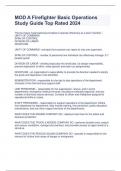
MOD A Firefighter Basic Operations Study Guide Top Rated 2024
The four basic organizational principles to operate effectively as a team member: - UNITY OF COMMAND SPAN OF CONTROL DIVISION OF LABOR DISCIPLINE UNITY OF COMMAND - principle that a person can report to only one supervisor. SPAN OF CONTROL - number of personnel one individual can effectively manage. 3-7 people typical DIVISION OF LABOR - dividing large jobs into small jobs. (to assign responsibility, prevent duplication of effort, make specific and clear-cut assignments) DISCIPLINE - an organization's responsibility to provide the direction needed to satisfy the goals and objectives it has identified. ADMINISTRATION - responsible for the day-to-day operations of the department. Consists of the chief and any support staff. LINE PERSONNEL - responsible for fire suppression, rescue, and in some departments: emergency medical services, hazardous materials response, and any number of technical rescue services. Consists of officer and firefighters assigned to operational shifts or crews. STAFF PERSONNEL - responsible for support operations of the department. Differs from department to department. May include training, fire prevention, public education, maintenance, and any other support services of the departments. WHAT DOES THE ENGINE COMPANY DO - deploys hose lines for fire attack and exposure protection. WHAT DOES THE TRUCK (LADDER) COMPANY DO - performs forcible entry, search and rescue, ventilation, salvage and overhaul, and provides access to upper levels of a structure. WHAT DOES THE RESCUE SQUAD/COMPANY DO - typically is responsible for the removal of victims from areas of danger or entrapment. WHAT DOES THE BRUSH COMPANY DO - extinguishes wild land fires and protects structures in the urban-interface WHAT DOES THE HAZARDOUS MATERIALS COMPANY DO - responds to and mitigates hazardous materials incidents. WHAT DOES THE EMERGENCY MEDICAL COMPANY DO - provides emergency medical care and support to patients. What is the mission of the fire service? - To practice life safety, incident stabilization, and property conservation. INCIDENT COMMAND COMPONENTS - -Incident commander -Safety -Information -Liaison -Operation -Planning -Logistics -Finance and Administration Two types of training records that are required to be maintained by the Division of Personnel Standards and Education: - -Learning objectives. -Practical evaluations and written exams. NFPA 1001 - Standard for Fire Fighter Professional Qualifications FIRE - a form of combustion, self-sustaining process of rapid oxidation of a fuel that produces heat and light COMBUSTION - self-sustaining chemical reaction yielding energy or products that cause further reactions. HEAT - the form of energy that raises temperature, the energy transferred from one body to another when the temperature of the bodies are different IGNITION TEMPERATURE - the minimum temperature to which a fuel, in air, must be heated to start self-sustained combustion without a separate ignition source. LOWER FLAMMABLE LIMIT ( LFL ) - minimum concentration of fuel vapor and air that will ignite. Limits below the lower flammable limit (LFL) are called too "lean" to burn.
Document information
- Uploaded on
- January 3, 2024
- Number of pages
- 10
- Written in
- 2023/2024
- Type
- Exam (elaborations)
- Contains
- Questions & answers


