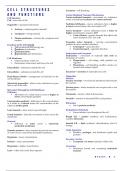
CELL STRUCTURES Crenation – cell shrinking
AND FUNCTIONS Carrier-Mediated Transport Mechanisms
Carrier-mediated transport – movement of a substance
Cell Structure
Cell – basic unit of life across a membrane by means of a carrier molecule
Organelles – specialized structures Facilitated diffusion – moves substances from a higher
to lower concentration; does not require ATP
1. Nucleus – contains genetic material
Active transport – moves substances from a lower to
2. Cytoplasm – living material higher concentration; requires ATP
Ø Cystic fibrosis – genetic disorder that affects the
3. Plasma membrane – encloses the cytoplasm and active transport of Cl- into cells
nucleus
Secondary active transport – moving concentration
Functions of the Cell (CSCR) gradient to move another substance
1. Cell metabolism and energy use. Ø Cotransport – same direction
2. Synthesis of molecules. Ø Countertransport – opposite direction
3. Communication.
4. Reproduction and inheritance. Endocytosis and Exocytosis
Endocytosis – movement of materials into cells by
Cell Membrane formation of vesicles
§ Outer boundary of the cell Ø Phagocytosis – cell eating; solid particles are
§ Determines what enters and leaves the cell ingested
Ø Pinocytosis – cell drinking; smaller vesicles are
Extracellular – substances outside the cell formed and contains liquid
Intracellular – substances inside the cell Exocytosis – secretion of materials from cells
Fluid-Mosaic Model – arrangement of molecules in the Organelles
cell membrane Nucleus
Nuclear envelope – two-layered membrane that bounds
Selectively permeable – allows some substances to pass the nucleus
into or out of the cells
Nuclear pores – where materials can can pass into or out
Movement Through the Cell Membrane the nucleus
Diffusion
§ Movement of a solute from an area of higher to Chromatin – loosely coiled chromosomes
lower concentration gradient
Nucleoli – consists of ribosomal RNA and proteins
Concentration gradient – difference in the concentration
of a solute in a solvent minus the concentration of the Ribosomes
solute at another point § Site of protein synthesis
Leak channels – allow ions to pass through Endoplasmic Reticulum
§ Forms tubules/sacs throughout the cell
Gated channels – limit the movement of ions across the
membrane Rough E.R. – protein synthesis and modification;
contains ribosomes
Osmosis
§ Diffusion of water across a selectively Smooth E.R. – lipid synthesis, detoxification, and Ca
permeable membrane storage
Osmotic pressure – force required to prevent movement Golgi Apparatus
of water across a selectively permeable membrane § Modifies, packages, and distributes lipids and
proteins
Hypotonic – lower concentration
Secretory vesicles
Isotonic – same concentration § Transports and stores materials within cells
Hypertonic – higher concentration Lysosomes
§ Membrane bound sacs containing hydrolytic
Lysis – when cells swell, then ruptures enzymes
M o r a n o , M . A .
AND FUNCTIONS Carrier-Mediated Transport Mechanisms
Carrier-mediated transport – movement of a substance
Cell Structure
Cell – basic unit of life across a membrane by means of a carrier molecule
Organelles – specialized structures Facilitated diffusion – moves substances from a higher
to lower concentration; does not require ATP
1. Nucleus – contains genetic material
Active transport – moves substances from a lower to
2. Cytoplasm – living material higher concentration; requires ATP
Ø Cystic fibrosis – genetic disorder that affects the
3. Plasma membrane – encloses the cytoplasm and active transport of Cl- into cells
nucleus
Secondary active transport – moving concentration
Functions of the Cell (CSCR) gradient to move another substance
1. Cell metabolism and energy use. Ø Cotransport – same direction
2. Synthesis of molecules. Ø Countertransport – opposite direction
3. Communication.
4. Reproduction and inheritance. Endocytosis and Exocytosis
Endocytosis – movement of materials into cells by
Cell Membrane formation of vesicles
§ Outer boundary of the cell Ø Phagocytosis – cell eating; solid particles are
§ Determines what enters and leaves the cell ingested
Ø Pinocytosis – cell drinking; smaller vesicles are
Extracellular – substances outside the cell formed and contains liquid
Intracellular – substances inside the cell Exocytosis – secretion of materials from cells
Fluid-Mosaic Model – arrangement of molecules in the Organelles
cell membrane Nucleus
Nuclear envelope – two-layered membrane that bounds
Selectively permeable – allows some substances to pass the nucleus
into or out of the cells
Nuclear pores – where materials can can pass into or out
Movement Through the Cell Membrane the nucleus
Diffusion
§ Movement of a solute from an area of higher to Chromatin – loosely coiled chromosomes
lower concentration gradient
Nucleoli – consists of ribosomal RNA and proteins
Concentration gradient – difference in the concentration
of a solute in a solvent minus the concentration of the Ribosomes
solute at another point § Site of protein synthesis
Leak channels – allow ions to pass through Endoplasmic Reticulum
§ Forms tubules/sacs throughout the cell
Gated channels – limit the movement of ions across the
membrane Rough E.R. – protein synthesis and modification;
contains ribosomes
Osmosis
§ Diffusion of water across a selectively Smooth E.R. – lipid synthesis, detoxification, and Ca
permeable membrane storage
Osmotic pressure – force required to prevent movement Golgi Apparatus
of water across a selectively permeable membrane § Modifies, packages, and distributes lipids and
proteins
Hypotonic – lower concentration
Secretory vesicles
Isotonic – same concentration § Transports and stores materials within cells
Hypertonic – higher concentration Lysosomes
§ Membrane bound sacs containing hydrolytic
Lysis – when cells swell, then ruptures enzymes
M o r a n o , M . A .