SSEKWE
𝑼𝒏𝒍𝒐𝒄𝒌𝒊𝒏𝒈 𝑶′𝒍𝒆𝒗𝒆𝒍 𝑷𝒉𝒚𝒔𝒊𝒄𝒔
ROBERT
MODERN PHYSICS
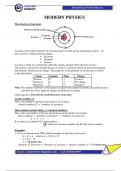
The structure of an atom:
𝑬𝒍𝒆𝒄𝒕𝒓𝒐𝒏 𝒔𝒉𝒆𝒍𝒍𝒔/𝒐𝒓𝒃𝒊𝒕𝒔
𝑵𝒆𝒖𝒕𝒓𝒐𝒏
𝑵𝒖𝒄𝒍𝒆𝒖𝒔 𝑬𝒍𝒆𝒄𝒕𝒓𝒐𝒏
𝑷𝒓𝒐𝒕𝒐𝒏
An atom is the smallest particle of an element that can take part in a chemical reaction. An
atom consists of three particles namely;
▪ Electrons
▪ Neutrons
▪ Protons
An atom is made of a central part called the nucleus around which electrons revolve.
The nucleus is positively charged because it consists of protons which are positively charged
and neutrons which have no charge. The properties of the particles of an atom are as shown
in the table below.
Name Symbol Mass Charge
Protons P 1 Positive
Neutrons n 1 No charge
Electrons e 0 Negative
Note: The number of protons in the nucleus is equal to the number electrons around the nucleus
and since they have opposite charges the atom has no charge.
Likely question: Describe the model/structure of an atom
Atomic number, Z:
This is the number of protons in the nucleus of an atom.
𝐴𝑡𝑜𝑚𝑖𝑐 𝑛𝑢𝑚𝑏𝑒𝑟, 𝑍 = 𝑁𝑢𝑚𝑏𝑒𝑟 𝑜𝑓 𝑝𝑟𝑜𝑡𝑜𝑛𝑠
Mass number [atomic mass], A: (nucleon number):
This is the total number of protons and neutrons in the nucleus of an atom.
𝑀𝑎𝑠𝑠 𝑛𝑢𝑚𝑏𝑒𝑟 = 𝑁𝑢𝑚𝑏𝑒𝑟 𝑜𝑓 𝑝𝑟𝑜𝑡𝑜𝑛𝑠 + 𝑁𝑢𝑚𝑏𝑒𝑟 𝑜𝑓 𝑛𝑒𝑢𝑡𝑟𝑜𝑛𝑠
𝐴 = 𝑍 + 𝑛
If an atom of an element X is represented as
𝑨 where A is the mass number and Z is the atomic number
𝑍𝑿
Examples:
1. Given a chloride atom 35
17𝑪𝒍. Find the number of electrons in the atom.
𝐴 = 𝑍 + 𝑛 𝑤ℎ𝑒𝑟𝑒 𝐴 = 35, 𝑍 = 17
𝑛 = 35 − 17
𝑛 = 𝟏𝟖 𝒏𝒆𝒖𝒕𝒓𝒐𝒏𝒔
𝑁𝑢𝑚𝑏𝑒𝑟 𝑜𝑓 𝑒𝑙𝑒𝑐𝑡𝑟𝑜𝑛𝑠 = 𝑁𝑢𝑚𝑏𝑒𝑟 𝑜𝑓 𝑝𝑟𝑜𝑡𝑜𝑛𝑠 = 𝐴𝑡𝑜𝑚𝑖𝑐 𝑛𝑢𝑚𝑏𝑒𝑟 𝑍 = 𝟏𝟕 𝒆𝒍𝒆𝒄𝒕𝒓𝒐𝒏𝒔
𝑬𝒎𝒂𝒊𝒍: 𝒔𝒔𝒆𝒌𝒘𝒆𝒓𝒐𝒃𝒆𝒓𝒕@𝒈𝒎𝒂𝒊𝒍. 𝒄𝒐𝒎 𝑪𝒂𝒍𝒍: 𝟎𝟕𝟓𝟐𝟎𝟓𝟑𝟗𝟗𝟕 1
, SSEKWE
𝑼𝒏𝒍𝒐𝒄𝒌𝒊𝒏𝒈 𝑶′𝒍𝒆𝒗𝒆𝒍 𝑷𝒉𝒚𝒔𝒊𝒄𝒔
ROBERT
2. State the composition of the atom 𝟐𝟑𝟓
𝟗𝟐𝑼
𝐴𝑡𝑜𝑚𝑖𝑐 𝑛𝑢𝑚𝑏𝑒𝑟 = 92
𝑀𝑎𝑠𝑠 𝑛𝑢𝑚𝑏𝑒𝑟 = 235
𝑁𝑢𝑚𝑏𝑒𝑟 𝑜𝑓 𝑛𝑒𝑢𝑡𝑟𝑜𝑛𝑠 = 235 − 92 = 143
𝑁𝑢𝑚𝑏𝑒𝑟 𝑜𝑓 𝑒𝑙𝑒𝑐𝑡𝑟𝑜𝑛𝑠 = 92
𝑁𝑢𝑚𝑏𝑒𝑟 𝑜𝑓 𝑝𝑟𝑜𝑡𝑜𝑛𝑠 = 92
ISOTOPES:
These are atoms of the same element with the same atomic number but different mass numbers.
Therefore, isotopes of an element have the same number of protons and electrons and different
number of neutrons
Examples of isotopes are:
35 36 37
Chlorine; 17𝐶𝑙 , 17𝐶𝑙 , 17𝐶𝑙
12 13 14
Carbon; 6𝐶 , 6𝐶 , 6𝐶
1 2 3
Hydrogen; 1 , 1𝐻 , 1𝐻
𝐻
RADIOACTIVITY:
This is the spontaneous disintegration of unstable nucleus of an atom to form a stable nucleus
with emission of radiations.
There are three radiations emitted by radioactive nucleus namely:
▪ Alpha particles, 𝛼.
▪ Beta particles, 𝛽.
▪ Gamma rays, 𝛾.
Elements that undergo radioactivity are called radioactive elements/nuclides.
Heavy nuclides are generally unstable hence radioactivity ensures that they reach a stable state.
Examples of radioactive elements are:
▪ Uranium (U)
▪ Radium (Ra)
▪ Polonium (Po),
▪ Protactinium (Pa)
▪ Etc.
Radioisotopes:
These are radioactive atoms of the same element having the same atomic number but different
mass number.
𝑬𝒎𝒂𝒊𝒍: 𝒔𝒔𝒆𝒌𝒘𝒆𝒓𝒐𝒃𝒆𝒓𝒕@𝒈𝒎𝒂𝒊𝒍. 𝒄𝒐𝒎 𝑪𝒂𝒍𝒍: 𝟎𝟕𝟓𝟐𝟎𝟓𝟑𝟗𝟗𝟕 2
, SSEKWE
𝑼𝒏𝒍𝒐𝒄𝒌𝒊𝒏𝒈 𝑶′𝒍𝒆𝒗𝒆𝒍 𝑷𝒉𝒚𝒔𝒊𝒄𝒔
ROBERT
TYPES OF RADIATIONS
Alpha particle, 𝜶:
Alpha particle is a high speed helium nucleus ( 𝟒𝟐𝑯𝒆)
Alpha particles have a mass number of 4 and atomic number of 2 i.e. two protons and two neutrons
and they carry a positive charge. They have no electrons to balance the two positively charged
protons.
Properties of alpha particles:
▪ They are helium nuclei
▪ They are slightly deflected by both magnetic and electric fields because of their large mass.
▪ They are positively charged.
▪ They have the greatest ionizing power.
▪ They have the least penetrating power.
▪ They are stopped by a thick sheet of paper.
▪ They have a very short range in air.
▪ They affect the photographic films.
▪ They have speed less than the speed of light.
▪ They cause fluorescence when incident on fluorescent substance.
Alpha decay:
When a nuclide undergoes an alpha decay, it loses two protons and two neutrons.
Therefore its mass number reduces by four and its atomic number reduces by two and the daughter
nuclide is two steps to the left in the periodic table.
Given that a radioactive element, 𝑨𝒁𝑿 undergoes an alpha decay to form element Y. Then the
nuclear reaction equation is given by;
𝑨 𝑨−𝟒 𝟒
𝑍𝑿 𝑍−2𝒀 + 2𝑯𝒆 + energy
(Parent) (Daughter) (Alpha particle)
Examples:
1. Radium (Ra) decays to become radon (Rn) according to the equation
226 222
88𝑅𝑎 86𝑅𝑛 + 42𝐻𝑒
2. Uranium (U) decays to become thorium (Th) according to the equation
238 234
92𝑈 90𝑇ℎ + 42𝐻𝑒
Question 1:
A radioactive substance 226𝑋 undergoes decay and emits an alpha particle to form nuclide Y. Write
an equation for the process.
𝟐𝟐 𝟏𝟖 𝟒
𝟔𝑿 𝟒𝒀 + 𝟐𝑯𝒆
𝑬𝒎𝒂𝒊𝒍: 𝒔𝒔𝒆𝒌𝒘𝒆𝒓𝒐𝒃𝒆𝒓𝒕@𝒈𝒎𝒂𝒊𝒍. 𝒄𝒐𝒎 𝑪𝒂𝒍𝒍: 𝟎𝟕𝟓𝟐𝟎𝟓𝟑𝟗𝟗𝟕 3
, SSEKWE
𝑼𝒏𝒍𝒐𝒄𝒌𝒊𝒏𝒈 𝑶′𝒍𝒆𝒗𝒆𝒍 𝑷𝒉𝒚𝒔𝒊𝒄𝒔
ROBERT
Beta particle, β:
A beta particle is a high-speed electron emitted from the nucleus of a radioactive element.
Beta particles have no mass number and carry a negative charge ( −10𝒆).
A beta particle is produced as a result of one of the neutrons changing to a proton.
𝟏 𝟏 𝟎
𝟎𝒏 𝟏𝑷 + −𝟏𝒆
Properties of beta particles:
▪ They are negatively charged.
▪ They are lighter since they have negligible mass
▪ They are easily deflected by both magnetic and electric fields
▪ They have greater penetrating power than alpha particles because of their high speed.
▪ They have less ionizing power than alpha particle.
▪ They can be stopped by a thin sheet of aluminium.
▪ They have a greater range in air than alpha particles.
▪ They cause fluorescence when incident on fluorescent substance.
▪ They are electrons.
Beta decay:
When a nuclide undergoes beta decay its mass number does not change but its atomic number
increases by one. The daughter nuclide is one step to the right in the periodic table.
Given that a radioactive element, 𝑨
𝒁𝑿 undergoes a beta decay to form element Y. Then the
nuclear reaction equation is given by:
𝑨 𝑨 𝟎
𝑍𝑿 𝑍+1𝒀 + −1𝒆 + energy
(Parent) (Daughter) (Beta particle)
Examples:
1. Carbon-14 decays to Nitrogen according to the equation
𝟏𝟒 𝟏𝟒
𝟔𝑪 𝟕𝑵 + −𝟏𝟎𝒆
𝟐𝟑𝟓
2. 𝟗𝟐𝑈 decays by emitting 3 beta particles to form a daughter nuclide P. Find the atomic
and mass nummber of P.
𝟐𝟑𝟓 𝟐𝟑𝟓
𝟗𝟐𝑼 𝟗𝟓𝑷 + 𝟑 −𝟏𝟎𝒆
𝑴𝒂𝒔𝒔 𝒏𝒖𝒎𝒃𝒆𝒓 = 𝟐𝟑𝟓, 𝑨𝒕𝒐𝒎𝒊𝒄 𝒏𝒖𝒎𝒃𝒆𝒓 = 𝟗𝟓
Gamma rays, γ:
Gamma ray is an electromagnetic radiation with a very short-wave length.
Gamma rays have no mass number and carry no charge.
Gamma rays are produced when an excited atomic nucleus loses energy and the energy is given
out as gamma rays.
𝑬𝒎𝒂𝒊𝒍: 𝒔𝒔𝒆𝒌𝒘𝒆𝒓𝒐𝒃𝒆𝒓𝒕@𝒈𝒎𝒂𝒊𝒍. 𝒄𝒐𝒎 𝑪𝒂𝒍𝒍: 𝟎𝟕𝟓𝟐𝟎𝟓𝟑𝟗𝟗𝟕 4
𝑼𝒏𝒍𝒐𝒄𝒌𝒊𝒏𝒈 𝑶′𝒍𝒆𝒗𝒆𝒍 𝑷𝒉𝒚𝒔𝒊𝒄𝒔
ROBERT
MODERN PHYSICS
The structure of an atom:
𝑬𝒍𝒆𝒄𝒕𝒓𝒐𝒏 𝒔𝒉𝒆𝒍𝒍𝒔/𝒐𝒓𝒃𝒊𝒕𝒔
𝑵𝒆𝒖𝒕𝒓𝒐𝒏
𝑵𝒖𝒄𝒍𝒆𝒖𝒔 𝑬𝒍𝒆𝒄𝒕𝒓𝒐𝒏
𝑷𝒓𝒐𝒕𝒐𝒏
An atom is the smallest particle of an element that can take part in a chemical reaction. An
atom consists of three particles namely;
▪ Electrons
▪ Neutrons
▪ Protons
An atom is made of a central part called the nucleus around which electrons revolve.
The nucleus is positively charged because it consists of protons which are positively charged
and neutrons which have no charge. The properties of the particles of an atom are as shown
in the table below.
Name Symbol Mass Charge
Protons P 1 Positive
Neutrons n 1 No charge
Electrons e 0 Negative
Note: The number of protons in the nucleus is equal to the number electrons around the nucleus
and since they have opposite charges the atom has no charge.
Likely question: Describe the model/structure of an atom
Atomic number, Z:
This is the number of protons in the nucleus of an atom.
𝐴𝑡𝑜𝑚𝑖𝑐 𝑛𝑢𝑚𝑏𝑒𝑟, 𝑍 = 𝑁𝑢𝑚𝑏𝑒𝑟 𝑜𝑓 𝑝𝑟𝑜𝑡𝑜𝑛𝑠
Mass number [atomic mass], A: (nucleon number):
This is the total number of protons and neutrons in the nucleus of an atom.
𝑀𝑎𝑠𝑠 𝑛𝑢𝑚𝑏𝑒𝑟 = 𝑁𝑢𝑚𝑏𝑒𝑟 𝑜𝑓 𝑝𝑟𝑜𝑡𝑜𝑛𝑠 + 𝑁𝑢𝑚𝑏𝑒𝑟 𝑜𝑓 𝑛𝑒𝑢𝑡𝑟𝑜𝑛𝑠
𝐴 = 𝑍 + 𝑛
If an atom of an element X is represented as
𝑨 where A is the mass number and Z is the atomic number
𝑍𝑿
Examples:
1. Given a chloride atom 35
17𝑪𝒍. Find the number of electrons in the atom.
𝐴 = 𝑍 + 𝑛 𝑤ℎ𝑒𝑟𝑒 𝐴 = 35, 𝑍 = 17
𝑛 = 35 − 17
𝑛 = 𝟏𝟖 𝒏𝒆𝒖𝒕𝒓𝒐𝒏𝒔
𝑁𝑢𝑚𝑏𝑒𝑟 𝑜𝑓 𝑒𝑙𝑒𝑐𝑡𝑟𝑜𝑛𝑠 = 𝑁𝑢𝑚𝑏𝑒𝑟 𝑜𝑓 𝑝𝑟𝑜𝑡𝑜𝑛𝑠 = 𝐴𝑡𝑜𝑚𝑖𝑐 𝑛𝑢𝑚𝑏𝑒𝑟 𝑍 = 𝟏𝟕 𝒆𝒍𝒆𝒄𝒕𝒓𝒐𝒏𝒔
𝑬𝒎𝒂𝒊𝒍: 𝒔𝒔𝒆𝒌𝒘𝒆𝒓𝒐𝒃𝒆𝒓𝒕@𝒈𝒎𝒂𝒊𝒍. 𝒄𝒐𝒎 𝑪𝒂𝒍𝒍: 𝟎𝟕𝟓𝟐𝟎𝟓𝟑𝟗𝟗𝟕 1
, SSEKWE
𝑼𝒏𝒍𝒐𝒄𝒌𝒊𝒏𝒈 𝑶′𝒍𝒆𝒗𝒆𝒍 𝑷𝒉𝒚𝒔𝒊𝒄𝒔
ROBERT
2. State the composition of the atom 𝟐𝟑𝟓
𝟗𝟐𝑼
𝐴𝑡𝑜𝑚𝑖𝑐 𝑛𝑢𝑚𝑏𝑒𝑟 = 92
𝑀𝑎𝑠𝑠 𝑛𝑢𝑚𝑏𝑒𝑟 = 235
𝑁𝑢𝑚𝑏𝑒𝑟 𝑜𝑓 𝑛𝑒𝑢𝑡𝑟𝑜𝑛𝑠 = 235 − 92 = 143
𝑁𝑢𝑚𝑏𝑒𝑟 𝑜𝑓 𝑒𝑙𝑒𝑐𝑡𝑟𝑜𝑛𝑠 = 92
𝑁𝑢𝑚𝑏𝑒𝑟 𝑜𝑓 𝑝𝑟𝑜𝑡𝑜𝑛𝑠 = 92
ISOTOPES:
These are atoms of the same element with the same atomic number but different mass numbers.
Therefore, isotopes of an element have the same number of protons and electrons and different
number of neutrons
Examples of isotopes are:
35 36 37
Chlorine; 17𝐶𝑙 , 17𝐶𝑙 , 17𝐶𝑙
12 13 14
Carbon; 6𝐶 , 6𝐶 , 6𝐶
1 2 3
Hydrogen; 1 , 1𝐻 , 1𝐻
𝐻
RADIOACTIVITY:
This is the spontaneous disintegration of unstable nucleus of an atom to form a stable nucleus
with emission of radiations.
There are three radiations emitted by radioactive nucleus namely:
▪ Alpha particles, 𝛼.
▪ Beta particles, 𝛽.
▪ Gamma rays, 𝛾.
Elements that undergo radioactivity are called radioactive elements/nuclides.
Heavy nuclides are generally unstable hence radioactivity ensures that they reach a stable state.
Examples of radioactive elements are:
▪ Uranium (U)
▪ Radium (Ra)
▪ Polonium (Po),
▪ Protactinium (Pa)
▪ Etc.
Radioisotopes:
These are radioactive atoms of the same element having the same atomic number but different
mass number.
𝑬𝒎𝒂𝒊𝒍: 𝒔𝒔𝒆𝒌𝒘𝒆𝒓𝒐𝒃𝒆𝒓𝒕@𝒈𝒎𝒂𝒊𝒍. 𝒄𝒐𝒎 𝑪𝒂𝒍𝒍: 𝟎𝟕𝟓𝟐𝟎𝟓𝟑𝟗𝟗𝟕 2
, SSEKWE
𝑼𝒏𝒍𝒐𝒄𝒌𝒊𝒏𝒈 𝑶′𝒍𝒆𝒗𝒆𝒍 𝑷𝒉𝒚𝒔𝒊𝒄𝒔
ROBERT
TYPES OF RADIATIONS
Alpha particle, 𝜶:
Alpha particle is a high speed helium nucleus ( 𝟒𝟐𝑯𝒆)
Alpha particles have a mass number of 4 and atomic number of 2 i.e. two protons and two neutrons
and they carry a positive charge. They have no electrons to balance the two positively charged
protons.
Properties of alpha particles:
▪ They are helium nuclei
▪ They are slightly deflected by both magnetic and electric fields because of their large mass.
▪ They are positively charged.
▪ They have the greatest ionizing power.
▪ They have the least penetrating power.
▪ They are stopped by a thick sheet of paper.
▪ They have a very short range in air.
▪ They affect the photographic films.
▪ They have speed less than the speed of light.
▪ They cause fluorescence when incident on fluorescent substance.
Alpha decay:
When a nuclide undergoes an alpha decay, it loses two protons and two neutrons.
Therefore its mass number reduces by four and its atomic number reduces by two and the daughter
nuclide is two steps to the left in the periodic table.
Given that a radioactive element, 𝑨𝒁𝑿 undergoes an alpha decay to form element Y. Then the
nuclear reaction equation is given by;
𝑨 𝑨−𝟒 𝟒
𝑍𝑿 𝑍−2𝒀 + 2𝑯𝒆 + energy
(Parent) (Daughter) (Alpha particle)
Examples:
1. Radium (Ra) decays to become radon (Rn) according to the equation
226 222
88𝑅𝑎 86𝑅𝑛 + 42𝐻𝑒
2. Uranium (U) decays to become thorium (Th) according to the equation
238 234
92𝑈 90𝑇ℎ + 42𝐻𝑒
Question 1:
A radioactive substance 226𝑋 undergoes decay and emits an alpha particle to form nuclide Y. Write
an equation for the process.
𝟐𝟐 𝟏𝟖 𝟒
𝟔𝑿 𝟒𝒀 + 𝟐𝑯𝒆
𝑬𝒎𝒂𝒊𝒍: 𝒔𝒔𝒆𝒌𝒘𝒆𝒓𝒐𝒃𝒆𝒓𝒕@𝒈𝒎𝒂𝒊𝒍. 𝒄𝒐𝒎 𝑪𝒂𝒍𝒍: 𝟎𝟕𝟓𝟐𝟎𝟓𝟑𝟗𝟗𝟕 3
, SSEKWE
𝑼𝒏𝒍𝒐𝒄𝒌𝒊𝒏𝒈 𝑶′𝒍𝒆𝒗𝒆𝒍 𝑷𝒉𝒚𝒔𝒊𝒄𝒔
ROBERT
Beta particle, β:
A beta particle is a high-speed electron emitted from the nucleus of a radioactive element.
Beta particles have no mass number and carry a negative charge ( −10𝒆).
A beta particle is produced as a result of one of the neutrons changing to a proton.
𝟏 𝟏 𝟎
𝟎𝒏 𝟏𝑷 + −𝟏𝒆
Properties of beta particles:
▪ They are negatively charged.
▪ They are lighter since they have negligible mass
▪ They are easily deflected by both magnetic and electric fields
▪ They have greater penetrating power than alpha particles because of their high speed.
▪ They have less ionizing power than alpha particle.
▪ They can be stopped by a thin sheet of aluminium.
▪ They have a greater range in air than alpha particles.
▪ They cause fluorescence when incident on fluorescent substance.
▪ They are electrons.
Beta decay:
When a nuclide undergoes beta decay its mass number does not change but its atomic number
increases by one. The daughter nuclide is one step to the right in the periodic table.
Given that a radioactive element, 𝑨
𝒁𝑿 undergoes a beta decay to form element Y. Then the
nuclear reaction equation is given by:
𝑨 𝑨 𝟎
𝑍𝑿 𝑍+1𝒀 + −1𝒆 + energy
(Parent) (Daughter) (Beta particle)
Examples:
1. Carbon-14 decays to Nitrogen according to the equation
𝟏𝟒 𝟏𝟒
𝟔𝑪 𝟕𝑵 + −𝟏𝟎𝒆
𝟐𝟑𝟓
2. 𝟗𝟐𝑈 decays by emitting 3 beta particles to form a daughter nuclide P. Find the atomic
and mass nummber of P.
𝟐𝟑𝟓 𝟐𝟑𝟓
𝟗𝟐𝑼 𝟗𝟓𝑷 + 𝟑 −𝟏𝟎𝒆
𝑴𝒂𝒔𝒔 𝒏𝒖𝒎𝒃𝒆𝒓 = 𝟐𝟑𝟓, 𝑨𝒕𝒐𝒎𝒊𝒄 𝒏𝒖𝒎𝒃𝒆𝒓 = 𝟗𝟓
Gamma rays, γ:
Gamma ray is an electromagnetic radiation with a very short-wave length.
Gamma rays have no mass number and carry no charge.
Gamma rays are produced when an excited atomic nucleus loses energy and the energy is given
out as gamma rays.
𝑬𝒎𝒂𝒊𝒍: 𝒔𝒔𝒆𝒌𝒘𝒆𝒓𝒐𝒃𝒆𝒓𝒕@𝒈𝒎𝒂𝒊𝒍. 𝒄𝒐𝒎 𝑪𝒂𝒍𝒍: 𝟎𝟕𝟓𝟐𝟎𝟓𝟑𝟗𝟗𝟕 4