CO POST Study Guide Exam Questions with 100% Correct Answers
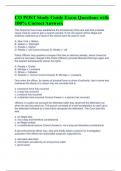
This Supreme Court case established the Exclusionary Rule and said that probable cause must be used to gain a search warrant. If not, the search will be illegal and evidence collected as a result of the search can't be used in court. A. New York v. Belton B. Gideon v. Wainright C. People v. Disher D. Weeks v. US Correct Answer D. Weeks v. US Police Officers may question a suspect that has an attorney already, about crimes for which he has been charged if the Police Officer(s) provide Miranda Warnings again and the suspect subsequently waives his rights. A. People v. Disher B. Montejo v. Louisiana C. Illinois v. Cabellas D. Graham v. Connor Correct Answer B. Montejo v. Louisiana Only when the officer, by means of physical force or show of authority, has in some way restrained the liberty of a citizen may we conclude that a: a. excessive force has occurred b. a stop has occurred c. a seizure has occurred d. a detention has occurred Correct Answer c. a seizure has occurred Officers in a patrol car pursued the defendant after they observed the defendant run when he saw the patrol car. The pursuit consisted of a brief acceleration to catch up to the defendant followed by a short drive alongside the defendant. The Court said this was: a. an illegal stop b. not a stop and therefore constitutional c. an illegal contact d. a constitutional seizure Correct Answer b. not a stop and therefore constitutional A law enforcement officer may. stop and briefly detain a person for investigation purposes if the officer has reasonable suspicion supported by: a. articulate-able facts b. information provided by an anonymous caller c. good cause d. contemporaneous factors related to the seizure Correct Answer a. articulate-able facts All formal arrests must be based on: a. reasonable suspicion b. reasonable grounds c. probable cause d. the totality of the circumstances Correct Answer c. probable cause When determining whether to frisk a suspect, officers must base their decisions on the ______________ standard. a. reasonably prudent man b. safety c. two-officer d. police officer Correct Answer b. safety Which of the following are considerations in deciding to frisk a person? I. suspect is nervous or edgy II. there is a bulge in the suspect's clothing III. suspect's hand is concealed in his clothing IV. suspect does not have an adequate explanation for his suspicious behavior A. I and ll are correct B. I, II, and III are correct C. I, II, III, and IV are correct Correct Answer C. I, II, III, and IV are correct The scope of a frisk must be limited to the: a. necessity to discover contraband b. necessity to discover weapons c. necessity to discover drugs d. necessity to discover illegal items Correct Answer b. necessity to discover weapons A frisk must initially be limited to a pat down of the outer clothing. If a weapon-like object is detected or if a non-threatening object's identity as contraband is immediately apparent to the officer's sense of touch, the officer: a. must ask the individual for consent and then retrieve the object b. must secure a warrant prior to any search c. may reach inside the clothing or pocket and seize the object d. may arrest the individual first and then seize the object incident to the arrest Correct Answer c. may reach inside the clothing or pocket and seize the object
Document information
- Uploaded on
- December 17, 2023
- Number of pages
- 46
- Written in
- 2023/2024
- Type
- Exam (elaborations)
- Contains
- Questions & answers