

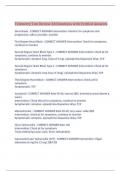
Telemetry Test Review 28 Questions with Verified Answers,100% CORRECT
Telemetry Test Review 28 Questions with Verified Answers Sinus Brady - CORRECT ANSWER Intervention: Monitor for symptoms and progression, talk to provider, monitor First Degree Heart Block - CORRECT ANSWER Intervention: Check for symptoms, continue to monitor Second Degree Heart Block Type 1 - CORRECT ANSWER Intervention: Check pt for symptoms, continue to monitor. Symptomatic: atropine 1mg, (max of 3 mg), epinephrine/dopamine drips, TCP Second Degree Heart Block Type 2 - CORRECT ANSWER Intervention: Check pt for symptoms. Symptomatic: Atropine 1mg (max of 3mg), epinephrine/dopamine drips, TCP Third Degree Heart Block - CORRECT ANSWER Intervention: Check pt for symptoms Symptomatic: TCP Junctional - CORRECT ANSWER Rate 40-60, narrow QRS, inverted p wave/absent p wave) Intervention: Check the pt for symptoms, continue to monitor Symptomatic: atropine, epinephrine/dopamine drips, TCP Idioventricular - CORRECT ANSWER Rate 20-40, no p wave, wide QRS Intervention: check pt for symptoms, continue to monitor Symptomatic: Atropine, epinephrine/dopamine drips, TCP Sinus Tachycardia - CORRECT ANSWER Rate 120 Intervention: Check pt for symptoms Treat underlying cause- pain, fever, dehydration Supraventricular Tachycardia (SVT) - CORRECT ANSWER Intervention: Vagal, adenosine (6 mg the 12 mg), BB/CCB Unstable: Cardioversion Atrial Fibrillation - CORRECT ANSWER Intervention: Check pt for symptoms. Possible anticoagulant therapy, possible BB/CCB Atrial Fibrillation with Rapid Ventricular Response - CORRECT ANSWER Intervention: Check pt for symptoms Possible AC/BB/CCB Unstable: Cardioversion Atrial Flutter - CORRECT ANSWER Intervention: Check pt for symptoms. Possible anticoagulant therapy, possible BB/CCB VTACH with a pulse - CORRECT ANSWER Intervention: Check pt for symptoms Asymptomatic: Amiodarone (150 mg over 10 minutes), adenosine (with expert consultation). Symptomatic: cardioversion Asystole - CORRECT ANSWER Intervention: Call code, start CPR, epinephrine 1mg 3-5 min, and consider cause (Hs and Ts) Pulseless Electrical Activity (PEA) - CORRECT ANSWER Intervention: Call code, initiate CPR, epinephrine 1mg 3-5 min, and consider causes (Hs and Ts) Ventricular Fibrillation, fine - CORRECT ANSWER Intervention: Call code, initiate CPR, DEFIBRILLATION, epinephrine 1 mg 3-5 min, amiodarone 300 mg for the first dose (if the second dose of amiodarone given dose 150 mg) VTACH no pulse - CORRECT ANSWER Intervention: Call code, initiate CPR, DEFIBRILLATION, epinephrine 1 mg 3-5 min, amiodarone 300 mg for first dose (if second dose of amiodarone given dose 150 mg) Tordes de Pointes - CORRECT ANSWER Intervention: Seek expert consult. In addition to normal treatment of pulseless vtach (Call code, initiate CPR, DEFIBRILLATION, epinephrine 1 mg 3-5 min, amiodarone 300 mg for first dose (if second dose of amiodarone given dose 150 mg)), check/replace magnesium sulfate Ventricular Fibrillation, coarse - CORRECT ANSWER Intervention: Call code, initiate CPR, DEFIBRILLATION, epinephrine 1 mg 3-5 min, amiodarone 300 mg for first dose (if second dose of amiodarone given dose 150 mg) NSR with unifocal PVCs - CORRECT ANSWER Intervention: Check pt, continue to monitor, treat underlying cause- electrolytes, O2? NSR with multifocal PVCs - CORRECT ANSWER Intervention: Check pt, continue to monitor, treat underlying cause- electrolytes, O2? SR with 10 beat run of VTACH - CORRECT ANSWER Intervention: Check pt, continue to monitor, treat underlying cause- electrolytes, O2? 100% atrial pacing (a-paced) - CORRECT ANSWER Intervention: Continue to monitor 100% ventricular pacing - CORRECT ANSWER Intervention: Continue to monitor 100% AV paced - CORRECT ANSWER Intervention: Continue to monitor failure to sense - CORRECT ANSWER Intervention: Interrogate pacemaker (Can lead to R on T phenomenon) Failure to capture - CORRECT ANSWER Intervention: Interrogate pacemaker, increase output/ma ST elevation, possible MI - CORRECT ANSWER Intervention: Check pt, VS, 12 lead, EKG, cardiac enzymes, possible nitro, O2, morphine, aspirin
Document information
- Uploaded on
- December 14, 2023
- Number of pages
- 3
- Written in
- 2023/2024
- Type
- Exam (elaborations)
- Contains
- Questions & answers


