

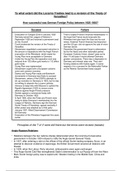
To what extent did the Locarno Treaties lead to a revision of the Treaty of
Versailles?
How successful was German Foreign Policy between 1925-1930?
Success Failure
- Evacuation of Cologne Zone in January 1926 - Tried to exploit France’s financial weaknesses- in
- Germany joined the League of Nations in the hope that France would evacuate the
September 1926 and received a permanent seat Rhineland and give back the Saar and its coal
on the Council mines. However French finances had improved
- Could accelerate the revision of the Treaty of and the US gov. did not approve the sale of more
Versailles German bonds
- Stresemann negotiated a permanent reduction in - December the government faced a referendum
the amount of reparations with the Anglo-French led by the Nazis and other nationalist parties
evacuation of the Rhineland- which made the - European Customs Union- doesn’t pass as he
Young Plan more acceptable to Germany dies- if it did pass it would allowed Germany
- Under the Young Plan the reparation sum was greater concessions. There was a depression in
reduced from 132 billion gold marks to 112 billion Germany and interest rates rise. They start
gold marks forming relations with Austria again. In some
- Young Plan was implemented respects it is a success for the Nationalist Parties
- Stresemann urged both a European customs as the Weimar Government loses support
union and common currency
- Dawes and Young Plan made anti-Bolshevik
movements in Germany less likely to succeed
- Stresemann, aware of the USSR’s attempts to
stir up revolution in Germany in 1923, but he was
not willing to abandon the Locarno policies.
- Anxious to keep links with Moscow to uphold the
Rapallo Agreement (1922) to ensure some
alliance against Anglo-French pressure
- Soviets agreed a commercial treaty with
Germany in October 1925
- In April 1926, when the Poles and French were
trying to delay Germany’s membership into the
League of Nations, Germany sign the German-
Soviet Treaty of Friendship- agreed neutrality if
either power was attacked by a third party
- January 1927- Allied Disarmament Commission
left Germany
- Evacuation of the Rhineland happened five years
earlier
Principles of the T of V were still there but the terms were revised (tweaks)
Anglo-Russian Relations
- Relations between the two nations sharply deteriorated when the incoming Conservative
government in October 1924 refused to ratify the Anglo-Soviet General Treaty
- In 1927, after ordering a raid on the offices of the official Soviet trading company, Arcos, in an
attempt to discover evidence of espionage, the British Government severed all relations with
Russia
- In 1929, when the Labour Party returned, ambassadors were again exchanged
- This Anglo-Soviet Cold War strengthened Stalin’s determination to cut Russia off from the West
- Main Soviet foreign policy was to exploit anti- Western feeling in the Middle East, China and
India
Versailles?
How successful was German Foreign Policy between 1925-1930?
Success Failure
- Evacuation of Cologne Zone in January 1926 - Tried to exploit France’s financial weaknesses- in
- Germany joined the League of Nations in the hope that France would evacuate the
September 1926 and received a permanent seat Rhineland and give back the Saar and its coal
on the Council mines. However French finances had improved
- Could accelerate the revision of the Treaty of and the US gov. did not approve the sale of more
Versailles German bonds
- Stresemann negotiated a permanent reduction in - December the government faced a referendum
the amount of reparations with the Anglo-French led by the Nazis and other nationalist parties
evacuation of the Rhineland- which made the - European Customs Union- doesn’t pass as he
Young Plan more acceptable to Germany dies- if it did pass it would allowed Germany
- Under the Young Plan the reparation sum was greater concessions. There was a depression in
reduced from 132 billion gold marks to 112 billion Germany and interest rates rise. They start
gold marks forming relations with Austria again. In some
- Young Plan was implemented respects it is a success for the Nationalist Parties
- Stresemann urged both a European customs as the Weimar Government loses support
union and common currency
- Dawes and Young Plan made anti-Bolshevik
movements in Germany less likely to succeed
- Stresemann, aware of the USSR’s attempts to
stir up revolution in Germany in 1923, but he was
not willing to abandon the Locarno policies.
- Anxious to keep links with Moscow to uphold the
Rapallo Agreement (1922) to ensure some
alliance against Anglo-French pressure
- Soviets agreed a commercial treaty with
Germany in October 1925
- In April 1926, when the Poles and French were
trying to delay Germany’s membership into the
League of Nations, Germany sign the German-
Soviet Treaty of Friendship- agreed neutrality if
either power was attacked by a third party
- January 1927- Allied Disarmament Commission
left Germany
- Evacuation of the Rhineland happened five years
earlier
Principles of the T of V were still there but the terms were revised (tweaks)
Anglo-Russian Relations
- Relations between the two nations sharply deteriorated when the incoming Conservative
government in October 1924 refused to ratify the Anglo-Soviet General Treaty
- In 1927, after ordering a raid on the offices of the official Soviet trading company, Arcos, in an
attempt to discover evidence of espionage, the British Government severed all relations with
Russia
- In 1929, when the Labour Party returned, ambassadors were again exchanged
- This Anglo-Soviet Cold War strengthened Stalin’s determination to cut Russia off from the West
- Main Soviet foreign policy was to exploit anti- Western feeling in the Middle East, China and
India


