

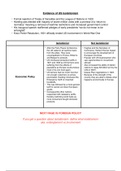
Evidence of US Isolationism
- Formal rejection of Treaty of Versailles and the League of Nations in 1920
- Harding was elected with majority of seven million votes with a promise of a ‘return to
normalcy” meaning a removal of wartime restrictions and increased government control
- His inaugural speech reaffirmed pledges of early presidents “we do not mean to be
entangled”
- Knox Porter Resolution, 1921 officially ended US involvement in World War One
Isolationist Not Isolationist
- After the Paris Peace Conference - Hughes and the Secretary of
the US called in all wartime loans Commerce, Herbert Hoover hoped
from the allies. They were to encourage the development of
unsympathetic to France, Britain’s European countries.
and Belgium’s protests. - Popular with US businessmen who
- US introduced protective tariffs in saw opportunities for investment
1921 and 1922 as US farmers were abroad.
suffering from the effects of - Also increased the ability of debtor
peacetime as Europe could produce nations to repay $3 billion lent by the
most of its own food again. USA in WW1.
- US farmers had too much food but - Dawes Plan negotiations in 1923.
not enough customers so prices - Because of the strength of the
Economic Policy plummeted. Harding introduced the country they are able to dictate what
Emergency Tariff on imported happens economically in Europe.
foodstuffs.
- This was followed by a more general
tariff to cancel out lower European
goods.
- Consequently other nations
responded with retaliatory tariffs,
thereby restricting world trade as
more consumers bought domestic
products.
NEXT PAGE IS FOREIGN POLICY
If you get a question about isolationism- define what isolationism:
aka. entanglement vs.involvement
- Formal rejection of Treaty of Versailles and the League of Nations in 1920
- Harding was elected with majority of seven million votes with a promise of a ‘return to
normalcy” meaning a removal of wartime restrictions and increased government control
- His inaugural speech reaffirmed pledges of early presidents “we do not mean to be
entangled”
- Knox Porter Resolution, 1921 officially ended US involvement in World War One
Isolationist Not Isolationist
- After the Paris Peace Conference - Hughes and the Secretary of
the US called in all wartime loans Commerce, Herbert Hoover hoped
from the allies. They were to encourage the development of
unsympathetic to France, Britain’s European countries.
and Belgium’s protests. - Popular with US businessmen who
- US introduced protective tariffs in saw opportunities for investment
1921 and 1922 as US farmers were abroad.
suffering from the effects of - Also increased the ability of debtor
peacetime as Europe could produce nations to repay $3 billion lent by the
most of its own food again. USA in WW1.
- US farmers had too much food but - Dawes Plan negotiations in 1923.
not enough customers so prices - Because of the strength of the
Economic Policy plummeted. Harding introduced the country they are able to dictate what
Emergency Tariff on imported happens economically in Europe.
foodstuffs.
- This was followed by a more general
tariff to cancel out lower European
goods.
- Consequently other nations
responded with retaliatory tariffs,
thereby restricting world trade as
more consumers bought domestic
products.
NEXT PAGE IS FOREIGN POLICY
If you get a question about isolationism- define what isolationism:
aka. entanglement vs.involvement


