

Module 4 Exam: HESI VN TXGRP 1912COHORT(VNE 39)
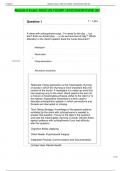
Module 4 Exam: HESI VN TXGRP 1912COHORT(VNE 39) Question 1 1 / 1 pts A client with schizophrenia says, “I’m away for the day ... but don’t think we should play … or do we have feet of clay?” Which alteration in the client’s speech does the nurse document? Neologism Word salad Correct! Clang association Associative looseness Rationale: Clang association is the meaningless rhyming of words in which the rhyming is more important than the context of the words. A neologism is a made-up word that has meaning only to the client. Word salad is the term for a mixture of meaningless phrases, either to the client or to the listener. Associative looseness is a term used to describe schizophrenic speech in which connections and threads are interrupted or missing. Test-Taking Strategy: Knowledge of the speech patterns exhibited by the client with schizophrenia is needed to answer this question. Focus on the data in the question and note the meaningless rhyming of words. Review these speech patterns with schizophrenia if you had difficulty with this question. Cognitive Ability: Applying Client Needs: Psychosocial Integrity Integrated Process: Communication and Documentation Content Area: Mental Health A client with schizophrenia and his parents are meeting with the nurse. One of the young man’s parents says to the nurse, “We were stunned when we learned that our son had schizophrenia. He was no different than from his older brother when they were growing up. Now he’s had another relapse, and we can’t understand why he stopped his medication.” Which response by the nurse is appropriate? Telling the parents, “Medication noncompliance is the most frequent reason that people with this diagnosis relapse.” Telling the parents, “Well, it’s his decision to take his medicine, but it’s yours to have him live with you if he stops the medication.” Correct! Asking the
Document information
- Uploaded on
- December 7, 2023
- Number of pages
- 136
- Written in
- 2023/2024
- Type
- Exam (elaborations)
- Contains
- Questions & answers


